With six UCLA faculty members among the 126 scientists and scholars selected today to receive 2025 Sloan Research Fellowships, UCLA ranks No. 1 among public colleges and universities in the U.S. and Canada in the number of new honorees.
The Sloan Fellowships are among the most competitive and prestigious awards available to early-career researchers and are often seen as evidence of the quality of an institution’s faculty in the fields of chemistry, computer science, Earth system science, economics, mathematics, neuroscience and physics.
UCLA shared the top public spot with UC Berkeley and the University of Texas at Austin; among all universities, only MIT and Northwestern, with seven each, had more fellows.
“The Sloan Research Fellows represent the very best of early-career science, embodying the creativity, ambition, and rigor that drive discovery forward,” said Adam F. Falk, president of the Alfred P. Sloan Foundation. “These extraordinary scholars are already making significant contributions, and we are confident they will shape the future of their fields in remarkable ways.”
Since the fellowships were first awarded in 1955, a total of 184 UCLA faculty members have been selected. Fifty-eight Sloan Research Fellows have gone on to win Nobel Prizes, including UCLA astrophysicist Andrea Ghez. Seventeen have won the Fields Medal in mathematics, 72 have received the National Medal of Science and 24 have won the John Bates Clark Medal in economics. Fellows receive a two-year, $75,000 award to support their research.
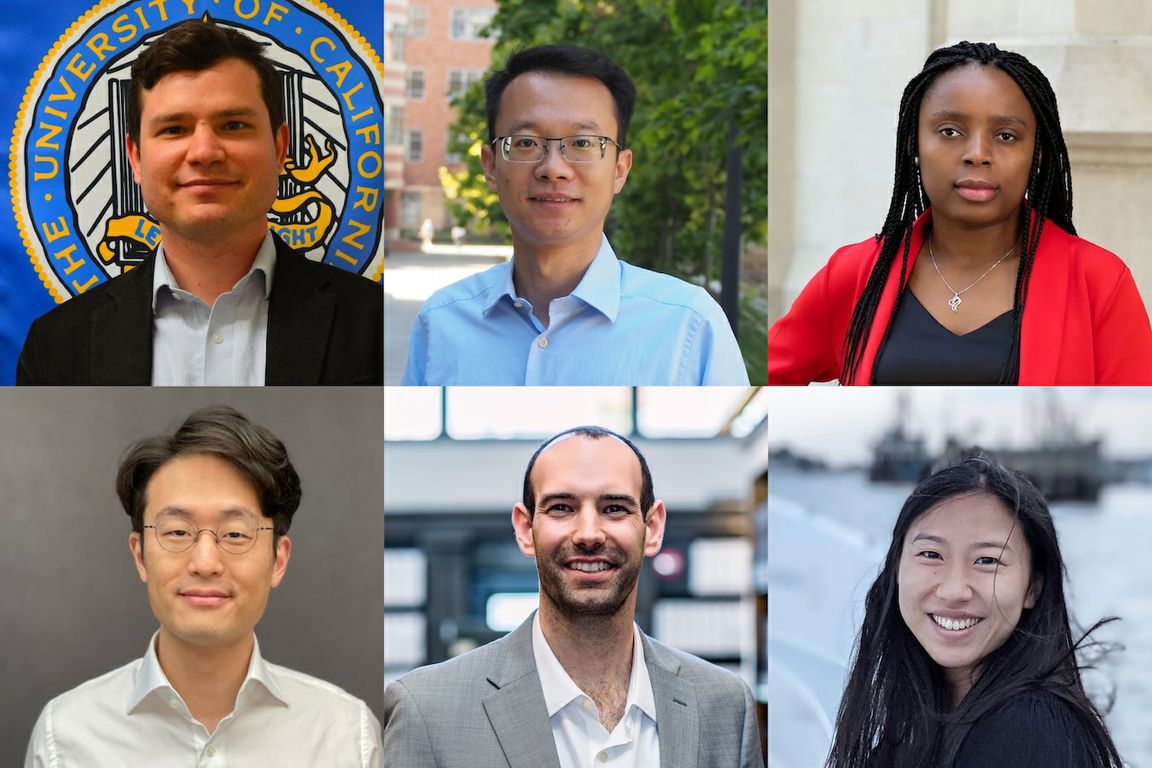
This year’s UCLA Sloan Research Fellows are:
Anton Bernshteyn
Assistant professor of mathematics
UCLA College
Bernshteyn specializes in descriptive set theory (a branch of mathematical logic) and combinatorics, focusing on their interactions and connections to other fields, such as computer science and dynamical systems. Through his research, he aims to develop versatile tools that yield explicit, constructive solutions to combinatorial problems across various mathematical disciplines. In particular, he explores how techniques from distributed computing— the area of computer science concerned with decentralized networks — can be applied in descriptive set theory and beyond. Bernshteyn is the recipient of a National Science Foundation CAREER award.
♦ ♦ ♦
Hao Cao
Assistant professor of Earth, planetary and space sciences
UCLA College
Cao studies the origin, dynamics and impacts of planetary magnetic fields. He and his team analyze measurements from the NASA Juno mission to understand the deep interior and space environment of Jupiter and its Galilean satellites. In preparation for the arrival of the Europa Clipper mission at the Jupiter system, he is leading an interdisciplinary team investigating the coupled dynamics of the moon’s space environment, ice shell and subsurface ocean. In addition, Cao and the UCLA MAG Lab are developing a temperature-controlled fluxgate magnetometer system for future space exploration, with application to lunar and Mars landers and to space missions to the Uranus and Neptune systems. He was awarded a NASA Group Achievement Award for his contribution to the magnetic field investigation of the Cassini mission to the Saturn system.
♦ ♦ ♦
Alvine Kamaha
Assistant professor of physics and astronomy
UCLA College
Kamaha’s research is contributing to the ongoing worldwide effort to directly discover and probe the nature of dark matter. She joined the team assembling the state-of-the art LUX-ZEPLIN dark matter detector in 2018, and she co-led the successful effort to keep it free of contamination during its assembly and to install and commission the calibration system of the highly sensitive completed instrument. Since then, Kamaha and her colleagues have been collecting and analyzing data, as well as developing new calibration technologies to further improve the detector. This year, she was named a 2025 Cottrell Fellow and was recently the recipient of a DOE early career award, a Hellman Fellowship and the Edward A. Bouchet award.
♦ ♦ ♦
Ernest Ryu
Assistant professor of mathematics
UCLA College
Ryu is an applied mathematician working in the areas of optimization and machine learning. His research analyzes the family of acceleration mechanisms — of which the most commonly known are momentum-based techniques in machine learning optimizers — with the ambitious goal of formulating a grand unified theory of acceleration. Ryu is the recipient of the INFORMS Optimization Society Young Researchers Prize.
♦ ♦ ♦
Yotam Shem-Tov
Assistant professor of economics
UCLA College
Shem-Tov studies labor economics, applied econometrics, and criminal justice and crime, including the impact incarceration has on individuals and families. His research leverages novel data sources and innovative empirical methods to understand why people charged, convicted and incarcerated often experience high rates of recidivism and low employment. His work also serves to inform policymakers and scholars about how alternative programs like restorative justice can lead to substantial and lasting reductions in recidivism rates and to support the design of programs that ensure successful reintegration into society after release from incarceration. Ultimately, his efforts aim to achieve a more effective and equitable system that balances public safety with rehabilitation.
♦ ♦ ♦
Chuchu Zhang
Assistant professor of physiology and neurobiology
David Geffen School of Medicine at UCLA
Nausea can be caused by an array of pathogens, poisons and diseases, but the sensory neuroscience behind it remains poorly understood, and the clinical management of nausea is often ineffective. Zhang’s research focuses on uncovering the physiology, neural circuitry and molecular basis of nausea — including nausea caused by food allergies, food poisoning and pregnancy. By combining genetic tools with animal models and using imaging, electrophysiology, natural products screening and RNA sequencing, her laboratory is working to define stimulus-specific nausea mechanisms and to improve current treatments. Zhang is the recipient a Damon Runyon Research Fellowship and a National Institutes of Health BRAIN Pathway to Independence Award, and is an active member of the Leading Edge Fellows.