Tobias Higbie is a UCLA scholar of labor history who is using digitized historical records to gain new perspectives about labor and social movements of past eras.
Fernando Torres-Gil writes that Americans can learn a lot from how two of the country’s fastest growing populations are learning how to embrace change.
UCLA education professor Linda Sax undertook a study to better understand who women’s college students are today and to identify how they’ve changed over time.
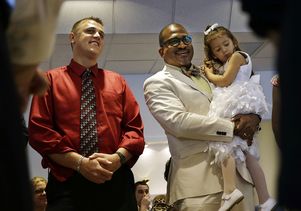
Law professor Douglas NeJaime writes in the Los Angeles Times that the struggle for full legal protections and equal rights has not ended for gay and lesbian families.
UCLA professor Michael Stoll chronicles shift from getting tough on crime with policies like mandatory minimum sentences to smarter approaches to crime and punishment.
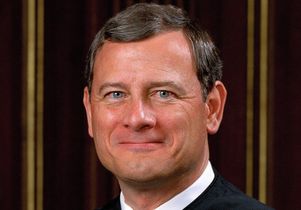
Adam Winkler notes that the legal reasoning used by Chief Justice John Roberts in the decision that upheld the president’s signature health care law will preserve it against future challenges.
In its historic decision legalizing same-sex marriage nationwide, the U.S. Supreme Court today cited research by Gary Gates, the Blachford-Cooper Distinguished Scholar and Research Director at the Williams Institute at UCLA School of Law.
Better mentorship, revised performance reviews and more transparency are among the recommendations shared at a recent UCLA conference that attempted to figure out how to increase the number of women in tech.
Law professor Adam Winkler writes that there are two cases — one famous and one forgotten — that may haunt the chief justice and explain his recent pivot away from the court’s conservative bloc.
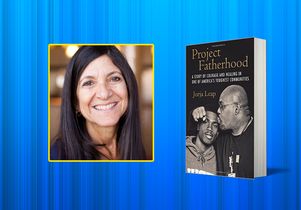
In “Project Fatherhood,” social welfare professor Jorja Leap writes about the struggles and triumphs of men doing their best to become good fathers and mentors in Watts.
The director of the Center for Gender-Based Biology at UCLA co-wrote an op-ed stating that we should be careful not to confuse the properly banned gay-conversion therapy with potentially helpful therapy for gender dysphoria.
UCLA study shows that by 2040 there will be an additional 6 million-plus registered Asian American voters in the United States — an increase of more than 100 percent — and explores what this means for future elections.
Education professor Mike Rose writes in the Washington Post that character education is no substitute for improving poor students’ lives by addressing inequality.
Frequency of drinking correlates with a higher likelihood of supervisory neglect by parents but a lower likelihood of physical neglect, according to a UCLA-led study.
Behavioral economist Shlomo Benartzi’s research shows that smarter and simpler website and app design can guide people to save for retirement properly.
UCLA’s Lynn Vavreck writes in The New York Times that people’s opinions about abortion tend to converge when they’re asked to evaluate specific situations rather than simply express support or opposition.
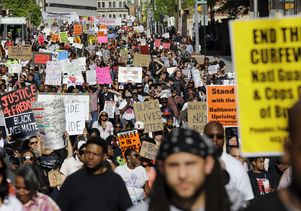
History professor Robin D.G. Kelley writes that claiming rioters are sabotaging “legitimate” efforts to bring about racial and social justice mistakenly presupposes that “legitimate” efforts have been working.
Dean Marcelo M. Suárez-Orozco co-wrote a New York Times op-ed arguing that if the justice system recognized the humanity of undocumented immigrants it would benefit all of society.
Law professor Adam Winkler writes about the importance of Justice Kennedy, the relative value of precedent and the role of originalism, among other things to look out for during oral arguments about same-sex marriage.
Gary Gates of the Williams Institute at UCLA School of Law writes in an op-ed that data shows same-sex couples are far more likely to raise adopted or foster children.