Energy created by the movement of two materials can be harvested from the surrounding environment and converted to electricity by a triboelectric nanogenerator.
25 undergraduates who received the scholarships to pursue science, technology, engineering or math degrees visited the cast and crew as the show wraps its final season.
Denis Chetverikov, Yongjie Hu and Aaswath Raman are among 126 early-career scientists and scholars from across the United States and Canada selected to receive fellowships.
Only a dozen such quakes have been identified in the past two decades, according to Lingsen Meng, UCLA’s Leon and Joanne V.C. Knopoff Professor of Physics and Geophysics.
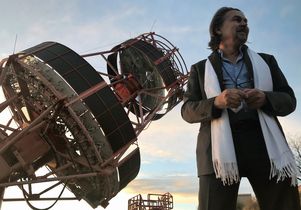
Vladimir Vassiliev, professor of physics and astronomy, has served as principal investigator on project that could help address questions in very-high-energy astrophysics.
At the heart of the dispute is the Hubble constant, a number that relates distances to the redshifts of galaxies — the amount that light is stretched as it travels to Earth.
25 years after Northridge, civil and environmental engineers are using artificial intelligence, machine learning, sensor networks and advances in mapping in their work.
Dr. David Sabatini, a Massachusetts Institute of Technology biologist and associate director of the Whitehead Institute for Biomedical Research, earned the 2018 Switzer Prize for his research into influences on cell growth.
The life scientists have provided the first cell “atlas” of the hippocampus — the part of the brain that helps regulate learning and memory — when it is affected by traumatic brain injury.
The $3.7 million, three-year grant will go toward research aimed to develop imaging technology that allows the recording of tens of thousands of neurons to better understand how the brain goes awry in disease.
Learn about nanotechnology, meteorites and dinosaurs, among other science topics. Actress, author and mathematics alumna Danica McKellar will receive a science and education award.
The free event will include moon dust, meteorites and lunar experts. The viewing is part of International Observe the Moon Night, an annual worldwide celebration that encourages appreciation of the moon.
Researchers from the School of Dentistry and the David Geffen School of Medicine will use a technology created in the lab of Dr. David Wong from the dental school.