UCLA scientists use brain imaging to show that social media approval activates the same areas in teens’ brains as eating a favorite food or winning a competition.
Kepler-62f could have atmospheric compositions that allow it to be warm enough to have surface liquid water, which would make it possible for the planet to support life.
The researchers made the discovery using an effect called gravitational lensing to see the incredibly faint object, which was born just after the Big Bang.
UCLA scientists have recently partnered with the Sandia National Laboratory to develop special screening libraries based on a gene-editing technology called CRISPR.
Mutations in mitochondrial DNA can cause devastating diseases that mainly affect tissues and cells with high-energy demands, like the brain and muscles.
Small enough to fit on a standard silicon computer chip, the device developed at UCLA Engineering could be used for improved timing, attosecond physics and measuring universal constants.
Students are taught about extinction in classrooms, but it’s their direct experience with nature that is rapidly disappearing, warns Peter Kareiva, director of the UCLA Institute of the Environment and Sustainability.
The device combines two components invented at UCLA: a photonic time stretch microscope and a deep learning computer program that identifies cancer cells with over 95 percent accuracy.
Researchers will develop and test mobile technology, big data analytics, screening technologies and medical robotics in order to address challenges in the way health care is delivered.
UCLA biochemists have devised a way to convert sugar into a variety of useful chemical compounds without using cells and that could lead to the production of biofuels and pharmaceuticals.
Denisovans, ancient hominids who lived alongside humans and Neanderthals, were first described in 2010 through DNA extracted from remains in a Siberian cave in 2008.
The animals, which are related to spiders and scorpions, “look terrifying, but are actually delicate, timid and afraid of you,” says UCLA doctoral candidate Kenneth Chapin.
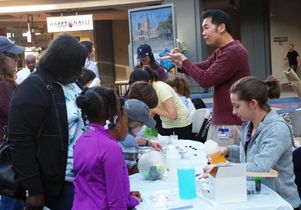
Volunteer scientists, graduate students and staff from the California NanoSystems Institute at UCLA set up a booth to demystify nanoscience in fun ways.
The $2.8 million NSF grant will support Sandoval's UCLA research team working in collaboration with teachers in the Montebello Unified School District.
The events are designed to appeal to people who share a fascination with the science hidden in our food or who are simply curious to know more about the food we eat and cook.
UCLA has joined the Center for the Integration of Research, Teaching and Learning, established in 2003 with support from the National Science Foundation to improve teaching skills and increase the diversity of future university faculty in science, ...
Previous research showed that ice shelves are vulnerable to even small increases in greenhouse gases, but the new study was the first to demonstrate that huge, land-based glaciers are also vulnerable.
Brad Shaffer, director of the UCLA La Kretz Center for California Conservation Science, says the role of citizen scientists is important in helping scientists track changes in the environment due to climate.
In this Q&A, Jon Christensen of UCLA and his colleague Adam Wolf discuss their study of how climate change affects plant species’ shifting in California.
BPS, a common replacement for BPA in plastics, has also been linked to health risks. New UCLA-led research demonstrates some of the mechanisms that make BPS just as harmful.