Economist Jerry Nickelsburg on how not leveraging the windfall of abundant natural resources into investments into education and infrastructure limits economic growth.
UCLA researchers note that the next decade shows great promise for things like improving food safety, fighting infections, storing energy and supplying clean energy.
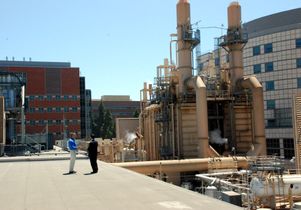
U.S. Secretary of Energy Ernest Moniz spoke with UCLA leaders and researchers in engineering and physics this morning and toured two laboratories on campus that receive support from the U.S. Department of Energy.
Magali Delmas, an environmental economist at UCLA, has been focusing on finding the most effective strategies to motivate people to change their behavior and conserve electricity.
The L.A. Energy Atlas project, a first-of-its-kind interactive website, enables policymakers and the public to sort energy consumption and emissions by building size, neighborhood and other metrics.
Mary Nichols, chair of the California Air Resources Board and a UCLA faculty member, is a fierce fighter for the environment. She has championed a difficult cause without succumbing to bitterness or wallowing in the polarization that has crippled Sacramento and Washington.
During a launch event for the new issue, editor-in-chief Jim Newton spoke to Mary Nichols, whose work as an environmental advocate is profiled in the magazine.
U.S. Deputy Secretary of Energy Elizabeth Sherwood-Randall met Tuesday with stakeholders from across the energy ecosystem at UCLA’s Kerckhoff Hall to discuss how Los Angeles can meet its energy goals.
Measures put in place by the state have mitigated financial impacts that could be expected as costs passed along to electricity, natural gas and gasoline consumers.
While the experts agreed on the need to reduce greenhouse gas emissions, they sharply divided on how to achieve that goal at a recent discussion sponsored by the UCLA Institute of the Environment and Sustainability.
Tata Power Delhi Distribution Limited and researchers at UCLA have reached an agreement to develop advanced technologies for delivering energy more efficiently, less expensively and to more people in India and beyond.
The UCLA Sustainable LA Grand Challenge’s first competitive research grants will go to 11 projects, ranging from developing lightweight solar panels that double as batteries to studying the costs of algae-based biofuels.
Among the topics discussed at the inaugural UCLA-Tata Global Forum in New Delhi were sustainable megacities, the integration of solar power into smart energy grids and sustainable biological fuels.
There are more than 100 research projects that will help conserve, invent and incentivize the county to fully renewable energy, 100 percent local water and a healthier ecosystem.
From less electricity generated by coal to more whales in California, UCLA Institute of the Environment and Sustainability director Peter Kareiva offers things to be thankful for.
Jon Christensen writes that to take these solutions from UC-wide to a global scale, we’ve got to start now using a combination of technology, outreach and policy.
The new cell construction extends the cell’s effective life in air by more than 10 times, with only a marginal loss of efficiency converting sunlight to electricity.
By combining never-before–released data from energy utilities with public data, UCLA researchers created a database that provides an unprecedented look at the energy-use landscape.
A team of engineers from the UCLA Henry Samueli School of Engineering and Applied Science, in partnership with Southern California Edison, has received a $1.62 million grant to build a hybrid energy storage system.