The Julian Schwinger Foundation for Physics Research has created a first-of-its-kind award for the physics and astronomy department in the UCLA College of Letters and Science by endowing the department with a $1.2 million fellowship.
A $1.2 million gift from the foundation of late UCLA professor and Nobel laureate Julian Schwinger will enable UCLA to offer fellowships to the world's best physics students.
By growing larger, rangeomorphs, fern-like organisms that existed on the sea floor some 580 million years ago, were able to access nutrient-carrying ocean flows.
The powerful Gemini Planet Imager, with an advanced spectrometer designed at UCLA, has collected its first set of images and spectra from several distant planetary systems.
A scientist, together with a graduate student, used cutting-edge research tools at UCLA to help Turkish archaeologists decipher a large, neolithic mural that many believe is the world's earliest depiction of a volcanic eruption.
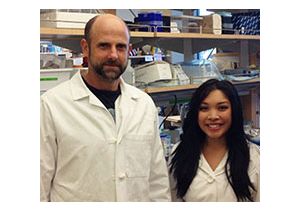
UC Berkeley biologist Randy Schekman, who graduated from the UCLA College of Letters and Science in 1971, received the 2013 Nobel Prize in physiology or medicine.
During a recent visit to UCLA, Schekman spoke about his passion for science, his memories of UCLA and why he's decided to donate his Nobel money to the University of California.
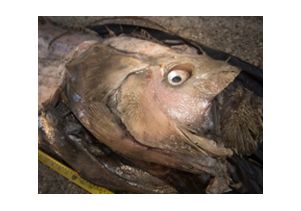
"Wow, that’s one big fish!" That was the reaction of everyone at UCLA’s Translational Research Imaging Center when a monster fish story became reality in the form of a rare 14-foot, 250-pound oarfish.
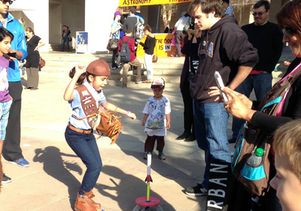
More than 4,000 people swarmed the Court of Sciences and Kinsey Pavilion to participate in a scientific open house where children (and adults) could learn by observing and participating in dozens of live demos and experiments.
Flexible smartphone screens, room-illuminating curtains and nanodiamonds that deliver chemotherapy directly into tumors are among the innovations resulting from the joint work of UCLA and private industry.
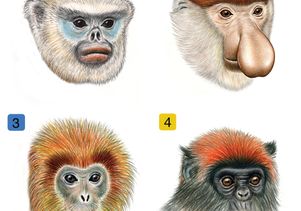
For Old World primates, the variety and complexity of their facial colors and patterns play a major role in helping them identify members of their own species and communicate with one another.
The search for the elusive "God particle" was aided by a number of faculty members and their teams, who helped design and build the cutting-edge equipment and conduct research.
Randy Schekman is the seventh UCLA alumnus to win a Nobel Prize. Professors at UCLA remember him as a brilliant undergraduate with insights far beyond his years.
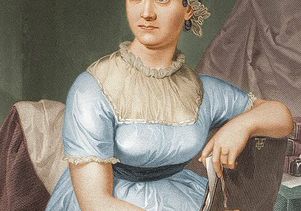
Some 150 years before game theory was used by superpowers during the Cold War, Austen mapped its strategies in all six of her novels, UCLA's Michael Suk-Young Chwe argues.
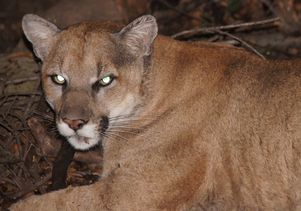
UCLA researchers test blood and saliva samples, compare bite marks and use claw swabs and traces of fur to track the family tree and the animals’ behavior.