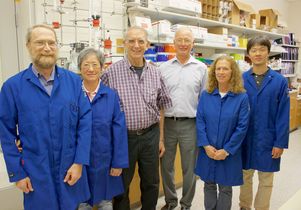
UCLA scientists and colleagues identify the structure of a molecule that kills mosquitoes carrying malaria. The findings are a step toward genetically engineering a toxin that would be lethal to species that carry other diseases.
Multicolored laser light could be used to cool atoms of hydrogen or carbon to nearly absolute zero, allowing scientists to study chemical reactions at the quantum scale.
The UCLA professor emeritus, who directed the California NanoSystems Institute at UCLA, was honored with two others for designing and developing molecular machines.
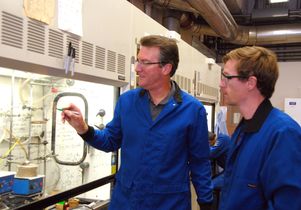
Craig Merlic, an associate professor of chemistry at UCLA, has been committed to laboratory safety for three decades. He serves as the executive director of the UC Center for Laboratory Safety.
A Distinguished Professor of Chemistry and Biochemistry, Gelbart was honored with a special issue of the Journal of Physical Chemistry B, recognizing his far-reaching interests and contributions.
A professor of chemistry and biochemistry as well as materials science and engineering, Weiss will explore the development of wearable external and internal sensor arrays for personalized health monitoring.
The award recognizes Garg, professor and vice chair for education in the UCLA Department of Chemistry and Biochemistry, for his outstanding achievements in catalysis science.
Associate professor Anastassia Alexandrova of the department of chemistry and biochemistry has been honored with a 2016 Rising Star Award, which recognizes exceptional women chemists on a national level.
UCLA biochemists have devised a way to convert sugar into a variety of useful chemical compounds without using cells and that could lead to the production of biofuels and pharmaceuticals.
An authority on synthetic organic and medicinal chemistry, Jung and has 60 patents and applications, including an FDA-approved drug that can slow or stop the progression of prostate cancer.