UCLA researchers and colleagues have designed a first-of-its-kind nanogenerator that can work in remote areas because it provides its own power and does not need batteries. It also acts as a weather station.
The engineers and mathematicians have designed a unique and effective system that could be used to produce clean, fresh water, or to recycle industrial water that would otherwise be wasted.
A Q&A with Danijela Cabric of the UCLA Samueli School of Engineering on the legendary actress’s less-known role as inventor of a frequency hopping technology.
“The platform is like a motion detector for the microscopic world because of its ability to lock onto any moving objects in a fluid sample,” said Yibo Zhang, a UCLA doctoral student and the study’s first author.
In tests at the U.S. Department of Energy’s National Renewable Energy Laboratory, the device converted 22.4 percent of the incoming energy from the sun, a record for that type of cell.
The researchers demonstrated that the device could accurately identify handwritten numbers and items of clothing — both commonly used tests in AI studies.
The UCLA Connection Lab, to be led by Leonard Kleinrock, will foster interdisciplinary research on a range of technologies, such as blockchain, computer networks, big data and artificial intelligence.
The device, designed by UCLA Engineering researchers, operates across a broad range of light, processes images more quickly and is more sensitive to low levels of light than current models.
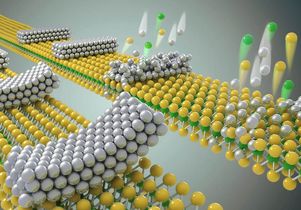
Their method joins a semiconductor layer and a metal electrode layer without the atomic-level defects that typically occur as part of the process commonly used now.
“Tissues are wonderfully complex structures, so to engineer artificial versions of them that function properly, we have to recreate their complexity,” said UCLA professor Ali Khademhosseini.
The advance could help bring high-quality medical diagnostics into resource-poor regions, where people otherwise do not have access to high-end technology.
Working to upend one of the most stalwart of construction materials, a team of UCLA researchers created a near carbon dioxide-neutral version of concrete.