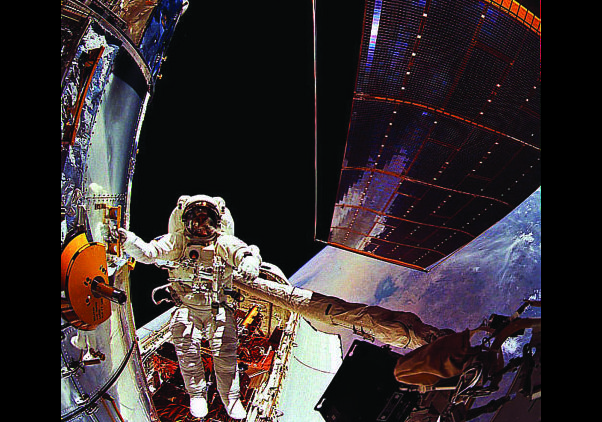
Astronaut and three-time UCLA alumna Anna Lee Fisher addressed a roomful of students Monday at a UCLA Careers in Chemistry and Biochemistry to talk about her career and the lessons she learned while she attended UCLA.
Most of the laws of nature treat particles and antiparticles equally, but stars and planets are made of particles, or matter, and not antiparticles, or antimatter. That asymmetry puzzled scientists for many years.
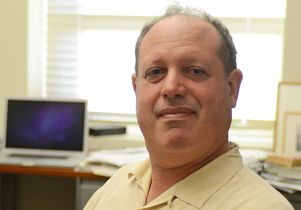
Smadar Naoz, UCLA assistant professor in the department of physics and astronomy, was selected to receive the prestigious 2015 American Astronomical Society Annie Jump Cannon Prize for outstanding research.
Alan Rubin, the associate curator of the UCLA Meteorite Gallery and unofficial “cosmic killjoy,” regularly has to tell people the answer is no. But he'll also tell you where meteorites actually come from.
A team of UCLA researchers have been awarded 83 million core hours of computing time on one of the world’s fastest supercomputers to study the origins and evolution of the Earth’s magnetic field.
Scientists explained the bizarre object in the center of the Milky Way that some astronomers believed was a hydrogen gas cloud headed toward our galaxy’s enormous black hole.
The National Science Foundation has funded UCLA research astronomer R. Michael Rich and an international team to use the world’s largest camera to map the central bulge of the Milky Way.
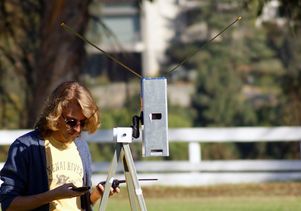
Dozens of students from majors across campus have spent thousands of hours on building a loaf-of-bread-sized satellite that will measure space weather.
While both planets are rocky with iron cores, the complex dynamics of Mercury's interior create an unusual magnetic field that is three times stronger at its northern hemisphere than its southern one.
The powerful Gemini Planet Imager, with an advanced spectrometer designed at UCLA, has collected its first set of images and spectra from several distant planetary systems.