For the last 18 years, UCLA’s Lisa Snyder has been bringing to life the bygone glory of a true architectural, social and cultural wonder — the Chicago World’s Fair.
The model, developed from six years of mathematical research and a decade of police crime data, has been so successful that the LAPD adopted it for use in 14 of its 21 divisions.
Men who buy sex have less empathy for women in prostitution than men who don’t buy sex, and they are more likely to report having committed rape and other acts of sexual aggression.
Sociologist Edward T. Walker writes in the New York Times that rich corporations are leveraging social media to get customers and ordinary citizens to act as de facto lobbyists.
On the 50th anniversary of the Watts riots, historian Robin D.G. Kelley writes in the L.A. Times that the era gave birth to social justice and arts organizations that remade the community and whose legacy continues today.
Regardless of where they are from, people judge acts like lying, theft and assault to be wrong — but less wrong if those acts happened far away or long ago.
The Labor Studies Applied Research Methods course at the UCLA Labor Center introduces students to basic social science research methods by immersing them in a hands-on project to assist community organizations.
UCLA scholar Ramesh Srinivasan has established a center that will link scholars who want to study the role digital technology plays in cultures globally.
The donor says he hopes the gift, which will benefit students, faculty and the community, will honor his family’s legacy of giving — one that started with his late grandmother.
Anthropology professor Alan Page Fiske writes in an op-ed that the ‘Charlie Hebdo’ attackers, like so many people who use violence, probably thought they were acting righteously.
That most people have never heard of Hatshepsut — a pharaoh of ancient Egypt, who was the greatest female ruler of the ancient world — is emblematic of the challenges women have always faced in politics, writes UCLA Egyptologist Kara Cooney.
UCLA professor Lynn Vavreck writes in The New York Times that if the Democrats lose the Senate, it would follow recent electoral history for the party of an unpopular president. Also, watch a video of Vavreck speaking about political TV ads.
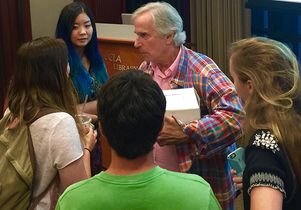
Actor Henry Winkler, who played “The Fonz” on the long-running sitcom “Happy Days,” recently talked with UCLA students about the process he goes through in co-authoring the popular “Hank Zipzer” series of children’s books.
In a new mainstream biography, Kara Cooney sets out to rehabilitate the image of the pharaoh Hatshepsut, a woman whose successes were later erased or reassigned to male forebears.
Many white Americans are becoming less enthusiastic about diversity and multiculturalism as the U.S. moves toward becoming a minority-majority nation, UCLA psychologists report.
A new book by a UCLA professor shows how ailments presented in 19th century French mental hospitals held up a kind of fun-house mirror to the often horrific political dramas of the country's post-revolutionary era.