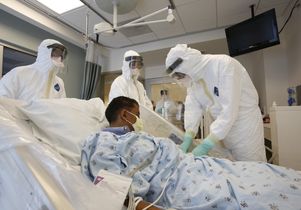
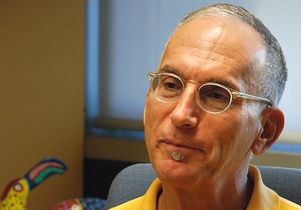
Public policy professor John Villasenor calls for a thorough reexamining of safety measures and recommends more rigorous training protocols to protect those charged with treating people who are sick.
New UCLA research may lead to dramatically fewer bladder infections following spinal cord injuries and other traumatic injuries — infections that can cause kidney damage, and even death.
Demonstrations, film screenings, lectures and a special dinner are on the menu for campus consumers Oct. 22 - 24 as UCLA joins thousands of other organizations nationwide, including several UC campuses, to celebrate Food Day.
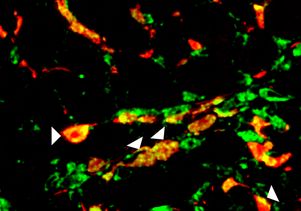
UCLA researchers have discovered that some scar-forming cells in the heart, known as fibroblasts, have the ability to become endothelial cells — the cells that form blood vessels.
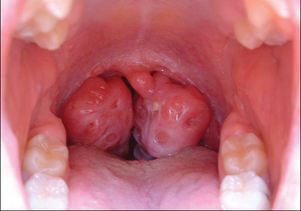
In the first study of its kind, UCLA researchers found that there was a disparity in post-tonsil removal doctor’s visits based on income status, race and ethnicity.
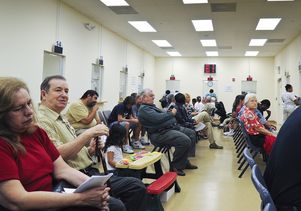
Research by the UCLA Center for Health Policy Research shows that a pent-up demand for health care will decline significantly after the first year of enrollment.
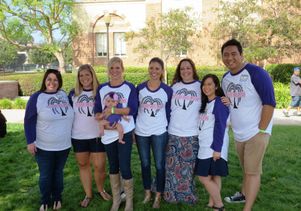
Former patients of the Neonatal Intensive Care Unit reunited with their nurses, doctors and other health care professionals at a reunion that was held at UCLA’s Wilson Plaza Sunday, Oct. 12.
The second-annual Inventathon encourages interdisciplinary teams of young inventors to develop innovative solutions using the latest technology and mobile applications.
The $2.3 million National Institutes of Health awards go to scientists from the Eli and Edythe Broad Center of Regenerative Medicine and Stem Cell Research at UCLA for work in stem cells and neuroscience in medicine.
UCLA researchers demonstrated that, in pregnant mice, inflammation can trigger an excessive division of neural stem cells that can cause “overgrowth” in the offspring’s brain.
UCLA will create analytic tools to address the daunting challenges facing researchers in accessing, standardizing and sharing scientific data to foster new discoveries in medicine.
In a UCLA study more than twice as many people ended up with coverage. These findings could prove useful in finding ways to increase participation in plans and reduce disparities in health insurance coverage.
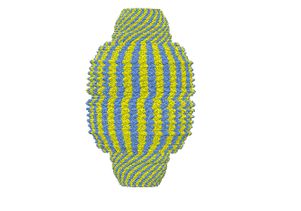
Developed by UCLA’s Dr. Leonard Rome and Dr. Steven Dubinett, the treatment combines an immunotherapy agent with a drug delivery nanotechnology using nanoparticles called vaults.
In a small-scale study, nine of 10 people with the disease displayed subjective or objective improvement in their memories beginning within three to six months.
A University of California center that fosters health care innovation at UC's five medical centers is proving to be a boon to both patient health and the bottom line.
Motivated by a drive ‘to do work that can save lives,’ UCLA's Mark Kaplan has become a leading expert on suicide, the 10th-leading cause of death in the United States.