Key takeaways
- At the charging stations, daily concentrations of dangerous air particles, known as PM2.5, ranged from 7.3 to 39.0 micrograms per cubic meter.
- Urban sites without fast-charging stations had concentrations of PM 2.5 ranging from only 3.6 to 12.4 micrograms per cubic meter.
- The tiny particles likely come from particle resuspension around Direct Current Fast Charging power cabinets. Cooling fans designed to prevent the electronics from overheating can also stir up dust and particles from internal surfaces.
A team led by UCLA Fielding School of Public Health researchers has found that the levels of fine particulate matter in the air near electric vehicle fast-charging stations across Los Angeles County are significantly higher than those measured at urban sites without fast-charging stations.
Researchers from UCLA Fielding and the UCLA Samueli School of Engineering published their findings in the study, “Fine particulate matter emissions from electric vehicle fast charging stations,” in the July edition of the peer-reviewed journal Environment International.
“For anyone, exposure to fine particles can contribute to health issues, and for those with existing conditions or heightened sensitivity, the risks are even greater,” said Michael Jerrett, professor in UCLA Fielding’s Department of Environmental Health Sciences and a study co-author. “Because these particles are so small, they can travel deep into your lungs and even enter your bloodstream — potentially leading to serious problems like heart or lung disease.”
Where the researchers went to look at air quality
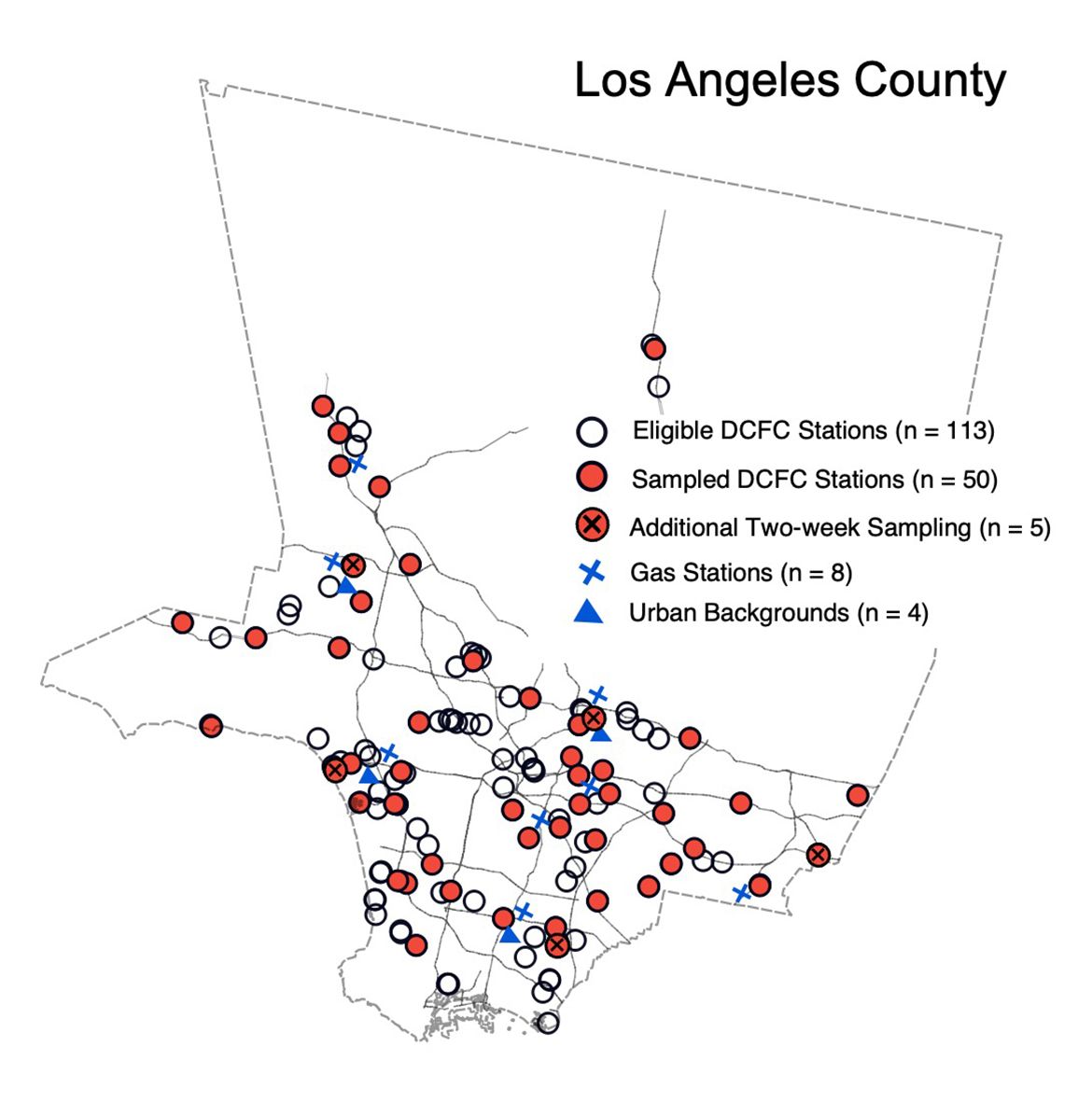
The study team examined air quality at 50 Direct Current Fast Charging (DCFC) stations — with a variety of owners and equipment — across 47 cities in Los Angeles County, performing field measurements in communities from Lakewood north to Santa Clarita, and from Malibu on the coast inland to Pomona. For comparison purposes, the researchers also sampled air quality at gas stations and other types of urban sites without fast-charging stations across the county and during the same sampling period.
The researchers checked for potentially dangerous air particles, known as PM 2.5, that measure roughly 2.5 micrometers or less in width — about 30 times smaller than a human hair. At the charging stations, daily concentrations ranged from 7.3 to 39.0 micrograms per cubic meter, while the same analysis at the urban sites without fast-charging stations found concentrations of only 3.6 to 12.4 micrograms per cubic meter.
Why higher particulate matter was found in the air at EV-charging stations
“Our findings suggest that these tiny particles likely come from particle resuspension around the DCFC’s power cabinets. These cabinets convert electricity from the grid into the direct current needed to charge electric vehicle batteries,” said Yuan Yao, a UCLA Fielding scholar and first author of the study. “The cabinets also contain cooling systems to prevent the electronics from overheating, and these cooling fans can stir up dust and particles from internal surfaces. That’s what we think might be one of the reasons for the increased pollutant levels we found.”
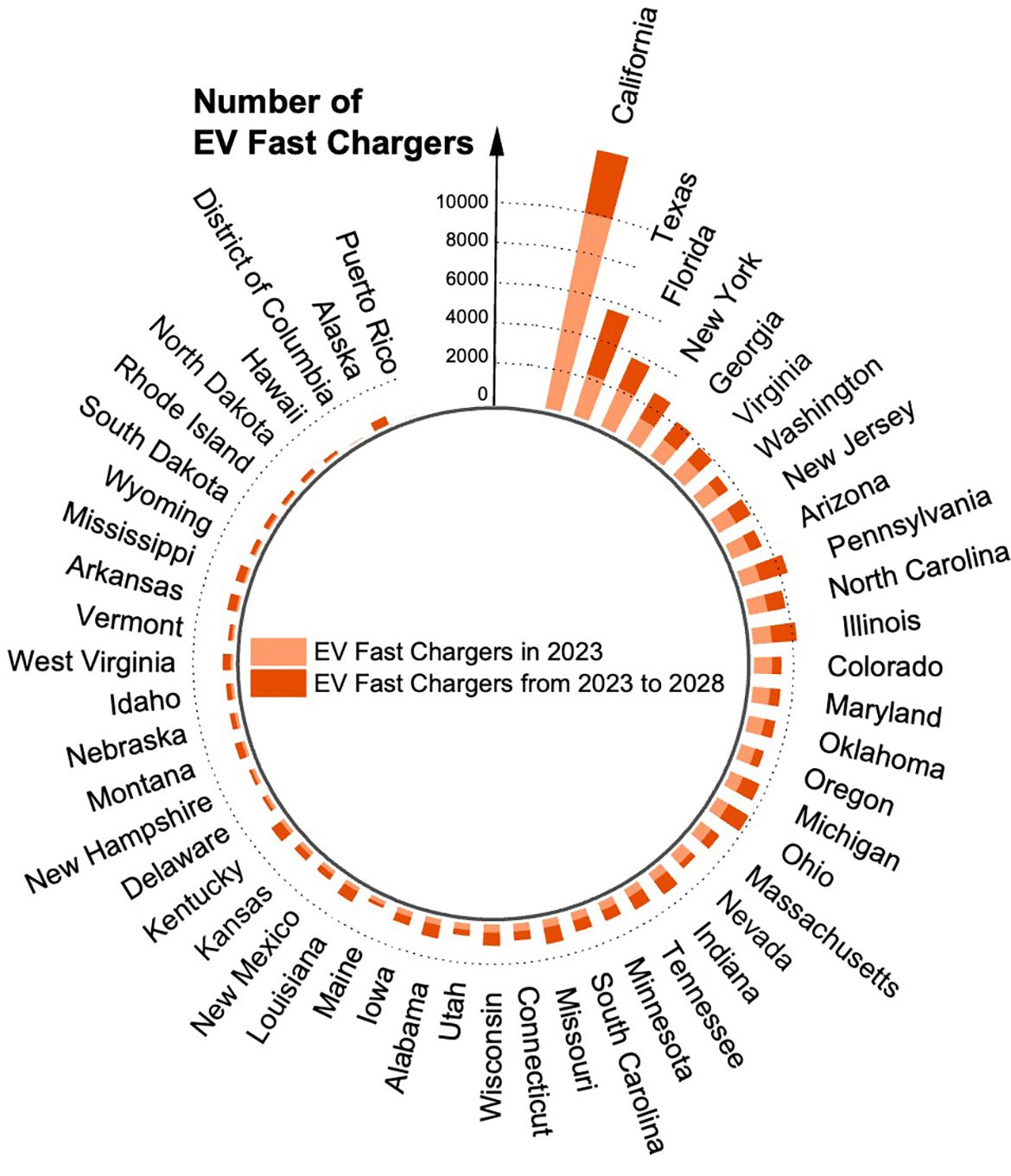
Among all counties in the United States, Los Angeles County had the highest number of EV fast chargers in operation, totaling 1,938 units of some 9,900 across the state of California as of November 2023. There are some 36,000 such units across the U.S., with 2,200 in Texas, and 2,100 in Florida, respectively.
The result of the Los Angeles County study included measurements as high as 39 and 34 micrograms per cubic meter in cities as far apart as West Hollywood and Santa Clarita, to lower but still concerning measurements of 7.3 and 7.5 micrograms per cubic meter in communities as disparate as Santa Monica and Claremont. The original sources of the particles include a mix of possibilities, ranging from brake and tire wear to dirt and dust, researchers said.
“Transportation electrification is vital to California’s climate goals, and EV charging infrastructure plays a key role in that transition,” said Yifang Zhu, professor in UCLA Fielding’s Department of Environmental Health Sciences and a lead author of the study. “To fully deliver on its health promises, we must also address unintended emissions from DCFC stations to ensure that clean transportation truly means clean air for all.”
The work was supported by the University of California Office of the President’s climate action under a grant.