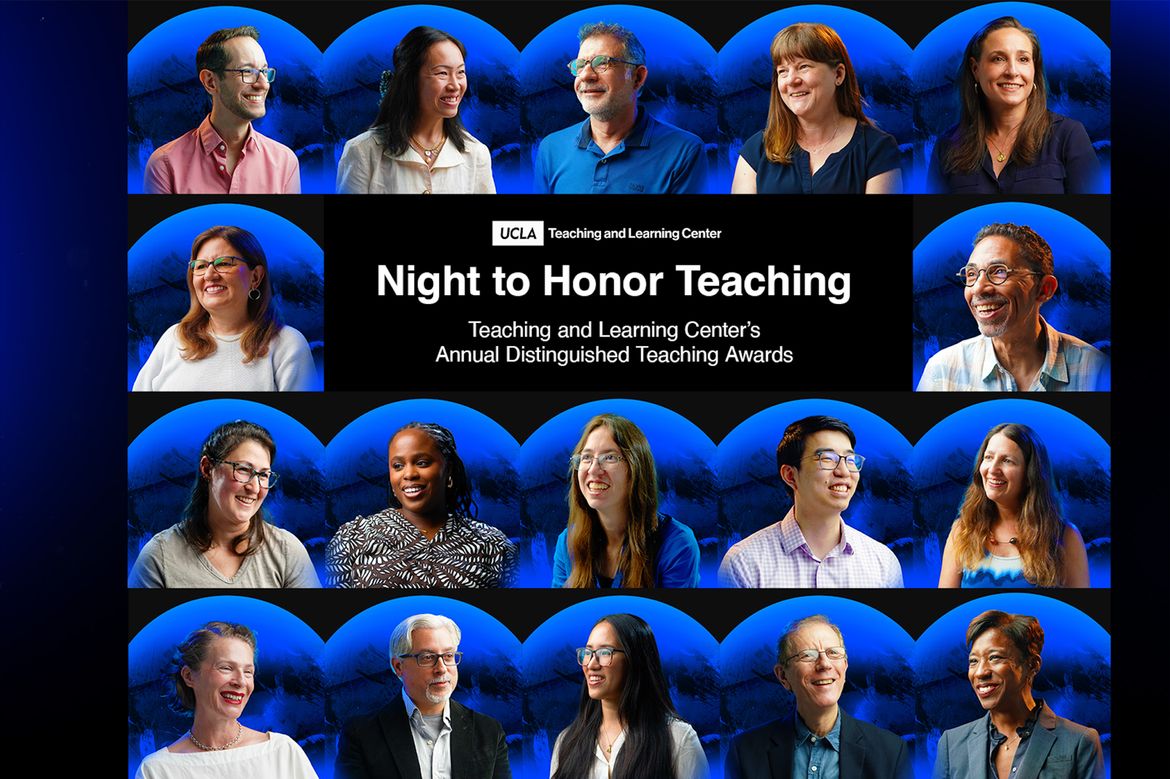
UCLA instructors with a commitment to innovative teaching practices and outstanding educational service were recently honored at the 2025 Andrea L. Rich Night to Honor Teaching annual awards ceremony. The awards are sponsored by the Teaching and Learning Center and the UCLA Office of the Chancellor.
The Distinguished Teaching Awards, the university’s highest teaching honor, recognize instructors in three categories: senate faculty, non-senate faculty and teaching assistants. Criteria such as student success, use of innovative teaching methods, efforts to foster learning for all students, community engagement activities, and student surveys are considered by the selection committee in determining the recipients.
This year’s Night to Honor Teaching also recognized the center’s Educational Innovation Grants winners, who are leading initiatives to enhance the learning experience at UCLA. The program awarded approximately $1 million during the 2024–2025 academic year to fund projects aimed at making instructional improvements for students, instructors and departments.
The Night to Honor Teaching emphasizes that instructional excellence remains a key priority on campus. Elevating excellent teaching is outlined in the UCLA for Life flagship initiative, a part of Chancellor Julio Frenk’s One UCLA campaign and Goal 4 of the university’s strategic plan.
Michael Levine, vice chancellor for academic affairs and personnel, delivered remarks at the ceremony on behalf of Chancellor Frenk, highlighting the key mentorship teachers provide to individuals across various levels of society.
“Teaching is the foundation of all professions,” Levine said. “This is because every leader, professional, and engaged citizen was influenced and guided by educators. It is a discipline that reaches back to the ancient roots of humanity.”
Overall, the Night to Honor Teaching celebrated the dedicated educators who provide students the time and space to learn, creating the conditions for students to thrive in achieving their academic goals.
Distinguished Teaching Senate Faculty Award
The Distinguished Senate Faculty Award winners for 2025 are professors Idan Blank, Jessica L. Collett, Stephen Gardbaum, Tracy Johnson, Jonathan Kao and Robin D.G. Kelley.
Idan Blank is an assistant professor of psychology with a courtesy appointment in linguistics at the UCLA College. His research into psycholinguistics explores how the human brain understands language. In his courses, Blank adapts lessons to help students connect with new material in a way that acknowledges the changing world. “I have to talk to students in their language and in ways that would benefit them without compromising critical thinking, and that means constantly changing,” he said.
Jessica L. Collett is a professor of sociology at the UCLA College. Her teaching practice is informed by her experiences attending a small community college, where instructors offered the time and attention to form impactful relationships with students. These opportunities have inspired Collett to invite research assistants and students into her own home at the end of her courses. “It makes me think about the professors who invited me as an undergraduate into their lives and made not only sociology accessible but profoundly shaped how I view my role as a professor,” she shared.
Stephen Gardbaum is the Stephen Yeazell Professor of Law at UCLA School of Law. His research into constitutional law led him to create a comparative constitutional law course at UCLA that draws students from around the world. Gardbaum’s students come from various political and legal frameworks, which creates opportunities for rich discussion as they share their knowledge bases. “It’s very rewarding to me when I see that students from around the world become study partners,” he noted. “That to me is a sign of success — that I am bringing all of these varied students together.”
Tracy Johnson is dean of life sciences at the UCLA College and holder of the Keith and Cecilia Terasaki Presidential Endowed Chair, and a professor in the department of molecular, cell and developmental biology. She believes that educating students in the sciences is not simply about conveying factual information but modeling how to think scientifically about key topics and questions. “What does it mean to do science? It’s a way of looking at the world,” Johnson explained. “The value of undergraduate education is that you put that into practice ... of being in a space where you practice doing it.”
Jonathan Kao is an associate professor of electrical and computer engineering at the UCLA Samueli School of Engineering. He finds teaching offers scholars a way to accept the gaps in their own knowledge, as well as an opportunity to become better experts on unfamiliar concepts. In designing a new artificial intelligence course, he became more knowledgeable about tools he was previously not as familiar with. “The act of offering this second course made it so I had to learn this material at such a depth so that I could teach it to the students,” he recalled.
Robin D.G. Kelley is a distinguished professor and the Gary B. Nash Professor of U.S. History in the Meyer and Renee Luskin Department of History at the UCLA College. Throughout his 40 years as an instructor, he has moved his teaching practice beyond enforcing traditional grading systems to center grace and prioritize students’ productive struggle with course material. Instead, Kelley applies rigor to helping students think systematically about complex topics and issues. “Everything about teaching is grace ... to have grace is to figure out how to help them, not fail them,” he said.
♦ ♦ ♦
Distinguished Non-Senate Faculty Award
The Distinguished Non-Senate Faculty Awardees for 2025 are professors Tamar Christensen, Joseph Esdin, Bonnie Goff, Diana Márquez-Garbán, Rafael Romero and Shanna Shaked.
Tamar Christensen is a continuing lecturer in writing programs at the UCLA College. As artificial intelligence becomes more prevalent in the classroom, she hopes to teach students how to think for themselves about when to use the technology and for what purposes in their writing. Instead of enforcing strict AI rules, Christensen encourages students to own their perspectives and the ideas they write about. “When we come back to the real goals of independent critical thinking and articulating those thoughts to others in ways that are effective and empowering, then they have to do the messy work of it themselves,” she shared.
Joseph Esdin is a continuing lecturer in integrative biology and physiology at the UCLA College. He recognizes that students are eager to learn how they might practically apply the information that they’re learning in the classroom. Throughout his courses, Esdin emphasizes to students why particular concepts are important in their daily lives beyond simply getting good grades. “For example, to make the material relatable when we talk about the cardiovascular system ... when you go to the doctor and they ask you for a blood test, what does that blood test mean?” he explained. “Here is the information we’re learning.”
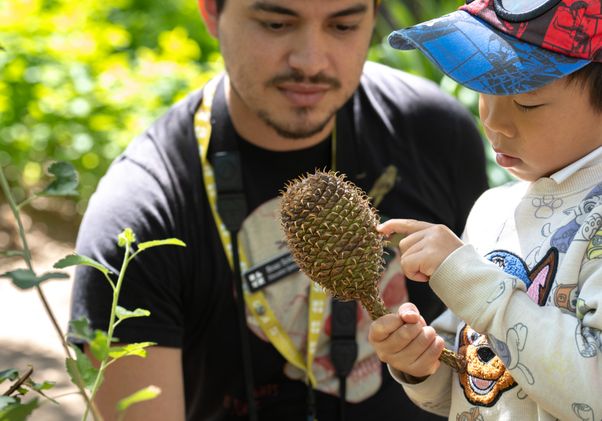
Bonnie Goff is a continuing lecturer in psychology at the UCLA College. While her courses teach about how stress impacts the nervous system, she also knows that it’s vital to help keep the students’ stress levels low to facilitate learning. Goff enforces active rest throughout her courses, which includes taking students on field trips to places like botanical gardens to practice mindfulness. “We reflect on some of the principles they’ve learned regarding nervous system regulation and to just take a break from the hustle,” she said.
Diana Márquez-Garbán is an assistant professor of medicine – Hematology/Oncology at UCLA’s David Geffen School of Medicine. She enjoys having the opportunity to get to know students and see them grow throughout their academic careers, from grasping new lab techniques to developing a passion for research that pushes them to pursue graduate study. “I think when you know someone personally, you can help them succeed and do whatever it is they want to do,” Márquez-Garbán shared. “For me, teaching is the most rewarding thing of what I do.”
Rafael Romero is a continuing lecturer in molecular, cell and developmental biology at the UCLA College. He actively works to instill a classroom environment where students feel comfortable asking any question they have and seeking guidance about concepts that are confusing them. In centering curiosity, Romero hopes to model how active inquiry can become a way students might move through the world. “Science and education for me are part of my being, so I don’t ever interpret them as being work,” he noted.
Shanna Shaked is an adjunct professor at the UCLA Institute of the Environment and Sustainability and senior associate director for the Center for Education Innovation and Learning in the Sciences. Through her work establishing UCLA’s Learning Assistant program, she encourages instructors to reconsider thinking about teaching STEM courses as a solitary act, but rather as a way that they can work in a community by team teaching. “I think for anyone who’s had experience teaching, it can be really isolating,” Shaked observed. “Having this team for discussion can be really helpful in thinking through what assignments we want to include and where.”
♦ ♦ ♦
Distinguished Teaching Assistant Award
The Distinguished Teaching Assistant Awardees for 2025 are Lynette Dixon, Caitlyn Fick, Alexis Korb, Ivy Kwok and Vanessa Pooudomsak.
Lynette Dixon is a teaching assistant in gender studies at the UCLA College. She has found that her teaching practice has greatly benefited from being able to experiment with new techniques that have allowed her to hone her pedagogical approach. Dixon advises newer instructors to trust their intuition and experiences as a learner when creating lesson plans. “We’ve always been learning, we’ve been learning before we were in a classroom — we know what works and what doesn’t work,” she said.
Caitlyn Fick is a teaching assistant in chemistry and biochemistry at the UCLA College. Throughout her experience at UCLA, she has discovered that effective instruction comes through small-scale interventions that foster a supportive space where students can more deeply engage with material. Short handwritten surveys, for instance, have allowed Fick to gauge what topics students are most nervous about. “I’ve learned that you don’t need to be flashy with what you do in the classroom to be an impactful teacher,” she observed.
Alexis Korb is a teaching assistant in computer science at the UCLA Samueli. Because coding assignments are often graded based on whether one’s program successfully runs, she finds it important to also test students on their understanding of various concepts. In encouraging students to see beyond whether their code works, Korb hopes students find the value that comes from their attempts. “I like to focus on giving them the intuition to ask, ‘What is actually happening? Why is this working?’ Not just the solution, but how do we actually solve this problem?” she said.
Ivy Kwok is a teaching assistant in civil and environmental engineering at the UCLA Samueli. She emphasizes group work throughout courses as a way of getting students to engage with one another in a space that might be less intimidating than a full lecture. This setting also allows students the time to thoughtfully consider their responses. “Hopefully, in these small group settings, it gives students a chance to think through things and be able to talk through them,” Kwok shared.
Vanessa Pooudomsak is a teaching assistant in political science at the UCLA College. Teaching courses in international legal theory, she encounters students who are initially skeptical about the effectiveness of international law. Pooudomsak hopes to encourage students to ask larger questions about how to facilitate global discussions around the rules of conflict. “This is something that is the basis of a lot of political theory, saying ‘yes, we want to have rules and laws, but we also want to have spaces to deliberate what those are,” she explained.