The newly formed UCLA Blum Center on Poverty and Health in Latin America held its inaugural spring symposium Wednesday, drawing members of the campus community together to share ideas aimed at alleviating poverty and improving health in Latin America.  "UCLA’s Blum Center promises to change the way we think, do research and move into the future as we seek solutions to the economic, social and health inequalities impacting neighborhoods and communities in Latin America, and locally in our own Latin American immigrant communities," said Scott Waugh, UCLA’s executive vice chancellor and provost. "The role of universities is to ... transform society, with far-reaching consequences for the public good. This is what we’re all interested in."
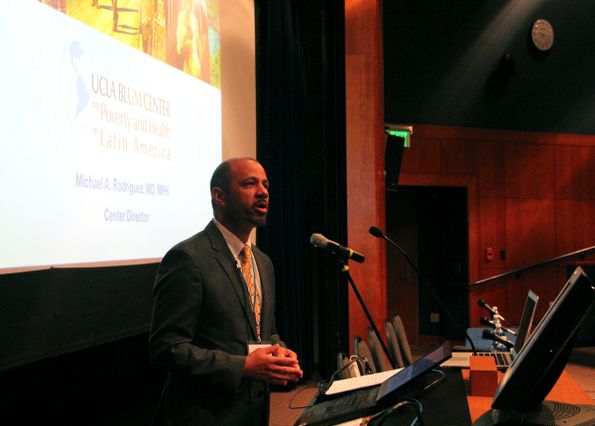
Dr. Michael Rodriguez, director of the Blum Center, addresses the audience.
The center is named for Richard Blum, a University of California regent who provided $1 million toward its creation.
With an interdisciplinary focus, the center aims to advance research, policy and training by drawing from on UCLA’s broad expertise in business, medicine, public health, social sciences, communications, public affairs and dentistry, among other areas, said Dr. Michael Rodriguez, the center’s director. "While these disciplines are diverse, we’re coming together for one cause."
Collaborations with campus partners and institutions around the world will fuel the center’s mission to eliminate injustice and social disparities.
"We need to come together as a community to leverage each other’s resources, skills and expertise in order to focus research and training and make a collaborate effort to work with our colleagues not only at UCLA, but at other institutions and south of the border in Latin America, so that we can learn from one another and move forward," said Rodriguez, a professor and vice chair of research in the department of family medicine at the David Geffen School of Medicine at UCLA. "We’ll work with governments, academic leadership, community organizations and businesses to address these social determinants of health."
The symposium featured a keynote presentation by Dr. Jaime Sepulveda, executive director of Global Health Sciences at UC San Francisco and a former director of the National Institutes of Health of Mexico, who discussed innovative ways to pay for medical care in Latin America and spoke about his experience with the Mesoamerica Health Initiative, an organization that targets indigenous communities from Southern Mexico down through Panama. Other sessions included discussions led by UCLA faculty on interdisciplinary efforts to improve health in Latin America and social determinants of health in Latin America.