When Natasha Wheaton began her training in UCLA’s Dialogue across Difference Faculty Fellows Program last fall, she believed that dialogue was meant to sway people to adopt a different position on an issue.

But over the course of the academic-year fellowship, Wheaton, an associate clinical professor of emergency medicine and assistant dean for curricular affairs at the David Geffen School of Medicine at UCLA — and a self-described “argumentative” person — came to value dialogue itself as a powerful tool for establishing genuine connection with others, even when underlying differences persist.
“This,” she said of the program, “has been one of the most impactful things I’ve been part of as faculty.”
Earlier this month, Wheaton and 15 other faculty members from schools and departments across campus, were honored as the first cohort to complete the innovative program, which supports instructors in facilitating complex classroom conversations that acknowledge and honor differences in lived experiences, cultural backgrounds and perspectives.
A partnership between the Teaching and Learning Center and the Dialogue across Difference (DaD) Initiative within the Bedari Kindness Institute, the program brings together a community of colleagues to practice a range of dialogue skills and learn teaching strategies with the goal of creating supportive classroom settings that advance key learning objectives. This active collaboration equips instructors to integrate the DaD Initiative’s five values into their courses: intellectual engagement, curiosity, empathy, active listening and critical thinking.
For the DaD Initiative’s organizers, the graduation of the first faculty fellows cohort comes at a time when engaging with different perspectives is most needed.
“Over the years, we’ve lost a lot of the muscle needed to listen to and to engage in dialogue,” said David Myers, UCLA’s Sady and Ludwig Kahn Professor of Jewish History and director of the Bedari Kindness Institute. He emphasized that higher education’s ability to develop understanding around complex issues relies on classroom settings where differences can be fully explored.
“The university depends on friction and dialogue to develop knowledge,” he said. “We have an obligation to foster, model and export this mode of engagement.”
How dialogue can have an impact: Faculty on what they learned
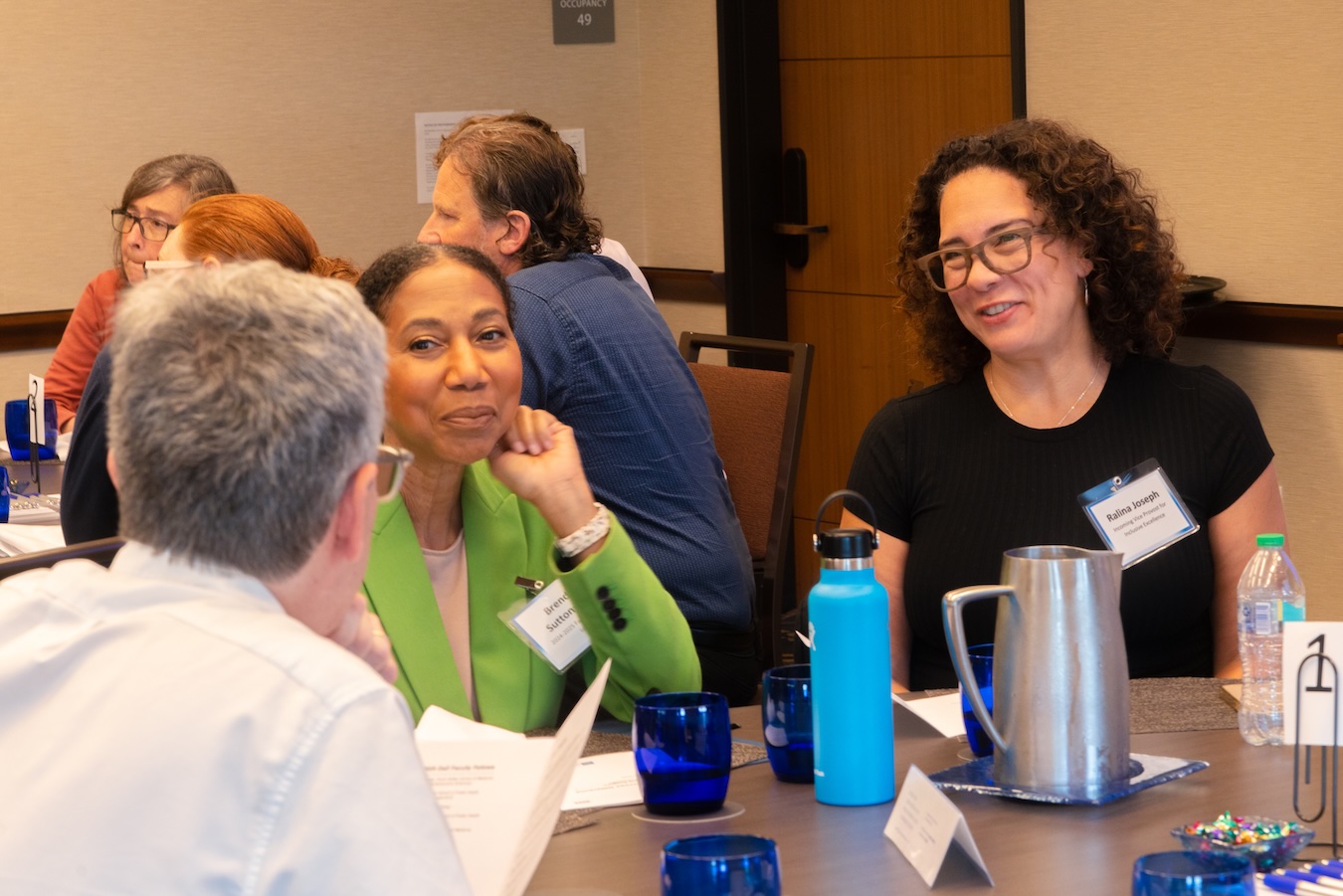
At a June 6 culmination event, fellows from the first cohort celebrated the community they formed during their time together and shared stories highlighting the program’s personal impact. Many noted the value of getting to learn from fellow faculty members about how to engage in productive dialogue.
For Wheaton, the training and interaction with her colleagues was key to understanding dialogue across differences as a way to make connections and find common ground— something she’ll incorporate in her instruction.
“The Dialogue across Difference program brings community together,” she said, “and you start to see your commonalities,”
Other faculty fellows recounted how, despite initial reservations, they came to see the valuable role dialogue can play in a university setting.
“The history of medicine is riddled with well-meaning but ineffective work,” said Jonathan Heldt, an assistant clinical professor and psychiatry and biobehavioral sciences and psychiatry residency director at the Geffen School of Medicine, recalling his initial skepticism about the program. “I am walking away convinced that dialogue can have an impact.”
Heldt also detailed how the principles of dialogue had played out in his department during monthly meetings at which attendees discuss a controversial topic together.
In supporting instructors’ adoption of evidence-based frameworks for using dialogue in instruction, the DaD Faculty Fellows program highlights how educational innovation remains a key priority at UCLA. The elevation of teaching is outlined as Goal 4 of the Strategic Plan, underscoring the vital role that creating a welcoming learning environment plays in the university’s ongoing success.
“We see it as an important lever of change to create classrooms that are more open to all,” said Erin Sanders O’Leary, vice provost for teaching and learning. “These have to be spaces where students can understand different experiences and perspectives and interrogate their own assumptions.”
The DaD Initiative was launched by Executive Vice Chancellor and Provost Darnell Hunt in January 2023. At the culmination event, he thanked the fellows for their commitment to advancing the program and for actively demonstrating the True Bruin Values and UCLA’s principles of community.
“Naming our values is easy; living them is the hard part,” he said. “We need these values to be more than aspirations — for our students to see them in practice in our classrooms.”
As the first cohort reflects on their experiences and carries on the program’s lessons in their classrooms, the Teaching and Learning Center and DaD Initiative are now welcoming the second cohort of DaD Faculty Fellows for the 2025–26 academic year. These new participants will spend the year working together and learning best practices that foster an engaging and open classroom environment.



