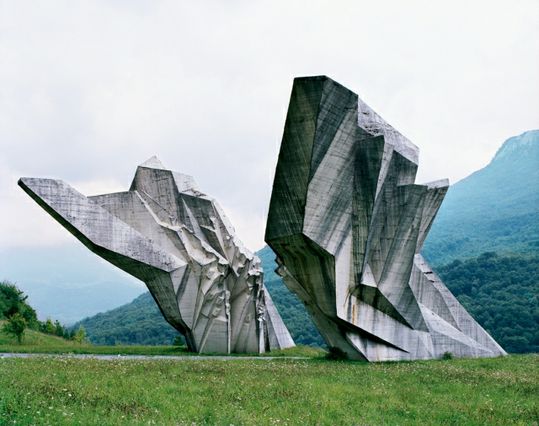

Jan Kempenaers took this shot of a monument near the village of Tjentište in Bosnia-Herzegovina in 2007.
Now, his photographs are the focus of the Fowler Museum’s latest exhibition, "Spomenik: Photographs of the Monuments of Former Yugoslavia by Jan Kempenaers," on display until August 11.
Kempenaers is all about art and aesthetics. "My main interest as an artist is to make interesting images, finding the right angle, having the right light, having an interesting framing," he said. But the subjects of his photography and the reason for their current state of decay stem from an undeniably rich and complex sociopolitical history.
"It’s difficult to describe. You can feel immediately that something has happened at this place," he explained. "All the monuments are at places where there were serious battles between the German and partisan armies [during World War II]."
The structures were meant to evoke somberness for lives lost and to serve as reminders of the amazing unity of Yugoslavia. Today, however, ugly memories from Yugoslavia’s tumultuous and violent breakup have tainted public sentiment about the monuments.

Photographer Jan Kempenaers
In fact, one of the buildings Kempenaers photographed for the exhibition has since been demolished. He explained that nobody — neither politicians nor residents — is looking after the monuments. As long as material from a monument can be used, people will sell pieces of it, he said. People will take the plates off a stainless-steel monument to make tables with the scrap metal.
It therefore comes as no shock that Kempenaers’ photographs have not been, and might never be, exhibited in the Serbo-Croatian region.
Interestingly, emigrants of the region, such as those currently living in Brussels after leaving the region due to wartime violence, fondly remember the monuments and flock to Kempenaers’ exhibits. "People often visited these monuments with their schools when they were kids," he explained.
For Kempenaers, the monuments are aesthetically interesting because they interact so well with their environment. He said that the artists and architects who built them were very conscious of the monuments’ relation to nature and erected them with the landscape in mind.
Kempenaers’ photography brings this relationship to the forefront, but with the infinitude of angles and considerations that go into a single shot, taking a picture isn’t as simple as point-and-shoot, he said.
"Sometimes it’s quite easy to decide where to take the shot from. Sometimes it’s really difficult. For one monument, it was so difficult, I took two images of it. … The monument is completely something else from several angles."

"Monument to the Revolution of the People of Moslavina," Podgarić (2006). Photo by Kempenaers
"I never shot photographs with one clear subject," he admitted. "Most of the time I photograph wide-angle landscapes that don’t really have a subject, except for the landscape itself."
Kempenaers is keen on pushing himself to move in new directions with his art. His next project will focus on abstract photography.
"Always having the subject and making a photograph of it got a bit boring in a certain way. It’s always the same thing to do," he said. "That’s why I started with abstract photographs. While you’re making it, you never know what it’s going to be like in the end, so it’s more exciting."
Kempenaers has been affiliated with the School of Arts Ghent in Belgium since 2006. "Spomenik" is part of his artistic research and will be on display until August 11 at the Fowler Museum.
The Fowler Museum at UCLA is open Wednesdays through Sundays from noon to 5 p.m., and on Thursdays from noon to 8 p.m. The museum is closed Mondays and Tuesdays. The Fowler Museum, part of UCLA Arts, is located in the north part of the UCLA campus. Admission is free. Parking is available for a maximum of $11 in Lot 4. For more information, call (310) 825-4361 or visit www.fowler.ucla.edu.