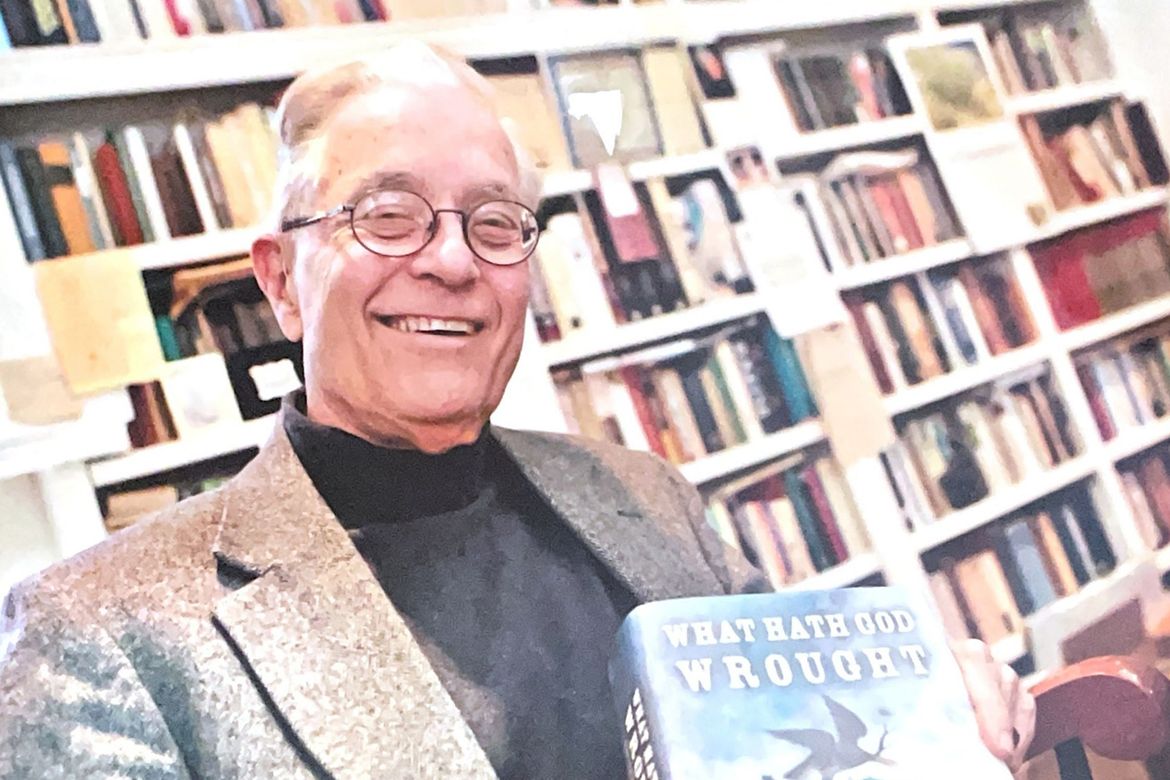
Daniel Walker Howe, a UCLA professor emeritus and one of the world’s most influential scholars of early American history, died Dec. 25, 2025. He was 88.
Howe joined the UCLA faculty in the early 1970s and spent the following two decades in Westwood teaching and researching U.S. history, with a focus on how intellectual, political, cultural and religious factors influenced the formation of American identity and the development of the early American republic between 1777 to 1860.
In 2008, Howe was awarded the Pulitzer for history for his landmark book “What Hath God Wrought: The Transformation of America, 1815–1848.” The volume explored the period from the battle of New Orleans to the end of the Mexican–American War, tracing how improvements in transportation and communications accelerated the extension of the American empire and how religion shaped many aspects of American life, influencing both slavery and antislavery, women's rights and other reform movements, and politics, education and literature.
More on Howe:
Read obituaries of Daniel Walker Howe in the New York Times and Associated Press.
“In a book that every student of American history and politics should read, Howe synthesizes a broad range of historical scholarship to produce an overview of this crucial era that is lucid, sensible, entertaining and revealing,” a 2008 Foreign Affairs magazine review read. “It is, in short, everything a work of historical scholarship should be.”
Howe was elated by the book’s widespread acceptance. “I'm grateful that the book has been appreciated and noticed,” he said, in part because “it's the first book I have written for the general, literate, curious public. I wanted to say something for the public at large, and I am very happy to have done that.”
“What Hath God Wrought” also won the New York Historical Society American Book Prize in 2008, and Howe was named American Historian Laureate that year. Among his other books were “Making the American Self: Jonathan Edwards to Abraham Lincoln” and “The Unitarian Conscience: Harvard Moral Philosophy, 1805–1861.”
A fellow of both the American Academy of Arts and Sciences and the Royal Historical Society, Howe earned his bachelor’s degree from Harvard University and his Ph.D. from UC Berkeley. He taught at Yale University before joining a talented group of U.S. historians at UCLA from 1972 to 1993; he served as the history department’s chair from 1983 to 1987.
In 1993, he moved to England, where he was the Rhodes Professor of American History at Oxford University until 2002.
Howe was remembered warmly by his students — including Kevin Terraciano, currently the Robert N. Burr Endowed Chair of UCLA’s Department of History — as a gifted teacher who brought the drama of historical ideas to life.
“Personally, I have fond memories of taking Dan’s excellent survey course on U.S. history in 1982, when he sang early American songs to the class in a fine baritone voice,” Terraciano said.
A memorial service for Howe will be held on Saturday, Jan. 10 — his birthday — at 11 a.m. at St. Albans Episcopal Church in Westwood.