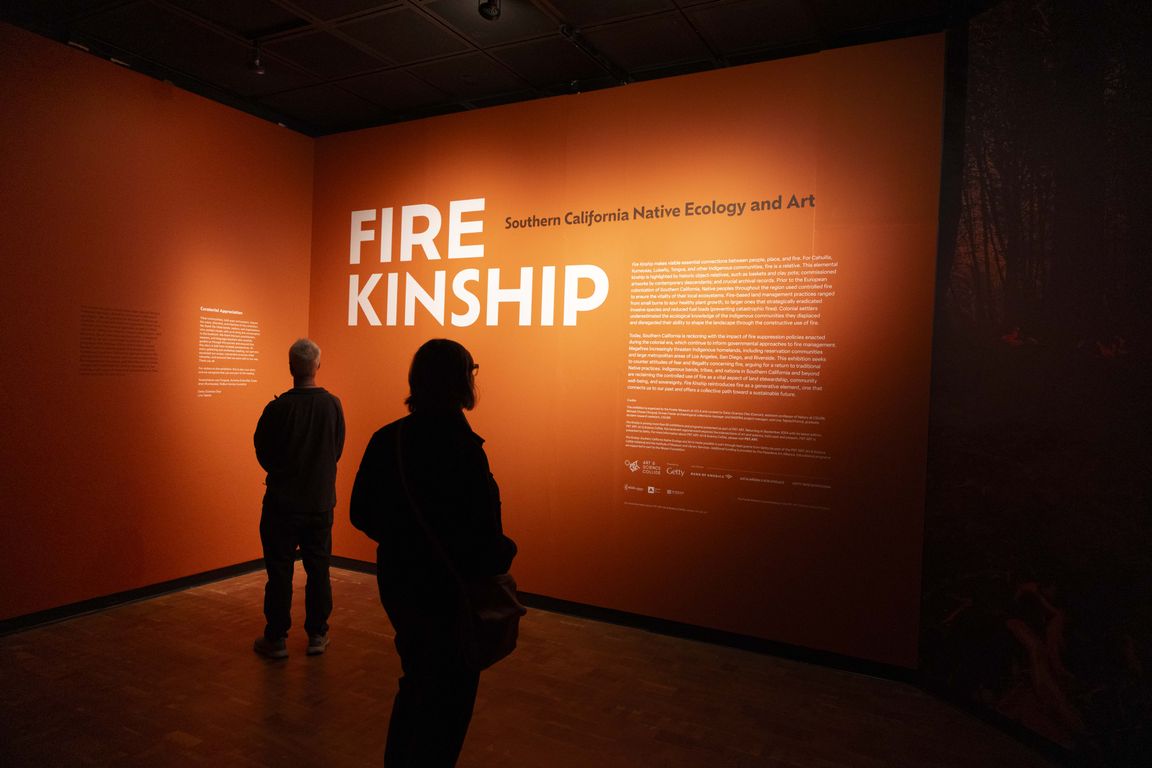
The curators behind “Fire Kinship: Southern California Native Ecology and Art” could never have anticipated opening the exhibition — which is centered around Native American use of fire and ancestral knowledge — while embers were barely cold within the burned-out hillsides following the Los Angeles wildfires this past January.
But now the exhibition, which just had its six-month anniversary at the Fowler Museum at UCLA, is greeting visitors, many of whom have been impacted by the Palisades or Eaton fires in some way. These visitors are coming through the museum doors to learn about Indigenous fire practices and a “kinship” with the element, in which its power is not feared but respected and harnessed between land and people.
The exhibition, originally scheduled to conclude in July, has been extended through April 2026.
“The overwhelming response to Fire Kinship, from Native communities and visitors seeking deeper understanding, especially in the wake of the recent wildfires, made it clear that this exhibition is more than a moment; it’s part of an ongoing dialogue,” Fowler Museum director Silvia Forni said.
“Extending its run honors the curators’ vision and the ancestral knowledge shared so generously by the artists in the exhibition. We hope its continued presence will create a space for learning, healing, and reimagining our relationship to fire and Southern California,” she added.
During the exhibition’s opening in February, Native communities gathered to mark the event and bless it with bird singers and dancing. Tongva elder Cindy Alvitre articulated the occasion in new terms: “People like to do land acknowledgements, and those are very fine,” she said. “But this fireship, kinship exhibition is a living land acknowledgment. It is the way it should be, as we all should be doing.”
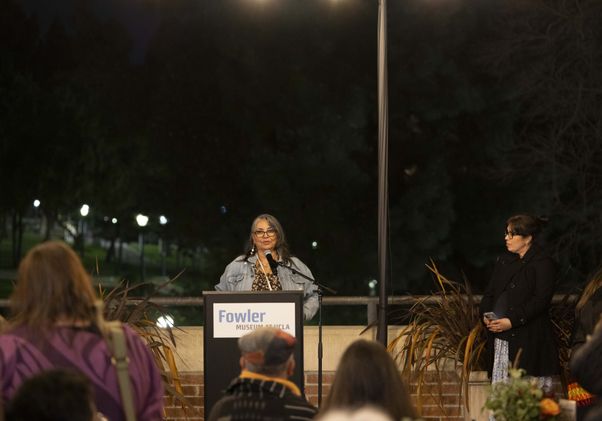
For Daisy Ocampo Diaz (Caxcan), co-curator of “Fire Kinship” and assistant professor of history at Cal State San Bernardino, the exhibition is just that. The scholar explained how the installations are intended to raise awareness around land management, ecological expertise and a misunderstood history.
“These were all part of the maintenance and active stewardship and management that took place in California Indian communities,” she said. “California wasn’t this Garden of Eden just because it was by definition. It was shaped that way, and it was actively managed that way, and I think we’ve lost sight of that contribution.”
Ocampo Diaz said that cultural burning — the use of small, controlled fires that restore land and renew ecosystems — is never about destruction. “There was always a purpose to a fire,” she said, adding that these fires did everything from assisting with hunting to controlling outbreaks of plant diseases.
Yet, Ocampo Diaz said these practices were forcibly disrupted by Southern California’s colonization, and later by state policies that outlawed cultural burning and replaced it with centralized fire suppression systems. Modern wildfire prevention emphasizes control, often sidelining the coexistence with fire that Native communities have long practiced.
In one gallery of the exhibition, the collision becomes visible. A display highlights how public messaging campaigns, like the launch of “Smokey Bear” in 1944, helped popularize the idea that all fire is dangerous. In doing so, it created a lasting stigma around Indigenous fire practices that had long maintained ecological balance.
“You start to see the separation, the compartmentalizing of fire: where it belongs, who can tend to it, who should be doing it,” said Ocampo Diaz. “It brings into question who the experts are.”
Today, CAL FIRE and local fire departments are often positioned as the primary authorities on fire. While that’s slowly — and only marginally — beginning to change, Ocampo Diaz and her collaborators wanted to present fire as a source of renewal deeply rooted in tradition and vital to shaping a more sustainable future. They also wanted to invite viewers to reconsider the fear and limitations often associated with fire. That vision guided the entire curatorial process for the exhibition, which didn’t start with objects, but with people — elders, artists, weavers and Native fire practitioners.
“This exhibit was definitely for the people,” said co-curator Lina Tejeda (Pomo). “Every single person who we connected with connected us with somebody else. So this exhibit really relies on the community input. We just let them guide us.”
What emerged is not a timeline, but a tapestry. In one video that loops in the gallery, families are shown gathering on their homelands to conduct cultural burns. “We really wanted to touch on the importance of this kinship being about family,” Ocampo Diaz said.
Forni remarked to those attending the exhibition’s opening how “Fire Kinship” was years in the making, with those behind its development unable to foresee the tragic circumstances that would affect Los Angeles at the time of its opening. Around 57,000 acres burned in the region and over 18,000 homes were destroyed. Thirty-one lives were also lost.
On the night of the opening, a small child experiencing the exhibition pointed to a flatscreen on a gallery wall showing the undulation of flames from a cultural burn extending across a field.
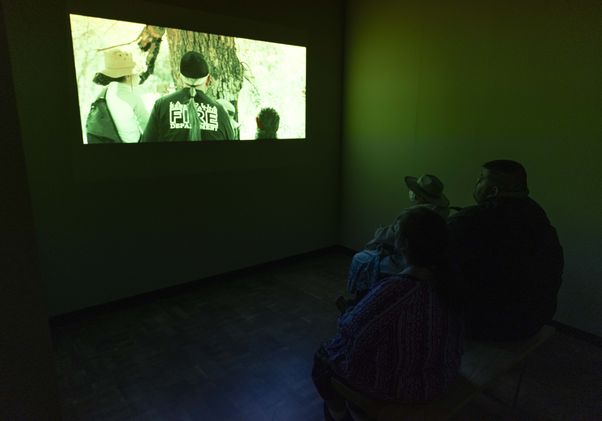
“Look, that’s good fire,” he said, the earnest comment not lost on those in the gallery enclave dedicated to “burn bosses” — a term for fire practitioners preserving native ecology in California and beyond. Bystanders smiled at hearing the child’s comment before returning their attention to the video, which was now showing fire practitioner Marlene’ Dusek and other members of the Indigenous Women in Fire Training Exchange sharing knowledge about Native American-controlled burns.
Ocampo Diaz said she hopes that for a city where smoke becomes a seasonal reality, “Fire Kinship” offers not escape but a reorientation.
“Hopefully, we’ve introduced something here that we can carry on and continue the conversation,” she said.