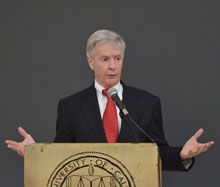
Ambassador Ryan Crocker identified three top priorities for U.S. foreign policy in the Middle East when he delivered the annual Bernard Brodie Distinguished Lecture on the Conditions of Peace organized by the UCLA Burkle Center for International Relations on May 30.
 The U.S. must maintain its relationship with Egypt. It also must support stability in Afghanistan and engage with Pakistan to promote a new strategic relationship, said Crocker, who served as U.S. ambassador to Afghanistan, Iraq, Pakistan, Syria, Kuwait and Lebanon during his nearly four-decade career in foreign service.
“In the Middle East,” remarked Crocker, “you have to be able to do more than one thing at once ... So you’ve got three top priorities — let’s see if our attention span will carry that far.”
On Egypt and the Arab Spring
Crocker, who is currently at Yale University as the first Senior Kissinger Fellow and also at the University of Virginia where he is the James Schlesinger Distinguished Visiting Professor, shared other insights with the audience attending the lecture held at the UCLA School of Law. He is on leave from his post as dean of the Bush School of Government and Public Service at Texas A&M University.
A recipient of the U.S. Presidential Medal of Freedom, Crocker contended that political changes in Tunisia, Egypt and Libya were only the beginning of a process begun by the Arab Spring that will continue for a long time. Unlike the revolutions of the 1950s, which toppled monarchies, he noted, the kingdoms of the Middle East were doing reasonably well.
“I make this point simply to suggest that we need to be a little humble in our judgments of other people’s political systems … [You] don’t have to be a democracy to stay in touch with your people,” he observed.
Non-state actors are becoming extremely significant in the political sphere in the Middle East, observed Crocker. In some cases, such as the Muslim Brotherhood in Tunisia and Egypt, they are leaving the shadows to enter politics and govern countries — having no previous experience in such a task.
Armed, hostile non-state actors — particularly but not exclusively Al Qaeda — represent a particularly serious challenge for the region and the United States as a member of the international community, said Crocker. “As bad as things seem today, they are better today than they will be tomorrow,” he predicted.
Syria — a multilayered war
Crocker described the war in Syria as a multilayered conflict in which a domestic, essentially sectarian, civil war between Sunnis and Shias was overlaid by a regional proxy war, with Saudi Arabia and Qatar on one side (supporting the Syrian rebels) and Iran and the Hezbollah Shia militia of Lebanon (supporting the regime of Bashar al-Assad) on the other.
At the same time, he continued, a civil war within a civil war is raging within the Free Syrian Army (FSA), in which the Islamist jihadi group Jabhat al-Nusra is clashing with other factions and efficiently seizing their weapons. Crocker argued against arming the FSA precisely because such a decision might further empower Jabhat al-Nusra, which he described as the most dangerous and lethal anti-western group in the country.
The speaker commended the Obama administration’s restraint in not rushing to “do something” in Syria that might prove exceedingly dangerous. “Do not send the 101st Airborne into this area,” Crocker cautioned.
Rather than put boots on the ground, he counseled the United States to make the “radical” and “nutty” decision to deploy diplomats instead.
He argued that region-savvy, Arabic-speaking diplomats were needed to assess who the opposition actually is on the ground and how the United States might influence these actors. “But right now,” he commented, “we haven’t got a clue, and going in blind with guns blazing is not a formula for victory or success.”
Crocker predicted that the government of Bashar al-Assad would persist. Calling the Syrian Alawite regime one of the most ruthless in the region, he believes it had been preparing for 30 years for precisely this current fight. The regime expected eventual consequences from the 1982 massacre in Hama, when the regime of Hafez al-Assad put down a Muslim Brotherhood uprising at the cost of well over 10,000 civilian lives.
Lessons from the ‘long war’ on terror
Lessons from the ‘long war’ on terror
Although historical consciousness is very acute in the Middle East, Crocker noted that the United States is “relentlessly ahistorical” and frequently operates in ignorance of what he called the “ground rules” of the region.
He offered two succinct lessons from what he called the “long war” on terror, which for him began almost 20 years before Sept. 11, 2001 — when the U.S. Embassy in Lebanon where he was serving was attacked by a suicide bomber in 1983.
Lesson #1: Be careful what you get into.
Middle Easterners, said Crocker, know that they can’t beat a Western occupier outright, so they retreat in the face of superior force and outlast the invader. “Whether it’s the British and Russians in Afghanistan, the French in Morocco and Algeria, the Italians in Libya, the Americans in Lebanon, the Israelis in Lebanon, the Americans in Iraq or Afghanistan — it’s the same pattern,” he said. “Basically, our adversary hasn’t started a fight until long after we think we’ve won the war.”
Once having invaded and run into an unexpected mess, he said, Americans impatiently cut their losses and go home. “Our adversaries count on that,” he noted, “[while] our allies become irritated.”
Lesson #2: Be careful what you propose to get out of.
If interventions have consequences, so too, do disengagements, argued Crocker. That is, getting out of an intervention may incur very grave consequences, such as the collapse of Afghanistan and the rise of the Taliban three years after the USSR withdrew from the country and stopped supporting the Afghan government —and the Afghan military.
In the case of Iraq in 2007, Crocker said believes that withdrawal by the U.S. at that point would have led to a complete collapse of the fledgling Iraqi state, causing him to join forces with U.S. Army General David Petraeus and argue for the troop surge that ultimately followed.
In the case of Afghanistan today, he urged the U.S to continue to support the bilateral strategic partnership over the long run after U.S. troops withdraw in 2014, or risk the resurgence of the Taliban and Al Qaeda.
Crocker's lecture was co-sponsored by the UCLA Burkle Center, the Asia Institute’s Program on Central Asia, the Center for India and South Asia, the Center for Middle East Development and the Younes & Soraya Nazarian Center for Israel Studies.
_____________________________________________________________________________________
To see the original version of this story in full, go to the International Institute’s website.



