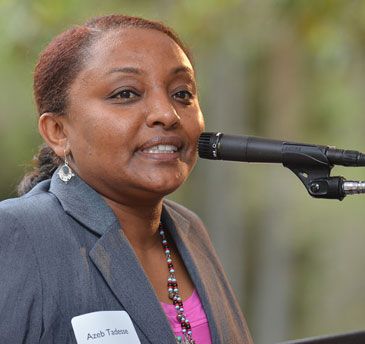
Working collaboratively with people from different cultures and countries comes naturally to Azeb Tadesse, deputy director of the African Studies Center at UCLA. As a child, she often visited her father at his job at Ethiopian Airlines at postings around the world and observed how he worked with others.  Today, using her own managerial skills, Tadesse has had such a significant and lasting impact on the people she leads at UCLA that she was recently singled out to receive the top leadership award given annually by the UCLA Administrative Management Group, a campuswide organization devoted to the professional development of managers and aspiring managers.
Azeb Tadesse, deputy director of the African Studies Center, speaks at the Staff Honors Reception on June 6. She is the winner of the top leadership award given by the UCLA Administrative Management Group.
She was formally presented with the 2013 UCLA Excellence in Leadership (Excel) Award at the annual Staff Honors Reception held June 6 at the Chancellor’s Residence.
"I don’t really ‘manage’ people," Tadesse explained, "I prefer to think of it as interacting with people and working towards a common goal. It’s what I’ve learned by example. I find working this way to be more productive and more conducive to a team atmosphere. If you have the right people, you can trust them to do their jobs. If you find that something isn’t getting done, then you have a conversation and perhaps end up providing someone additional resources."
"I don’t believe in punitive management," she stressed, "You don’t have to be authoritarian to get things done." She also credits UCLA with providing its employees with the space they need to creatively make their jobs their own; the job description is just a starting point, she said.
The UCLA African Studies Center is the place where she has been getting things done for the last 14 years. It’s there that she has seen firsthand the role that research can play in foreign policy and how conferences and public talks given there broaden people’s understanding of Africa.
The center has been in the front row of the history of how the West engages Africa in modern times, she said. The UCLA faculty affiliated with the center are giving, committed and cooperative, she said. "Our partners in Africa," she continued, "know we are going to go above and beyond to meet our commitment on projects and linkages."
However, Tadesse said, it’s unfortunate that the African Studies Center is not better known on campus as it is both in Africa and the United States overall. In Africa, the center "enjoys tremendous respect on the ground, as does UCLA as a whole," she said. UCLA alumni— both African and American — can be found all over Africa serving in ministries and international organizations. "Wherever you travel in Africa, people have heard of UCLA, and many in the older generation know who James Coleman is," she noted.
A world-renowned Africanist scholar who more or less singlehandedly created the field of African studies in American academia, Coleman, who died in 1985, was a UCLA professor of political science who founded the center in 1959. After teaching at UCLA for 12 years, he worked at the University of East Africa in Uganda and the University of Nairobi in Kenya, and for the Rockefeller Foundation in East Africa and Zaire before returning to UCLA. He eventually became the director of the International Studies and Overseas Programs, now known as the International Institute.
The center’s reputation and the achievements of its past leaders have allowed Tadesse to pick up where her predecessors left off. In her job as deputy director, she wears many hats and has a large degree of autonomy, conditions that have enabled her to continually grow and take on new projects in the center’s multidisciplinary environment.  At present, she is administering a grant for a partnership with the Kigali Institute of Education (KIE) in Rwanda to build that institution’s capacity to increase its outreach, recruitment and retention of young women in its Teacher Training College. She and African Studies Center Director Françoise Lionnet wrote the successful grant application for the project with less than one month’s notice last year.
Enjoying the reception are (from the left) Assistant Vice Chancellor Keith Parker of Government and Community Relations, Tadesse, political science professor Edmond Keller, Associate Vice Chancellor Lubbe Levin of Campus Human Resources and Chancellor Gene Block.
Funded by the U.S. Agency for International Development (USAID) through Higher Education for Development, the UCLA-KIE partnership involves making resources on gender equity research and gender-sensitive pedagogy, developed across the UCLA campus, available to KIE and then supporting it.
Two KIE representatives recently completed a two-week stay at UCLA last month to work intensively with colleagues from the UCLA Center for the Study of Women and the Graduate School of Education & Information Studies. "They saw immediately how they could incorporate these processes and ideas into their operations," she said.
She already has her eye on future projects. Tadesse and Lionnet envision future activities between KIE and UCLA that include increasing the number of Africans pursuing Ph.Ds. at UCLA and distance-learning projects. Another potential project could be making the center’s website a portal to all UCLA projects in Africa.
Tadesse ended up in Los Angeles by a circuitous route. Born in Ethiopia, she and her family followed her father to a series of job postings around the world, beginning when she was 2. When, years later, they moved back home to Ethiopia in the latter years of the Derg government of dictator Mengitsu Haile Mariam, they decided it was unfeasible to remain there.
"We didn’t have any idea how different or repressive it was," she said. So the family applied for and received political asylum in the United States, moving to Los Angeles in 1985 when Tadesse was a teenager.
Today, she is one of a growing number of people who live between two countries — in her case, the United States and Ethiopia. Calling it the "ultimate globalization experience," she described her transnational existence as "mind-opening." Not only does she have a deep understanding of the popular cultures of both countries, she has friends living all over the globe.
But UCLA has become both her educational and professional home. She completed a B.A. in history, followed by an M.A. in African studies here.
"I’m a product of UCLA," said Tadesse, "and of the African Studies Center specifically."



