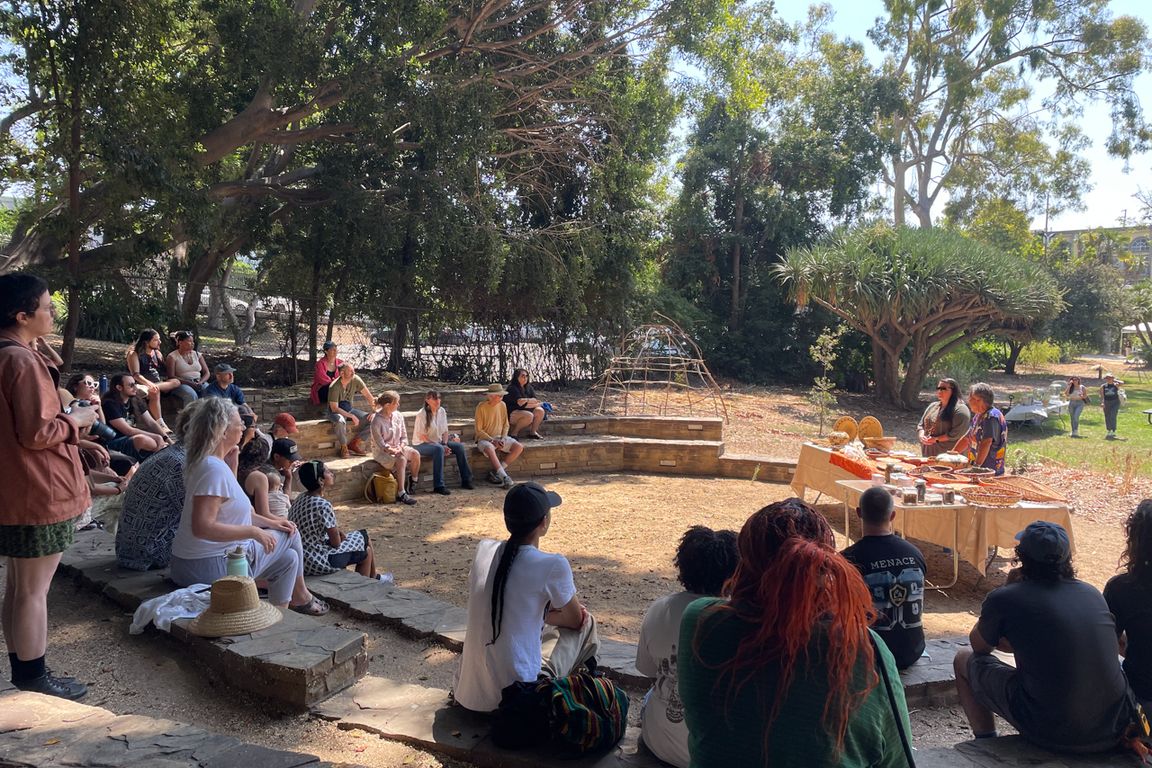
UCLA sits on land with a long and layered history — one shaped by the Gabrielino/Tongva Peoples, whose homelands encompass Tovaangar, the large expanse marked by the coastline from southern Malibu to northern Orange County. How that past informs the role of a public university today is at the heart of Theresa Ambo’s work, which examines how institutions understand their responsibilities to Native Nations and how these relationships can be strengthened in purposeful, community-centered ways.
A triple Bruin and one of the first two Gabrielino/Tongva women to earn a Ph.D. from UCLA, Ambo brings both lived experience and rigorous scholarship to this effort. Her early research traced the ways universities have historically been involved with tribes. At the urging of community partners, her work expanded to investigate deeper land histories that shape those relationships, particularly in California, where public higher education has played a significant role in both disrupting and restoring land relations. She sees this work as part of a broader commitment to illuminating the university’s origins while advancing opportunities for more reciprocal engagement with Native Nations.
Now a faculty member in the UCLA American Indian Studies Department, Ambo is expanding this research across the state, teaching courses that connect students with the region’s Indigenous history and present-day community leadership.
Newsroom caught up with Ambo about her goals in shaping a university that more fully understands the land it occupies — and the sovereign nations whose futures remain intertwined with its own.
This interview has been edited for brevity and clarity.
You’re a triple Bruin. Why did you choose to come back to UCLA as a professor? How does it feel to be back?
I am proud to have completed my degrees at UCLA. I remember, very vividly, my first campus visit as a high school senior. Walking on campus with a small group of schoolmates and our AP government teacher, I was overwhelmed by the architecture and size of the campus. Something felt incredibly familiar and comforting. While I struggled with impostor syndrome over the years, I felt the presence of our ancestors and knew they were with me every day.
Coming back has been more than I could have ever dreamed. I am excited to collaborate with UCLA colleagues, enhance student learning, extend my research, build community partnerships and strengthen the department of American Indian studies.
Your work focuses on the historical relationships and contemporary partnerships between Native Nations and public universities. How did you decide to study this? How do you hope to continue expanding on your research interests here at UCLA?
My research area stemmed from a deep interest in ensuring institutions were not only accountable to Native Nations as constituent groups of the university but also answerable for their role in the continued physical dispossession of communities. This work began by exploring contemporary relationships between Native Nations and universities. Out of community interest, however, it has grown into an interdisciplinary and collaborative research program that examines the history of California lands and the role of public postsecondary education in land-based relationships, both in disrupting and restoring land relations.
In 2023, Kelly Stewart and I co-authored “Tovaangar to UCLA” (in the American Indian Culture and Research Journal), which examines the physical transfer of Gabrielino/Tongva homelands across three waves of colonialism to become the UCLA campus we know today. With support from several community members and colleagues, we assert how parts of Gabrielino/Tongva ancestral lands came into the physical possession of the University of California and discussed the continued presence of the Gabrielino/Tongva across time and place.
Over the next few years, I plan to expand this research to other UC and CSU campuses, collaborating with Stewart (Gabrielino/Tongva, Luiseno), UCSD’s Heather Daly (Kumeyaay) and UC Davis’s Patricia Quijada (Chicana/Cupeno).
How can institutions like UCLA work to ensure deeper engagement with local Native Nations and communities?
Over the years, this has been something that I have thought deeply — and written extensively — about. The research I have conducted shows how this has traditionally been undertaken, mainly by Native faculty, staff and students, in response to unfunded federal and state legislation. Working with Native Nations and communities requires intimate knowledge of communities and colonial histories, sensitivity, patience and commitment, among other things. These relationships can be approached with intentions and strategies similar to engaging foreign relationships, because Native Nations are sovereign nations. Fostering government-to-government relationships with the leaders of Native Nations as a state entity is not only an important opportunity for universities to learn about the interests of tribes and the needs of students, but it is also intimately connected to the university’s mission.
Do you have any upcoming or current classes or projects that students should check out?
In the spring quarter, I am teaching American Indian Studies 19, a “Fiat Lux” course that introduces students to the Indigenous history of UCLA. We will have several community-based activities to connect students with the local Indigenous community and often untold stories of the region.



