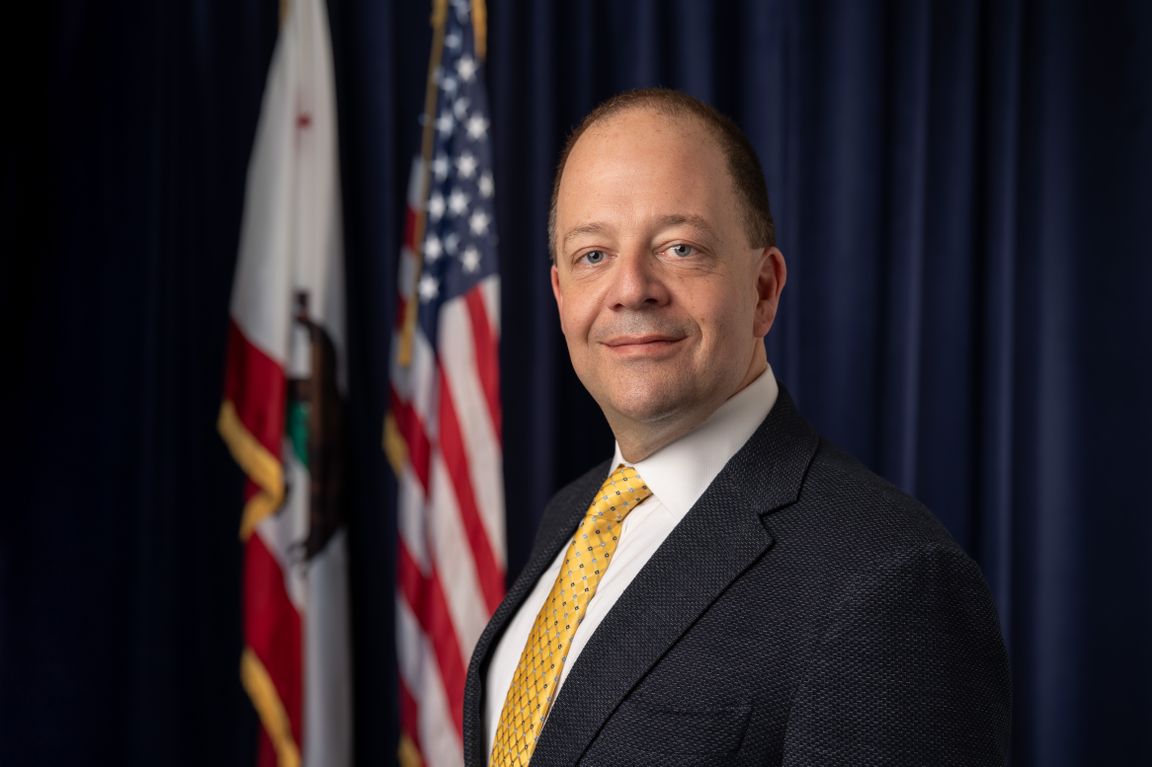
Steve Lurie is approaching his new tenure as UCLA’s associate vice chancellor for campus and community safety with the same enthusiasm, compassion and ingenuity as he did his time on campus as a cultural anthropology student in the early 1990s.
Back in those days, Lurie, who grew up in the South Bay, served as an undergraduate community service officer with the UCLA police, played in the Bruin Marching Band and drove an ambulance in South Los Angeles part-time to help pay for school. It was in that last role, he said, that he was a direct witness — and responder — to the violence that broke out across the city in 1992 following the acquittal of four police officers in the beating of Rodney King.
That experience didn’t deter the 19-year-old from pursuing a career in public safety — it spurred his passion. Eager to help people, Lurie developed a keen interest in criminal justice and relations between law enforcement and the community. Soon after his graduation in 1994, armed with an eagerness to learn and a zeal to serve, he embarked on a path that would take him to the highest levels of leadership in the Los Angeles Police Department and into academia as a law professor.
And he credits his time at UCLA, both in and outside the classroom, with helping him build the qualities that set him on that trajectory.
“Public safety, and especially public safety leadership, is rooted in relationships and communication, and my time at UCLA was critical in developing skills in these two areas,” he said. “I was a student, a musician, an employee and a public servant — it was a spectacular and formative experience to be all those things within a large campus community rich in diversity of background and thought. Had I not experienced the fabric of a university of UCLA’s caliber, I wouldn’t have become a public servant and leader.”
Now back on campus as UCLA’s top safety officer, Lurie is working to strengthen that community fabric by making sure every Bruin feels safe, respected and welcome and has an opportunity to participate fully in campus life.
An expansive career: Law, policy and community-based policing
After his first few years with the LAPD, Lurie began taking night courses at Loyola Law School, where he eventually earned his juris doctorate. He briefly considered a career in law, but when planes struck the World Trade Center on Sept. 11, 2001, he thought to himself, “Right now, the world needs good cops more than it needs good lawyers.” He would spend the next several years in counterterrorism work for the department, helping to develop systems to protect Los Angeles’ critical infrastructure from possible attack.
In 2005, he became a detective, and in 2007, he was promoted to sergeant. At the same time, he remained fascinated by the legal issues surrounding policing and began teaching a course on police practices to law students at Loyola and Pepperdine. He continues to teach criminology at the graduate level as an adjunct professor at USC.
Over the ensuing years with the LAPD, Lurie would rise from lieutenant to captain to commander, working across the city and serving the department in nearly every capacity, from investigating homicides to leading constitutional policing efforts, overseeing preparation and responses to major regional events, and helping to develop policies and procedures for improving operations and training.
During his time on the force, he earned a reputation as a community builder who worked compassionately and creatively to establish and improve relationships between the LAPD and the diverse populations of the city — efforts recognized with a slew of accolades from government officials, neighborhood councils and community organizations.
“My success in policing has been based on relationship building,” Lurie said. He intends to pursue the same strategy for public safety UCLA. “UCLA is much like a microcity. And community-focused leadership is successful when I, along with our UCLA police and fire professionals, have developed relationships — and even friendships — with the people we serve.”
‘Coming home’: A commitment to helping UCLA heal
Even after 27 years with the LAPD, Lurie wasn’t actively seeking a new opportunity when the UCLA role emerged. When the position became available, it felt tailor-made for him. What ultimately cemented his decision to accept the role, he said, was the appointment of Julio Frenk as UCLA’s new chancellor.
Lurie now reports directly to Frenk as head of the Office of Campus and Community Safety, which was launched in May to unify UCLA’s safety and emergency operations — including campus police and the Office of Emergency Management — under one umbrella. Former Sacramento Police Chief Rick Braziel initially served as associate vice chancellor to help guide the launch.
“I believe that with Chancellor Frenk, we are at the start of a new era in campus and community safety, which is something he’s described as a meta-priority,” he said. “I’m also moved by his background in public health — a community model that has strong analogies to public safety.”
For his part, Frenk has praised Lurie’s years of public service, leadership and academic instruction, saying the Bruin alum is uniquely qualified to lead UCLA’s efforts to strengthen and connect the campus’s safety initiatives.
“He will take a community-informed, collaborative approach to campus safety that reflects the diverse experiences and perspectives of those who call UCLA home,” the chancellor said. “Our goal is to ensure that our policies and practices are not only effective but also equitable, respecting the safety, rights and well-being of all Bruins. I am confident Lurie will find new ways to strengthen connections throughout our Bruin community and foster a safe, secure environment for our students, faculty and staff.”
What UCLA and Lurie are doing to ensure safety and well-being
As part of his new role, the associate vice chancellor is working to advance a series of campus initiatives, including the Four-Point Plan for a Safer, Stronger UCLA, laid out in the wake of the events of last spring. As part of its redoubled focus on community security, the university has issued updated guidelines on free expression activities on campus, instituted regular reviews of safety protocols and policing to ensure equitable and fair practices, and created new programs to combat antisemitism, Islamophobia and other forms of hate and discrimination. Lurie is deeply immersed in these endeavors, as he is with another UCLA priority — healing divisions among Bruins through programs that foster compassion, understanding and respectful dialogue.
Those efforts are already underway. “My office,” Lurie said, “is urgently moving to become the facilitator of repairing respect between groups on campus. This can occur in formal and informal settings. Healing occurs best when dialogue is open and honest, and I hope to bring parties together for just that.”
He cited campus programs like Dialogue across Difference, which focuses on cultivating empathy and active listening among UCLA community members who find themselves on opposite sides of difficult issues, as pivotal in those ongoing efforts.
In that same vein, the Office of Campus and Community Safety has been engaged with Bruins across campus to better understand and incorporate their diverse views on policing and safety, with an eye toward ensuring that the concerns of all community members are addressed fairly and effectively.
Setting out his vision and priorities for the future
In tandem with his focus on safety, community-building and fostering a campus culture centered on well-being and trust, Lurie has stressed the need for more effective communication between the campus and its stakeholders and municipal partners. Clear communication in all areas is key, he emphasized, particularly communication that keeps students, staff, faculty, parents, alumni and the public aware of the safety status of the UCLA campus and its off-site locations — “in near real-time.”
Equally important, he said, is developing and implementing detailed plans for potential emergencies and educating all members of the campus community on best practices for responding to such events. It’s an effort that brings into play both Lurie’s vast experience in policing, especially during major Los Angeles crises, and his skills in relationship building.
“In a true emergency, those responsible for making decisions to protect UCLA should already be colleagues and team members, and the Office of Campus and Community Safety is working to build those relationships before potential crises,” he said. “UCLA is the No. 1 public university, and we also need to be the most prepared university.”
And in the longer term, he is working to prepare UCLA to host the world’s athletes as the Olympic Village for the 2028 Games, a massive undertaking requiring intricate planning and logistics, as the eyes of the world will be focused on Westwood and the campus.
Lurie welcomes the opportunity. The chance to make UCLA an exemplar of campus and community safety and inclusion, both locally and on a broader global stage, is one he approaches with a deep sense of commitment to the university and its legacy.
“This is an incredible honor and an incredible responsibility,” he said. “Ultimately, I am here because this is UCLA. There is no other campus or environment for which I would have made the move. I am home.”



