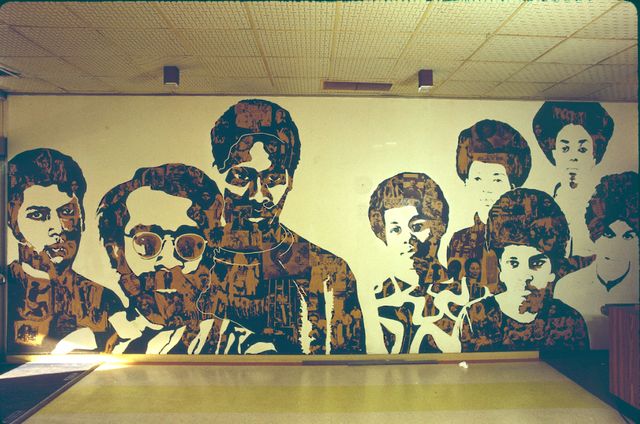

"The Black Experience," a mural created in 1970 by UCLA's African American fine art students, will soon be back for public viewing in Ackerman Union.
The mural, which measures 10 feet high by 27 feet wide, is located on a wall next to Panda Express on the first floor of Ackerman Union. A false wall erected in front of it during some renovations in 1992 has kept it hidden for 20 years.
"It was important in 1970, as it is today, to address issues of racial disparity on the UCLA campus, the entire University of California and on campuses across the United States," said Helen Singleton, one of the artists who helped design and create the art piece over an intensive three-week period in the spring of 1970. At that time, said Singleton, UCLA had taken several steps to increase campus diversity, including hiring qualified professors and administrators, and admitting qualified students of color.
"Our mission in creating ‘The Black Experience’ mural was to expand and enhance that effort with a visual representation of the history and experience of African Americans in the United States," said Singleton, who graduated from UCLA in 1974.

UCLA alumna Helen Singleton returned to campus on Oct. 4 for a reception celebrating the restoration of a mural she helped create more than 40 years ago.
"We learned a lot about our history by exploring what images to use," said Garrick, who was a freshman from Jamaica when he participated in the art project. The L.A.-based graphic artist later went on to create several of Bob Marley's album covers before becoming the founder and executive director of the Bob Marley Museum in Kingston, Jamaica.
The movement to uncover the mural gained momentum last fall after members of the Afrikan Student Union (ASU) brought the mural to the attention of the Associated Students UCLA (ASUCLA) board of directors.
"It is a part of the Afrikan Student Union's mission to ensure that all students are fully aware of UCLA’s rich history of social activism and how African people have contributed to it," said Kamilah Moore, a fourth-year political science major and ASU chair.

Kamilah Moore (center) and Neville Garrick (right) believe that "The Black Experience" is an important part of UCLA's history.
Costs for the project will be paid by the ASUCLA board, which will cover all expenses related to uncovering, repairing and restoring the mural. Panda Express will pay to reconstruct and push back the restaurant’s service area, which currently overlaps roughly one-third of the mural, said Roy Champawat, director of the UCLA Student Union. Most of the work is expected to take place over the winter break, he said.
Singleton and Garrick will work in consultation with ASUCLA; Christian de Brer, head of conservation at the Fowler Museum; and Ioanna Kakoulli, chair of the UCLA/Getty Conservation Program, to provide artistic information and advice.
"I am excited to have this work visible again for the UCLA community, and especially today's students," said Singleton. "The mural contributes to the enrichment of all students' experiences as they learn of the various cultures that make up the UCLA community. It is my hope that, as the viewer examines the images, they will want to know not only who or what is depicted, but also the significance of that image in our history and in what ways those issues continue to be relevant today."
She, Garrick and others involved in the restoration project also hope to make contact with the remaining five artists, who have not yet been located, in time for the final reveal.
"We worked diligently on this piece together through those turbulent times," said Singleton, noting that she is unsure if any of them have changed their surnames since graduation. "It would be fitting and joyous for all of us to come together again and participate in the mural's unveiling."