Beginning in the 1990s, Aomar Boum began conducting oral interviews with his father, Faraji Boum, who lived to be over 100 years old.
“I wanted to know what life was like in a small North African desert oasis in the middle of nowhere in the first half of the 20th century,” said Boum, now UCLA’s Maurice Amado Professor of Sephardic Studies.
Among the many stories his father shared over several decades, the most powerful one was a tale both deeply personal and historically significant — his own.
Faraji Boum is believed to have been the last living rekkas of Morocco, a foot courier who delivered letters across vast and perilous distances before the development of the modern postal system. Born in the Lamhamid oasis in the Anti-Atlas region of southern Morocco during the era of French colonialism, he belonged to the Haratine, a Black social group thought to be descendants of enslaved people from West and sub-Saharan Africa.
Under the Moroccan corvée system — a form of forced labor abolished after independence in 1956 — Faraji was compelled to become a rekkas in his early teens. Walking up to 40 miles a day, he delivered letters across the High Atlas, Anti-Atlas Mountains and the Sahara, braving wild animals — including snakes, scorpions and wolves — bandits and unforgiving terrain with little more than his determination and a simple bag.
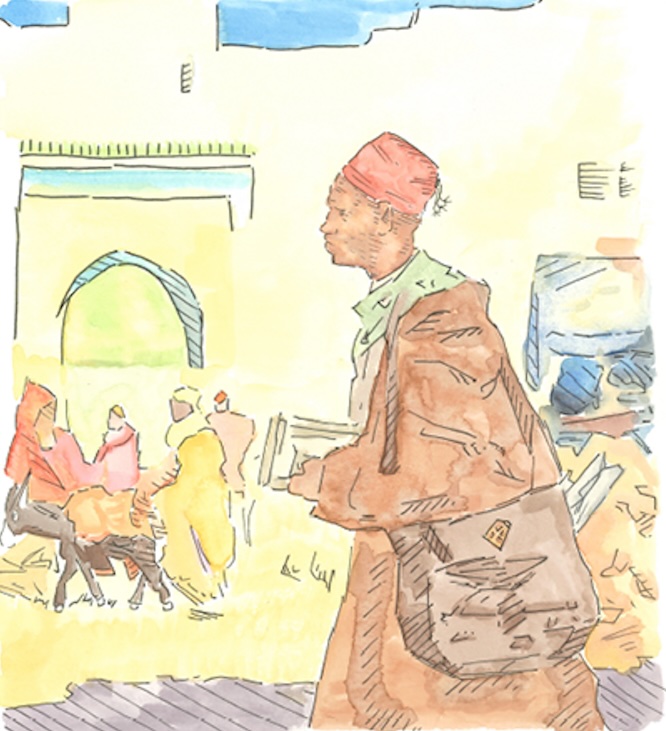
That bag, or chkara, remains a powerful symbol for Boum.
“It’s the only tangible evidence of the thousands of miles my father walked,” he said. “It’s been empty for decades, but whenever I take it out of the closet, it brings tears, emotions and hours of conversation among those who remember him.”
After his father died on Nov. 2, 2023, Boum, an author and professor of anthropology and of Near Eastern languages and cultures at UCLA, began combing through hundreds of hours of recorded conversations to shape the narrative of the man who raised him. As he considered the best approach to share it with the world, his 15-year-old daughter, Majdouline “Maggie” Boum-Mendoza, offered an intriguing suggestion. In January of that year, Boum had written the obituary for his brother while Boum-Mendoza illustrated it; she suggested they replicate this approach to tell her grandfather’s story, jokingly offering to supply the art for “a discounted rate.”
And so, “The Last Rekkas,” a graphic history in line with Boum’s previous success as an award-winning author, was published, marking an important milestone in multiple ways.
“Societies around the world remember the names of kings and queens,” said Boum, who was recently inducted into the National Academy of the Kingdom of Morocco. But this is the first time the history of rekkas — including my father, an illiterate, marginalized man from a remote oasis who endured forced labor — has ever been documented to this extent.”
Just as meaningful, the father and daughter add, is the powerful link the project forms between three generations of their Moroccan family.
A legacy recognized: From oral history to becoming history
In early 2024, while Boum and his daughter were still working on the book, enthusiasm and interest in publishing it grew quickly, including from Driss el-Yazami, a prominent Moroccan human rights activist and president of the National Council of Human Rights in Morocco, and Barid al-Maghrib, Morocco’s national postal service.
Although welcomed, this support came with one caveat: The book needed to be ready for the 29th edition of Morocco’s International Book Fair in May and for a discussion at the book fair in Rabat.
It was March.
Despite this tight turnaround, “The Last Rekkas” was successfully published in Arabic, English and French, just in time for the book fair. The book was also showcased in the Mairie de Paris, the historic and administrative heart of the French capital, where Boum-Mendoza had the opportunity to speak publicly about what it meant to her to contribute to the telling of her grandfather’s story.

“The Mairie de Paris is a complicated place for me,” Boum said. “It’s where the orders that forced my father into forced labor were devised and signed. But, to hear my daughter’s voice and my father’s name echoing throughout its walls — that was incredibly powerful. Finally, history was recognizing him.”
Boum hopes that his daughter’s illustrations help young readers around the world connect, relate and understand his father’s plight and shed light on early 20th-century Morocco, illuminating the not-so-well-known connection between the formation of the modern postal service system and the many mail couriers forced into the role.
Though the elder Boum never returned to forced labor after Morocco’s independence, he endured many hardships, including famine, drought and war. Yet through it all, he found peace, purpose and happiness, farming his land with the help of a beloved donkey and mule — feats that served as reminders of how far Faraji Boum had come — and astonishing his son with stories of survival, cunning and strength.
“For somebody who went through everything he did,” Boum said, “I used to believe that my father held a lot of hate in his heart, but in one of our interviews, he made his position very clear: ‘Why would I hold on to hate? I will never be free if I do. You have to learn to forgive if you want to move forward in life.’”