What if the solution to data centers’ extensive energy use and a finite resource — water — was sitting idly in your pocket?
A decentralized cloud computing solution was one of several innovations presented during the UCLA Anderson School of Management Easton Technology Management Center’s sixth annual Cross-Campus Innovation Challenge sustainability pitch event April 18. The challenge called on students to think about the world’s biggest problems — and opportunities — and how technology can help solve them.
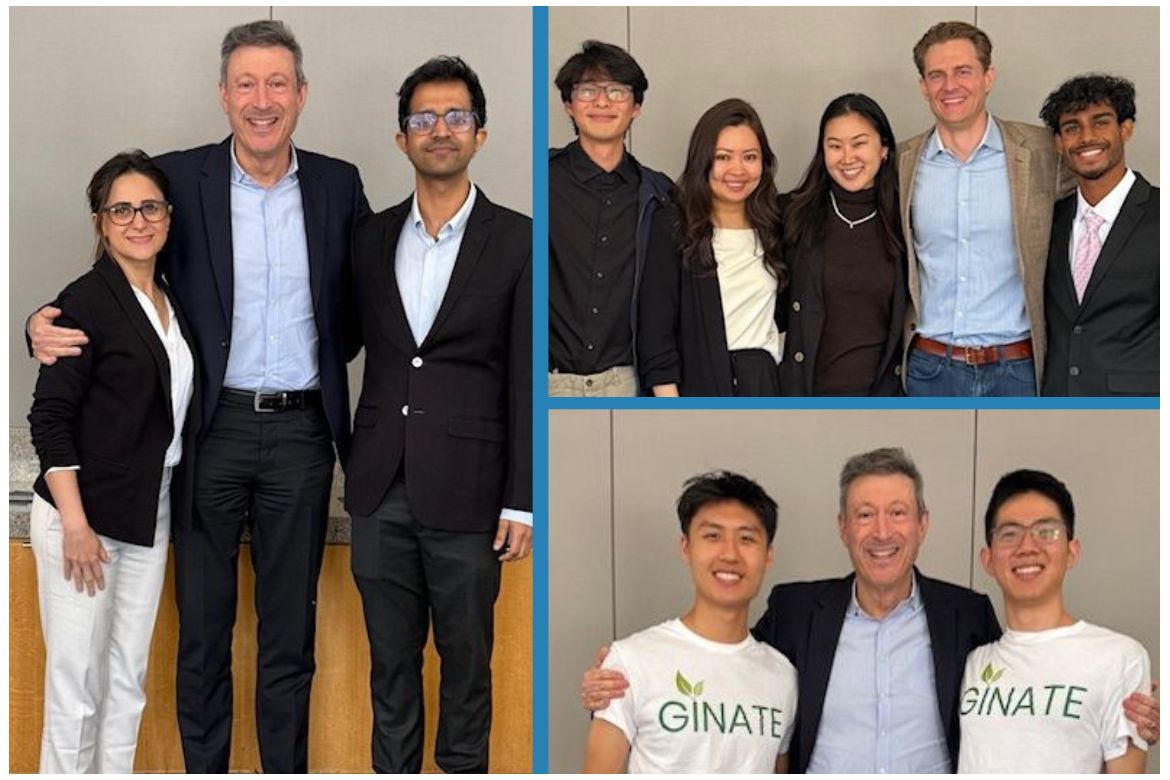
Five teams of students, faculty and company founders pitched their businesses and products to a live audience and a panel of judges at the UCLA Anderson School of Management. At stake for the three winners were prizes totaling $90,000 and advisory support to help the initiatives become successful ventures.
“The range, creativity and impact of the sustainability solutions were very impressive and remind me of the incredible capabilities we have across UCLA when we bring talent, ideas and expertise together,” said Terry Kramer, Easton Technology Management Center’s faculty director.
One winning team was Asearis, the company working to counter data centers’ rising environmental and financial impacts. They showcased its patented security infrastructure that will turn unused capacity from cell phones and personal devices into cloud computing capacity, cutting costs, avoiding some physical infrastructure costs and potentially helping to bring cloud services to emerging markets that cannot build the infrastructure.
“Emissions are growing to be a mile high, and so is demand for the cloud and the market,” said Agathiya Tharun, the company’s software developer. “Existing data centers are very expensive, unsustainable and slow. Wouldn’t it be great if we could solve just one of these issues? Asearis solves all three.”
The second winner was OpalAI, which, in conjunction with UCLA Engineering, is developing FireVision, a proactive wildfire risk assessment and mitigation planning tool for wildland-urban regions. Their new method uses artificial intelligence technology and space agency satellites to build faster vegetation growth mapping. FireVision also offers localized weather insights for risk analysts and utility operations; an updated daily fire potential index; and FireGPT, a tool that translates data and benefits agency planners and utility risk teams. The proprietary workflow is supported by a NASA Small Business Innovation Research Ignite Phase I contract.
“Look at how wildfires are changing in nature and behavior. Are our tech and solutions changing that fast? The answer is a solid no,” said Ryan Alimo, lead AI scientist and UCLA master’s student in business administration. “That’s why we need to bring the latest best technology from AI that is disrupting the world, as well as space technology from NASA, to solve problems and help our community.”
Gaia Technologies’ organic soil enhancer, Ginate, was the final winner, and its product is already on the market. Made from nutrient-rich lignite and meant to replace commercial fertilizers, Ginate is made through a patented process that combines an electrochemical process with a biodigestion process to break down complex carbon chains and makes it easier for microbes and plants to pick up. It has the potential to be used for mass crop agriculture, commercial and residential landscaping, and has been used by the cities of Denver and Fort Collins, Colorado.
The finalists also included NexAI, a company that has earned a grant from the U.S. Department of Transportation. Starting with a pilot program in Los Angeles that will expand to 35 cities, the company uses AI, LiDAR (a sensing method that utilizes laser light) and high-resolution mapping in a decision-making tool — which the team says has not been used in transportation before — to help urban planners to model scenarios like adding bus and bike lanes to see what the costs might be. The tool currently creates maps for assets like pavement metrics and signage.
The fifth company, HYenergy, aims to strengthen the hydrogen ecosystem by transforming wastewater into a resource for on-site hydrogen production for industrial and freight transportation needs, such as heavy-duty trucks, buses and heavy machinery at sites like the Port of Los Angeles. Their pilot program would use three patented catalysts developed by the Huang Research Group’s Lab at UCLA, designed to enhance electrolysis performance, increase the life expectancy of fuel cells and enable efficient hydrogen production from non-ultrapure water.