Watch a slideshow of the chancellor's first year in office.
When UCLA Chancellor Julio Frenk is asked about the books that shaped him, he doesn’t rattle off titles or talk about time spent in libraries. Instead, he reminisces about the train journeys he took in his youth, when he carried in his backpack Gabriel García Márquez’s “One Hundred Years of Solitude” and a notebook to capture all he was seeing, feeling and learning along the way.
That deeply engaged, connected approach to people and the world — one that has defined Frenk’s long and storied career in academia, government and public health — comes through often when the chancellor looks back at his first year at the helm of UCLA.
A year shaped by crises — and connection
For Frenk, 2025 began unexpectedly — and tragically. On Jan. 7, just the second day of his first full week as chancellor, he was confronted by one of the worst disasters in the Los Angeles region’s history as fires scorched a path of destruction through Pacific Palisades and Altadena.
It was only the first crisis to put UCLA in the national spotlight. Just months later, the new presidential administration began to suspend hundreds of millions of dollars in research grants to the university from the National Institutes of Health, the National Science Foundation and the U.S. Department of Energy, jeopardizing the lifesaving and life-changing research of UCLA scholars.
“Emergencies don’t announce themselves,” Frenk recently told Álvaro Castillo, host of the UCLA College’s “Tell Us What You Know” podcast, in a wide-ranging conversation about his first-year experiences. “You always need to be ready to pivot.”
While the unfolding fire catastrophe derailed Frenk’s immediate plans for his Listening Exercise — conversations aimed at fostering connections and understanding among the chancellor and faculty, students, staff and others across the university — the Bruin response embodied that connectedness, as the campus came together as a community, Frenk said.
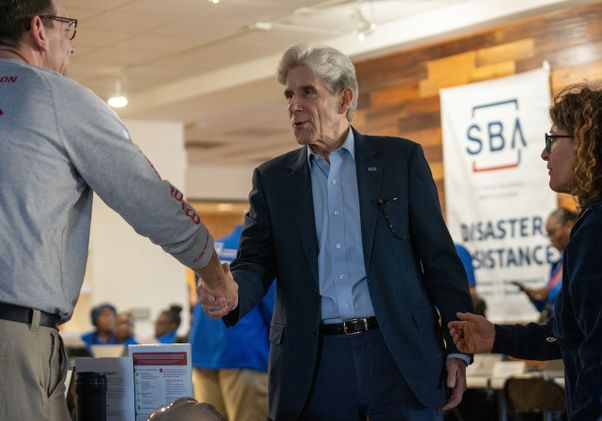
Indeed, the fires brought out an unprecedented spirit of compassion, generosity and support as Bruins rallied to support and check in on one another, launch basic needs drives, provide housing and emergency financial assistance, treat the injured, set up and help staff a disaster recovery center at UCLA Research Park and devote their knowledge and expertise to the city in its recovery and rebuilding efforts.
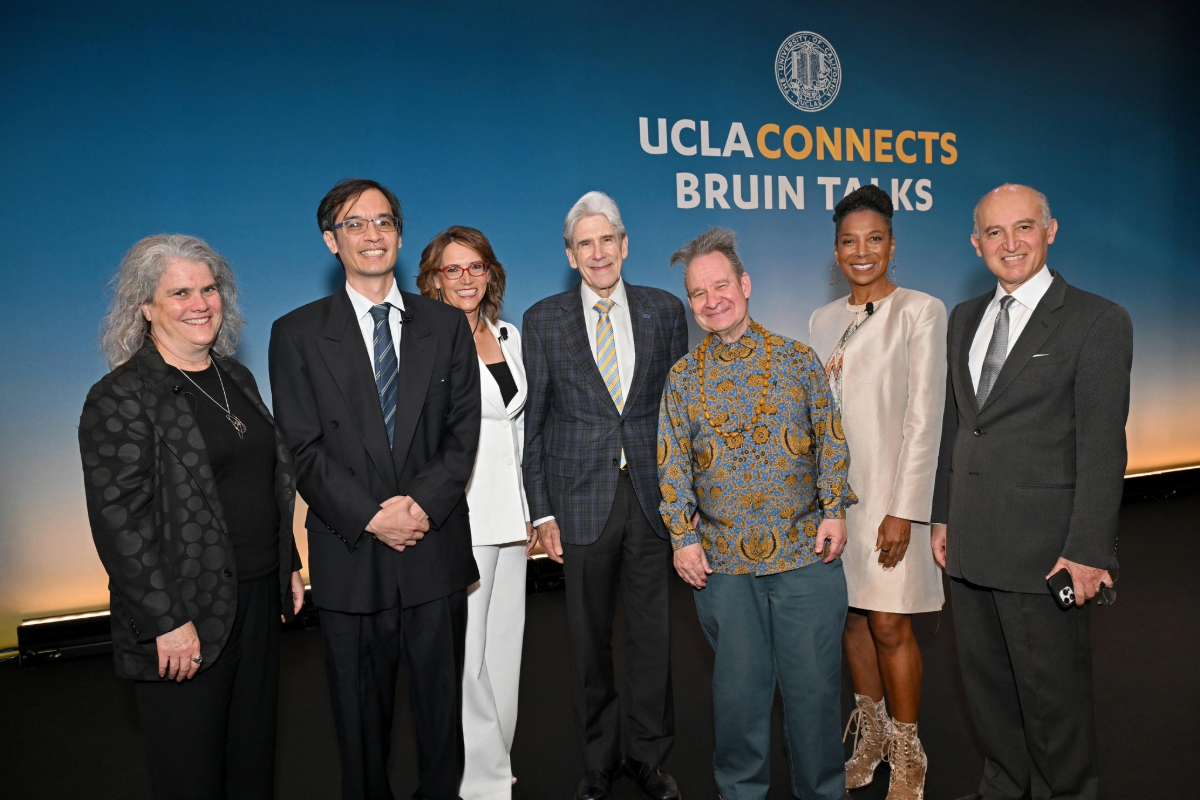
Galvanized by the response, Frenk launched UCLA Connects, a universitywide framework for working, collaborating and communicating designed to encourage even deeper, more meaningful connections among members of campus while building stronger bridges to the city’s communities and the wider world.
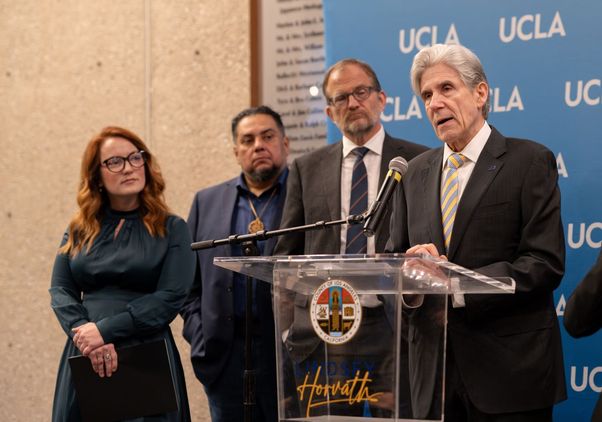
Looking back, he told Castillo, the fires were a moment that, in large part, shaped his understanding of UCLA and Los Angeles. “It was both an accelerated introduction to the internal community and an early opportunity to connect with the external, larger community of which we are a part,” he said.
It was also an opportunity for the campus and community to quickly get to know Frenk, his compassion, his thoughtfulness and his clarity of purpose. From the beginning of the crisis, Frenk prioritized direct and daily on-the-ground communications shot on a cellphone and posted on YouTube and social media, rather than texts or studio-produced messages, to keep everyone abreast of developments, signing off each time with “We are One UCLA.”
“It is critical to communicate,” he said. “In an emergency, every silence from the authorities is filled with people’s worst fears. … You need to be telling everyone in the community what's going on.”
Most people, Frenk said, don’t even know what a chancellor looks like in the first week of his arrival. Nine million YouTube views later, there can hardly be a Bruin that has not seen or heard Frenk’s messages to stay engaged and stay connected.
Frenk’s inauguration and his collective vision for UCLA
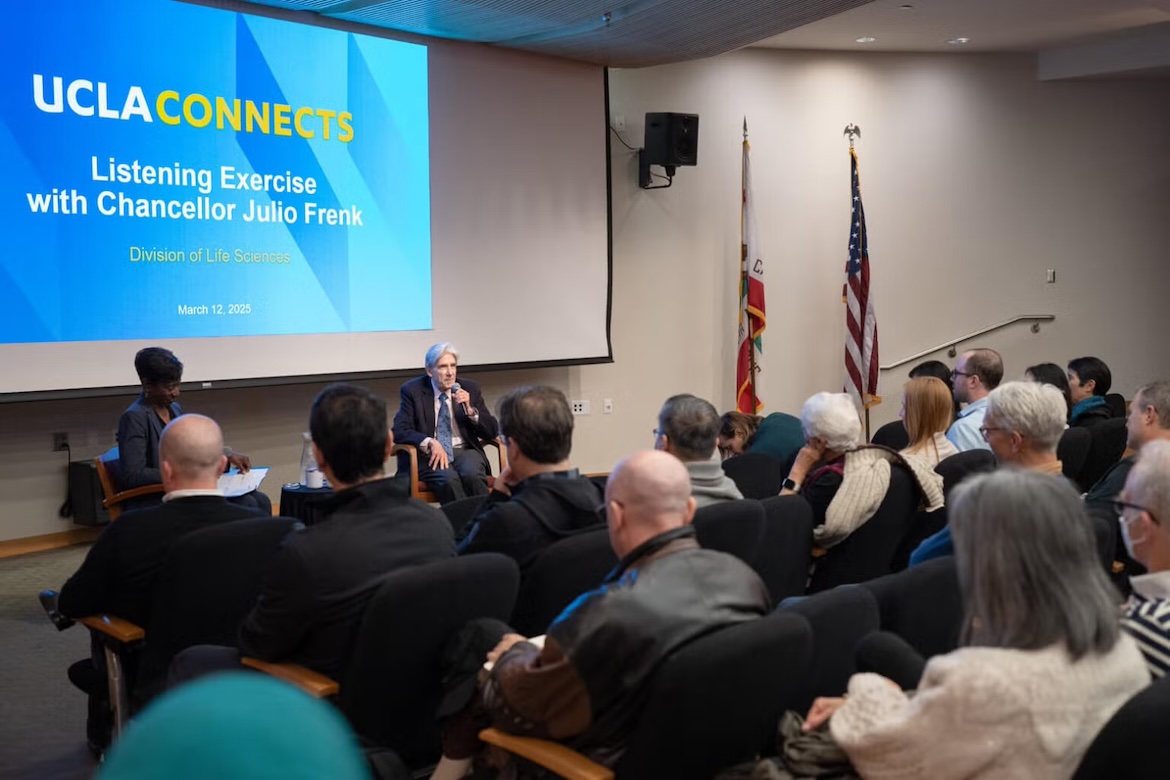
A month after the fires, Frenk launched his ambitious UCLA Connects: Listening Exercise, a series of 38 intensive, immersive group conversations that by its wrap-up in May had included some 6,300 Bruins from every school, unit and administrative area across campus. The goal, he said, was to listen to everyone “with open ears and an open heart,” and to deepen his understanding of the campus’s diverse concerns, hopes and expectations. What he gleaned from those sessions helped shape his approach to his chancellorship and chart a course — what he describes as a “collective vision” — for UCLA’s future.
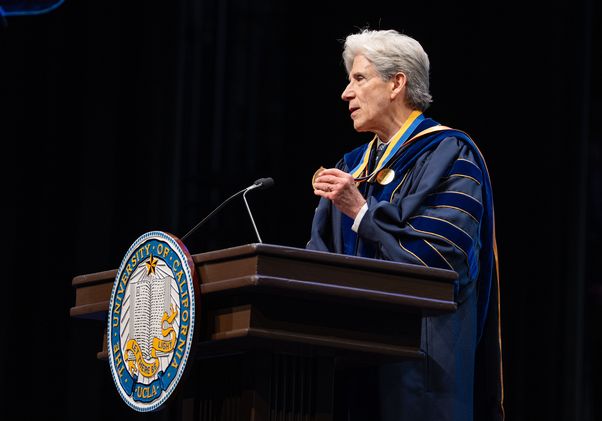
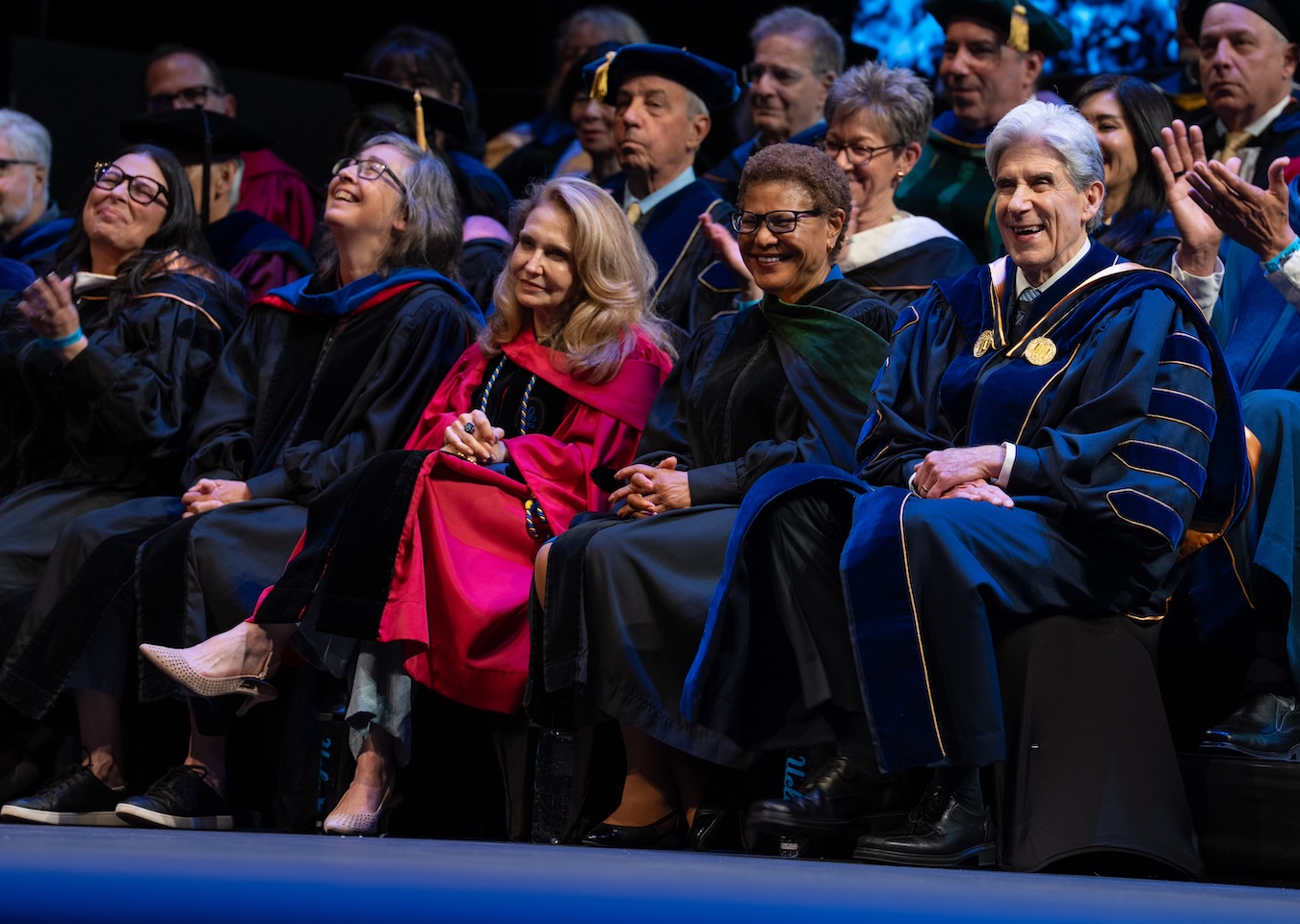
In June, he presented that vision at his inauguration, an event attended by local and global leaders in higher education, government and civic life. In his inaugural address, Frenk outlined three defining aspirations for the university: UCLA must be a connective institution that strengthens ties within our campus community and between our campus and the outside world; an impactful institution that pushes forward with creating solutions to the most pressing problems; and an exemplary institution that embraces values that set an example for the rest of society.
In the months since, those overarching goals have been refined strategically under the university’s “One UCLA” plan, which features four flagship initiatives aimed at maintaining and advancing UCLA’s status as one of the world’s top comprehensive research universities. They include UCLA Connects — the initiative that emerged from the Los Angeles fires — the UCLA Research and Innovation Blueprint, UCLA for Life and Effective UCLA.
Responding to the attack on UCLA research and education
Throughout his tenure, Frenk has emphasized the transformative power of public universities. “Universities are among the most enduring institutions,” he said on the podcast. “We are motors of innovation and change against the backdrop of continuity that defines what we call a civilization.”
That is why the federal government’s suspension of more than $580 million in vital research grants to UCLA in July was so devastating, he said. Longstanding government investment in university research has yielded immense benefits to society, Frenk stressed — including at UCLA, where federally funded breakthroughs have ranged from the development of the internet to game-changing treatments for cancer and other diseases.
“Almost every innovation that has improved the quantity and quality of life in these 80 years originated in basic research carried out at universities,” Frenk said.
Today, thanks to court orders issued after the federal action, nearly all UCLA’s research funding has been restored — for the time being. The university continues to advocate for its academic and research mission in tandem with the UC system through a strategy combining legal action, negotiation, mitigation efforts to provide temporary funding for research, and communication.
Frenk has been clear that the grant suspensions — based in part on accusations of antisemitism stemming from campus protests in 2024 — have targeted important research projects that “are unrelated to the problem that the government supposedly is trying to address.” At the same time, he has stressed that self-reflection and continuous improvement are vital elements of the university’s mission, especially in an environment of eroding public trust in higher education.
Even before the suspensions, Frenk had redoubled campus efforts to fight discrimination and bigotry in all its forms, creating the Initiative to Combat Antisemitism and helping to open new channels for respectful discussion and debate. Throughout the year, he has been a familiar face at workshops, community-building exercises and antidiscrimination trainings through campus initiatives like Dialogue across Difference that foster empathy and active listening among Bruins who find themselves on opposite sides of difficult issues.
Building a culture of connectedness, belonging and respect
Part and parcel with his concept of universities as bastions of pluralism, Frenk believes passionately that UCLA must foster an environment in which all people feel not only heard but safe in their right to express themselves without fear of discrimination, harassment or violence based on their identity or their ideas.
That approach to diversity and understanding is closely bound up with his own story, both as UCLA’s first Latino chancellor and as the child of a refugee. In the 1930s, Frenk’s grandparents, along with his 6-year-old father and 4-year-old aunt, fled rising antisemitism in Nazi Germany and found safe haven in Mexico. They didn’t speak the language and were unfamiliar with the culture. Still, they were given the opportunity to settle and build a new life.
“My grandparents were fortunate enough to be able to flee … and be welcomed in a country that took them in as if they were one of them,” he told Castillo during their conversation, part of which was conducted in Spanish. Frenk characterizes Mexico’s graciousness as “the defining event in my life,” an act of generosity that secured not only his own future but the future of his six siblings — and their children.
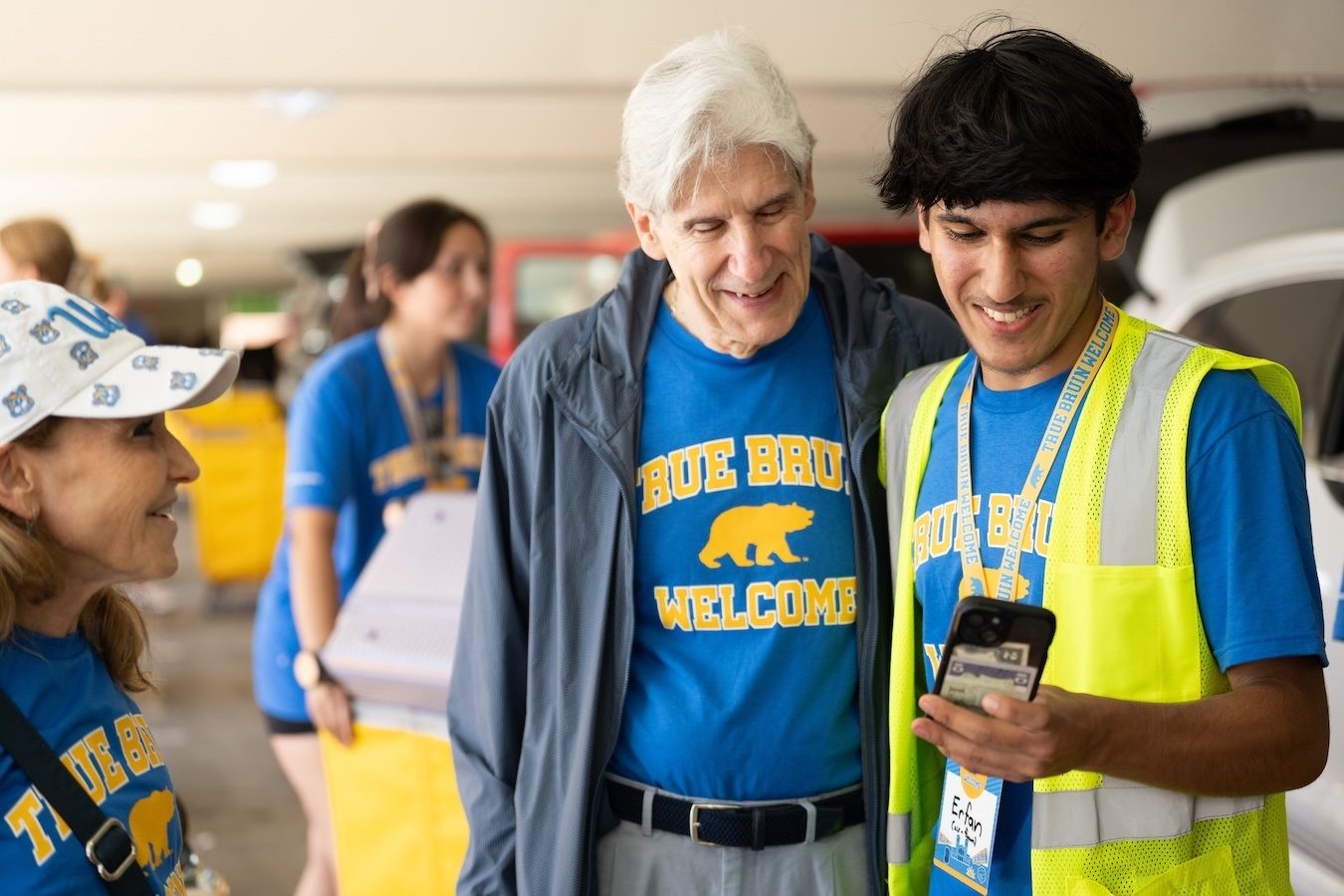
“We are all built out of acts of generosity and support from others,” he said. “And that has been a guiding concept — the need to offer that same kindness that saved my family’s life to others, to strangers, to people who are different.” That moral imperative, which Frenk says spurred his career in public health and service, has also informed his vision of UCLA as an inclusive, welcoming, supportive institution that fosters an environment in which all students can thrive.
And as UCLA’s first Latino leader and the head of an institution that has long served as an engine of advancement and social mobility, Frenk understands that he represents a sense of opportunity and possibility for others, particularly the 25% of first-years and 40% of transfers who are first-generation students.
“You can start in a very disadvantaged position — like my grandparents were, as part of a persecuted minority — and one or two generations later be able to realize dreams that would have seemed impossible,” he said.
Perhaps most importantly, Frenk recognizes that at a time of division in the nation and the world, UCLA has the potential, and the obligation, to model for society how a diverse community — representing various backgrounds, nations and religions — can unite around common ideals while demonstrating respect for one another.
“Each of us is all of us — in a very deep sense,” he said. “When we look at the person who … looks different or prays differently or loves differently or sounds differently when they speak or has different beliefs, we should celebrate that — not oppose it through discrimination or hate. That is the richness of our common family. … That’s why universities exist, and I am committed to making sure that this is exactly the spirit that prevails here at UCLA.”
Julio Frenk's first year in photos