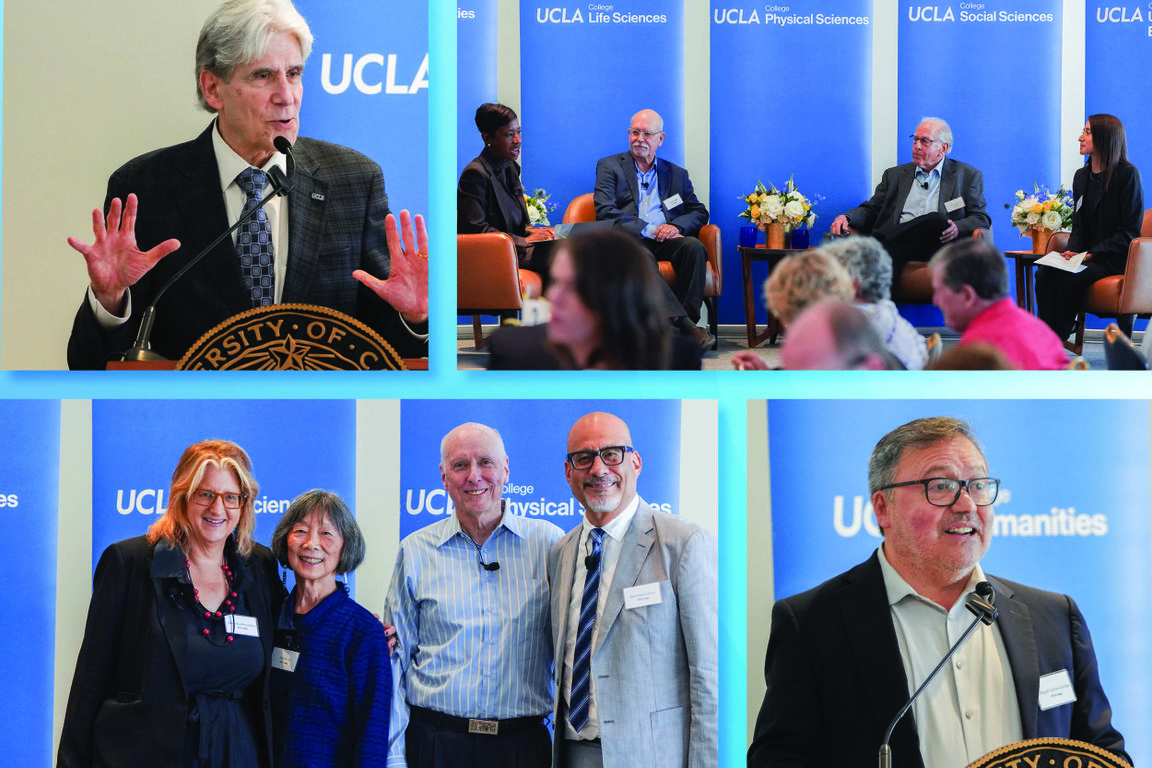
In addition to their invaluable service as scholars, researchers and educators, UCLA faculty and emeriti make a powerful impact in another meaningful way — the transformative, tangible difference that comes from their philanthropy. Their contributions are vast and can be measured in everything from new buildings to endowed chairs to student support.
To honor their vision and generosity, the UCLA College gathered more than 70 faculty and emeriti donors on campus Thursday, June 12, for a celebratory lunch featuring two panel discussions. The event was fittingly held in the UCLA University Club’s Morrison Room, named in recognition of the generosity of longtime professors and philanthropists Sherie and Donald Morrison.
“We are deeply grateful for your contributions in any form — your generous gift of funds, of time, of talent, of mentorship, of research, of teaching and more,” said Miguel García-Garibay, senior dean of the UCLA College and dean of physical sciences. “In countless ways, you are setting the definitive example for the next generation of leaders and helping us shape a brighter future for all.”
Making an impact
Years of experience in their departments and personal passions give professors insights into where funding can have the greatest effect.
For example, when Pauline Yu, professor emeritus in the department of Asian languages and cultures, concluded her deanship in the division of humanities in 2003, distinguished alumni Shirley and Ralph Shapiro gave a gift in her honor. When asked where it would be best used, Yu proposed creating an endowed fund for graduate student support — an area in which she also personally contributed.
“I knew both as a faculty member and as a dean how hard it was to get graduate student funding, especially for international students,” Yu said in the first of two panel discussions at the luncheon. “Graduate students are the linchpin of the whole academic operation, but that can be difficult for those outside of it to understand.”
Moderated by Alexandra Minna Stern, dean of humanities, and Abel Valenzuela, dean of social sciences, the first panel featured Yu and Scott Waugh, professor emeritus of history, former dean of social sciences and former executive vice chancellor and provost. The group discussed many topics, including how their unique academic journeys and leadership roles had shaped their view of and goals for their philanthropy.
The other guest on this panel, Waugh, also spoke from personal experience about the power of giving back. In 2015, in recognition of Waugh’s service to the university, distinguished alumni Meyer and Renee Luskin joined Ralph and Shirley Shapiro to establish an endowed chair in the division of social sciences in his name. In addition, Waugh himself helped establish the Stuart C. Waugh and Scott Waugh Endowed Scholarship with his father’s estate. He also has provided continuing support for the scholarship, geared toward undergraduates in the honors program at UCLA, Waugh’s academic home since his own undergraduate years.
“We’re all responsible for our institutions,” Waugh said. “We’re all in this together in the good times, but especially in the bad. By giving to the university, I’m doing a very small political act and saying that this is where my values lie, and I want to help preserve them.”
Philanthropy for the future
The second panel, featuring faculty in the sciences, was moderated by Tracy Johnson, dean of life sciences, and Adriana Galván, dean and vice provost of undergraduate education. In light of devastating recent and proposed cuts to federal research funding, the conversation shifted toward the renewed importance of philanthropy in the sciences.
“Grant cancellations in the sciences are changing the entire landscape of what we do,” Johnson said. “Philanthropy has always been important to us, but now that gratitude hits home even more.”
Also on hand for the second panel was Rich Turco, professor emeritus of atmospheric and oceanic science and founding director of UCLA’s Institute of the Environment and Sustainability. He and his wife, Linda Turco, established the first endowed faculty chair in the department of atmospheric and oceanic sciences. They had earlier funded an AOS endowment that provides fellowships for outstanding graduate students. More recently, through the IoES, the Turcos created an endowment that will provide support for undergraduate and graduate students seeking environment-oriented degrees.
“Supporting the sciences is about survival,” Rich Turco said in the second panel. “Humanity is not going to survive unless we support and advance science. We have to keep developing knowledge and technology for agriculture, for health and for all of these institutions we’ve built up. I would say the humanities and social sciences are necessary to tie everything together and make it work, but science must provide the means of survival.”
The other panelist in the second conversation was Jerry Zack, a distinguished professor and current department chair of microbiology, immunology and molecular genetics, who spoke about how he has been inspired by the example of the aforementioned Sherie Morrison.
“UCLA has nurtured me my entire career,” Zack said. “It’s the colleagues here, and being able to support them; that, I think, is really important.”
Echoing the vision he laid out for UCLA’s future in his recent inauguration, Chancellor Julio Frenk closed the event by expressing his appreciation for the dynamic, world-changing role played by UCLA’s professors in all their capacities, from the academic to philanthropic and beyond.
“To me, a newcomer who has experienced many other institutions, this is truly an extraordinary place,” Frenk said. “I’m inspired by all of you — members of our own community leading by example — because philanthropy is one of the best ways to rebuild trust in the university. Every time someone gives a gift to UCLA, we are sending a message that this institution is worthy of the public’s trust, and it is indeed a voice for good.”



