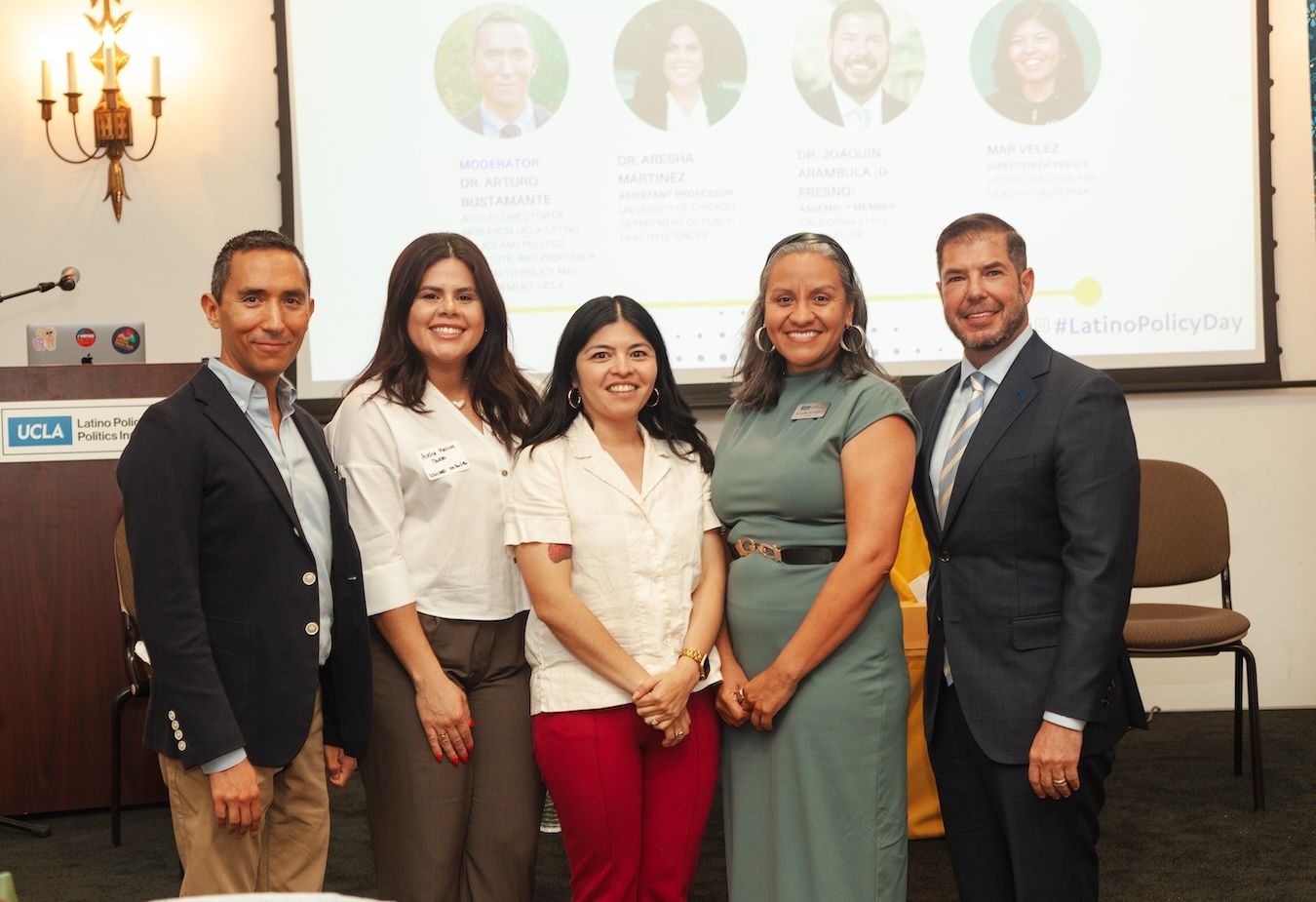
Earlier this month, the UCLA Latino Policy and Politics Institute hosted its inaugural Latino Policy Day, drawing more than 200 faculty, students, alumni, and policy leaders to UCLA’s Hershey Hall for a half-day-long program highlighting UCLA research that addresses critical challenges facing Latino communities.
As both a call to action and collaboration, the May 15 event reinforced the role of public universities like UCLA in shaping policy through rigorous, equity-focused research.
“We conduct research, support faculty research and amplify this work by putting data and facts into the hands of legislators and organizations who can use it to advocate for policy solutions for our communities,” said Amada Armenta, faculty director of the LPPI. “Latinos are central to California’s present and future — and we matter on this campus.”
The program began with a panel of UCLA alumni and former policy fellows from the institute, who discussed how LPPI and their time at UCLA prepared them for their careers. The main program featured three research presentations by institute faculty experts, each followed by a panel with issue-area leaders.
In the first session, Cecilia Rios-Aguilar, professor and associate dean of equity, diversity and inclusion at the UCLA School of Education & Information Studies, presented research about California’s community college bachelor’s degree programs, examining their potential to expand educational and economic opportunity for Latino students — and the reforms needed to improve access and completion rates. A subsequent panel moderated by Silvia Gonzáles, LPPI director of research, discussed strategies to close racial and socioeconomic gaps in higher education attainment.
Next, José Loya, an assistant professor at the UCLA Luskin School of Public Affairs, presented research on the challenges facing Latino and Black homeowners, who are less likely to be approved for mortgage refinancing than similarly situated white and Asian homeowners. Following Loya’s presentation, a panel offered policy recommendations to remove structural obstacles to home financing and improve data reporting under the Home Mortgage Disclosure Act.
In the final panel, LPPI faculty expert Aresha Martinez-Cardoso, an assistant professor at the University of Chicago, showed how expanding health insurance access to undocumented immigrants — using Illinois as a case study — can improve community health outcomes and reduce financial strain on hospitals. Following Cardoso’s presentation, Arturo Vargas Bustamante, director of faculty research at LPPI, led a panel discussion on how California can implement similar programs.
During closing remarks, California Assemblymember Dr. Joaquin Arambula encouraged attendees to engage in shaping the future of policy.
“No matter what career you’ve chosen, you can always take part in our democracy,” he said. “Government is better off with us, and we need more people with lived experience willing to stand up for our communities.” The program closed with a courtyard reception celebrating the contributions of faculty, students and advocates working to advance equity across California.