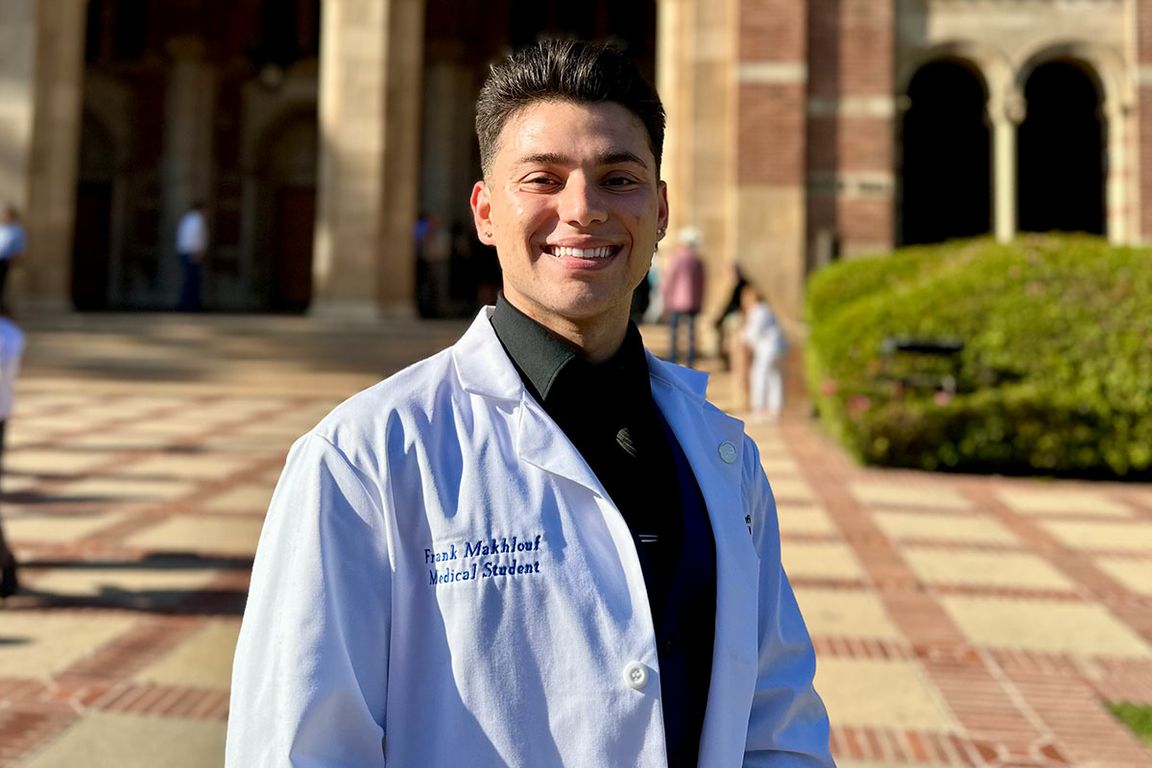
Second-year medical student Frank Makhlouf remembers being a child in Homs, Syria, and witnessing his mom coming home with blood stains on her clothes and crying a lot in bed. He says the first bullets of the civil war — that started with an uprising against Syria’s then-President Bashar al-Assad — were fired just a few blocks from home. “We were in the dead center, right in the middle of where the war broke out,” he recalled.
His mom was a licensed dentist, but like many others with any training in health care fields, when war broke out, she was needed at a hospital clinic and ended up practicing medicine and treating people with bullet wounds.
Makhlouf, 11 years old at the time, was told by his parents to stay home with his sister, who was four years his junior. He knew his parents were protecting them, but he felt trapped and helpless.
A year and a half later, his family ended up coming to the United States on a vacation visa, but they gained official refugee status when the airport in Syria was bombed while they were visiting an aunt in Northridge.
Before the war in Syria, Makhlouf’s family led a middle-class lifestyle. His dad had been an engineer working for a Chinese company that introduced 3G to the country. As refugees, the family moved to Porterville, California, where his dad worked at a Super 7 gas station until he was held up by a person with a machete. The incident led his father to go back to school to earn his master’s and Ph.D. in the United States.
His dad now runs technology for the Tulare River Indian Tribe government and business enterprises.
Thanks to his parents, Makhlouf knows what it is like to work hard and start from nothing. He is also clear on how he found his calling in medicine, with plans to pursue residencies in both internal medicine and pediatrics.
“Watching my mom and developing a love of science and human interaction, medicine checked all the boxes for me. Also, working with children. The alternative would be teaching high school science,” he said.
While fulfilling his volunteer responsibilities, answering emails for the Arab Health Organization — a group of students, residents and faculty fostering an Arab health care community at UCLA — he came across a request from the International Refugee Committee (IRC).
The organization requested assistance finding Arabic-speaking health care providers for refugees coming from the Middle East. No one at the IRC locally spoke Arabic.
Makhlouf jumped into action.
“There was not only the challenge of finding out which doctors spoke Arabic, but which dialect, as Arabic is different in all the Middle Eastern countries,” he said.
Makhlouf set out to help the IRC request by request, patient by patient, by building a spreadsheet of Arabic-speaking physicians — primary care and with specialties, along with information about which insurance they accepted.
Through calling doctors’ offices and clinics directly, he has helped find hundreds of doctors for refugees from Lebanon, Syria, Morocco, Saudi Arabia, Yemen, Egypt, Palestine and Iraq, among others.
“None of this felt like work,” Makhlouf said.
While continuing his demanding medical school coursework, Makhlouf continues to update the list.
Recognizing that there were more obstacles to successfully navigating health care even after initial visits to a doctor for diagnoses, Makhlouf helped develop a family mentorship program.
“In most countries in the Middle East, you just walk in and get health care, like in Canada. There is so much to become familiar with, including co-pays, deductibles; what is a lab?” said Makhlouf, recalling an older gentleman who received a lung cancer diagnosis and needed an oncologist but had no real idea what his physicians were advising him to do.
From July to December of last year, Makhlouf matched each of 12 refugee families with two Arabic-speaking volunteers from the UCLA health care community. Through WhatsApp or FaceTime group chats, these families have been able to get their questions answered on how to better navigate the health care system.
“There’s this feeling that even with so much health care, you can’t quite reach it, which all resonated with me,” Makhlouf said. “We’re often saying, ‘It’s going to be OK; the first couple of months are the hardest.’”
Family mentoring can extend beyond access to health care.
Makhlouf remembers one woman from Syria who was raising three children on her own after her husband died. Makhlouf said she seemed helpless and sympathizing with her situation, he helped her fill out an EBT application over Zoom, as she was unaware that she could get food assistance from the government.
He said he knows what it’s like to come to the United States and start from zero, and his family was lucky to benefit from a network of cousins and aunts.
“Many of the families we work with have had no one,” he said.
Another frequent need for female Arab refugees seeking medical care has been finding female obstetrician-gynecologists who speak Arabic.
There are not many, and Makhlouf has had to track down female Arabic-speaking primary care physicians who own their own practices and will go out of their way to do gynecological or more advanced procedures beyond their regular scope of work.
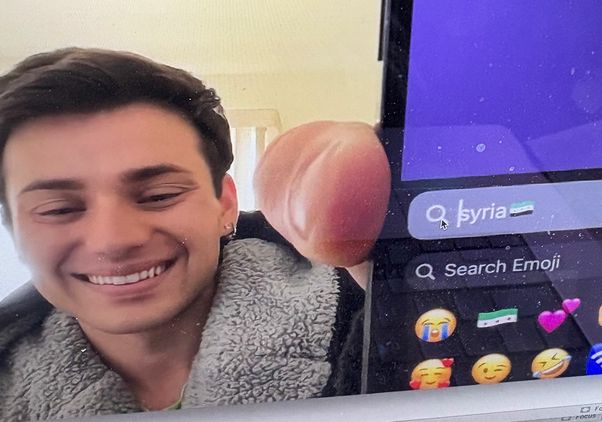
“There’s a solidarity among Arab Americans. Many of us are refugees, many of us are immigrants, and we all know how tough it is. It’s tight-knit,” Makhlouf says of the physicians, students and others in the healthcare field whom the organization has contacted and have gone out of their way to help others in the Arabic-speaking community.
He plans to start the next cohort of the family mentorship program this spring and transition leadership responsibility for the program to MS1s or first-year medical students.
Asked what message he hopes to send during Arab American Heritage Month, Makhlouf said one of greater understanding.
“Arabs have endured much suffering and are some of the most generous, brightest and most resilient people,” he said. “Even when poor, Arabs are still so generous. There is a community mindset of giving and sharing.”



