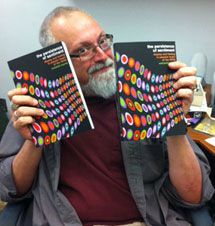
 If Karen Carpenter, Barry Manilow, Barry White, Dolly Parton and Cher number among your guilty pleasures, Mitchell Morris is your man.
In a new book, the UCLA musicologist rises to the defense of these and other ‘70s recording artists who, he writes, "have been as often execrated by would-be tastemakers as they have been exalted by adoring audiences." In "The Persistence of Sentiment: Display and Feeling in Popular Music of the 1970s" (University of California Press, 2013), Morris describes how these performers won a fan base that not only persists to this day but, in some cases, has even grown. He also shows how disdain toward their music often stemmed from a backlash against the era’s seismic shifts in sexual mores and racial divides.
Born in 1961 and raised in rural North Carolina, Morris grew up during the 1970s. He said he built his collection of albums with much of the music he writes about, but purged it in the mid-1980s because he was "so hideously embarrassed by my record collection. Within five years, I was kicking myself," he recalled. He’s been making up for that mistake ever since. Writer Meg Sullivan talked to Morris about the music and changing attitudes toward it. I was lucky enough when I was finishing graduate school to be hired at UCSD, where I taught for three years. That was in the early ’90s before the ’70s were fashionable again. I decided I like this stuff — if you don’t, too bad. So some grad students asked me to sponsor a group study on the ’70s. We also organized a conference, disco dance and library exhibit, and we had a really good time. The department chair then asked me to teach an undergraduate class in pop genres of the 1970s … I realized in teaching the course that I had tons of stuff to say about the subject.  You write about the negative reaction you got when you were putting the book together. Why did people turn up their noses?
What was your goal in writing "The Persistence of Sentiment"?
The book sets out to talk about a lot of things that people find embarrassing. I find embarrassment aesthetically interesting. Often, things are embarrassing to us because … we feel too exposed. We don’t necessarily like to be seen taking our pleasure. That’s one of the reasons, by the way, that the lights always go down in a concert hall. We don’t want to be seen having that experience. It’s a little too private.
Aside from popular music from the '70s, what are you known for?
I’ve been involved in LGBT musicology since its inception. I’ve also written about problems of musical ethics. But I was trained as an expert on the classical music of turn-of-the-century Slavic composers, particularly [the Russian Symbolist composer] Alexander Scriabin. I’ve also done an enormous amount of work on 20th-century opera. And I’ve written several librettos.
How did you come to be an authority on 1970s music?
Teenagers rebelled against Barry Manilow ("Even Now") because he was popular with their mothers.
Music that gives people pleasure and isn’t working really hard to be macho, complicated or authentic is often difficult for people. It’s not Bruce Springsteen or Down With The People. This is glossy pop music. It’s commercial. I just happen to think that just because it’s commercial doesn’t mean it’s bad.
What motivated the original haters of this music?
Why don’t you want to like Barry Manilow? Because it’s your mom’s music! You’re not a middle-aged, suburban white lady, and you don’t want to be thought of that way. Or you don’t want to listen to Dolly Parton because, "People will think I’m a hick!" Or Barry White because it’s too black and too nouveau riche. Disco is a big problem because it’s too black, too Latin and too gay. People dislike certain kinds of music in part because they don’t want to be included among the people who like it. It’s a way of distancing yourself from its constituency.  You extensively analyze Karen Carpenter, but if you had to describe the essence of her appeal, what would it be?
Karen Carpenter had an incredible voice that brought listeners close in and enveloped them in sound with songs like "Superstar."
She had a beautiful voice, and she was an incredibly talented singer. That, we can just stipulate. But what was really interesting is how her voice was positioned within the envelope of the sound. She was miked very close. You don’t hear just pitches. You hear all of the noise produced when the mechanics of your face work to make sound. You hear breaths. You hear those weird little noises that the mouth makes when it’s just trying to form words. There are only two contexts in which you hear those sounds -- during nurturing when you’re a child and during physical intimacy. That’s the only time that people’s mouths are that close to your ear. So, in effect, every Karen Carpenter performance is a profoundly intimate kind of thing.  What about Barry White?
Barry White transmitted physical touch in songs like "Can't Get Enough of Your Love, Babe."
Well, that’s a different kind of intimacy (laughs). He’s doing things that aren’t far off from what Karen Carpenter’s doing, but it’s got a very different physical profile because he’s after a different temporal experience. A Barry White song is extended heavy petting. It’s not just hearing. Touch is involved. Sound is essentially an abstraction of touch. Sound waves hit the ear drum, which vibrates and sends signals through the inner ear to the nerve that gets processed in the brain. But it starts out as a touch.  Why are Cher's "Dark Lady" songs so enduring?
  Dolly Parton appears to use sentimental stereotyping to her advantage as well.
Cher laid bare her outcast heritage in "Half-Breed."
Cher is singing from the point of view of the abject person who is stuck like that. She’s a half-breed. She’s a gypsy, tramp and thief. She doesn’t say, "I’m going to do an analysis of society and explain to you how this works." She says, "Look at me, I’m an individual, and I am pathetic. And you should be nice to me." It’s not necessarily her fault, and it’s a terrible spot to be in. That kind of sentimental stereotyping is very powerful. It goes all the way back to staged versions of "Uncle Tom’s Cabin" in the 19th century as a part of the Abolitionist Movement. Cher probably didn’t realize she was using the approach as effectively as she was. But the songs have achieved an emblematic status.
Dolly Parton played Southern stereotypes to the hilt with tearjerkers like "Coat of Many Colors."
Yes, she plays into all those cornpone stereotypes because my people (Southerners) seem to like that. I don’t know why they like being condescended to, but everyone I grew up with watched "Heehaw." She’s so smart that she can take this and flip it to her advantage.
If I had to summarize the book, I’d say I’m talking about people who are all geniuses. They do things very much on purpose. Some of my colleagues think there’s this commercial machinery that soullessly crushes people into some prepackaged form. The idea is that these artists sold out … As far as selling out goes, why exactly is that bad? Why don’t they have the right to get rich like anybody else?
Many sentimental songs from the '70s have endured and gained new fans. This was especially the case with the work of Karen Carpenter, whose death 30 years ago was mourned so widely earlier this year. Why does this happen?
Any particular style is a mass of conventions. As time goes on, the conventions get more and more embarrassing because they don’t seem invisible anymore. You know they’re there. So there’s a period when everything feels awkward and old-fashioned. Usually in about 20 years, things suddenly become available for reinterpretation. They’re not embarrassing anymore. It reminds me of what Southern churchgoers say about denominations that they view as stodgier than their own: "They’ve been dead so long they don’t stink any more."



