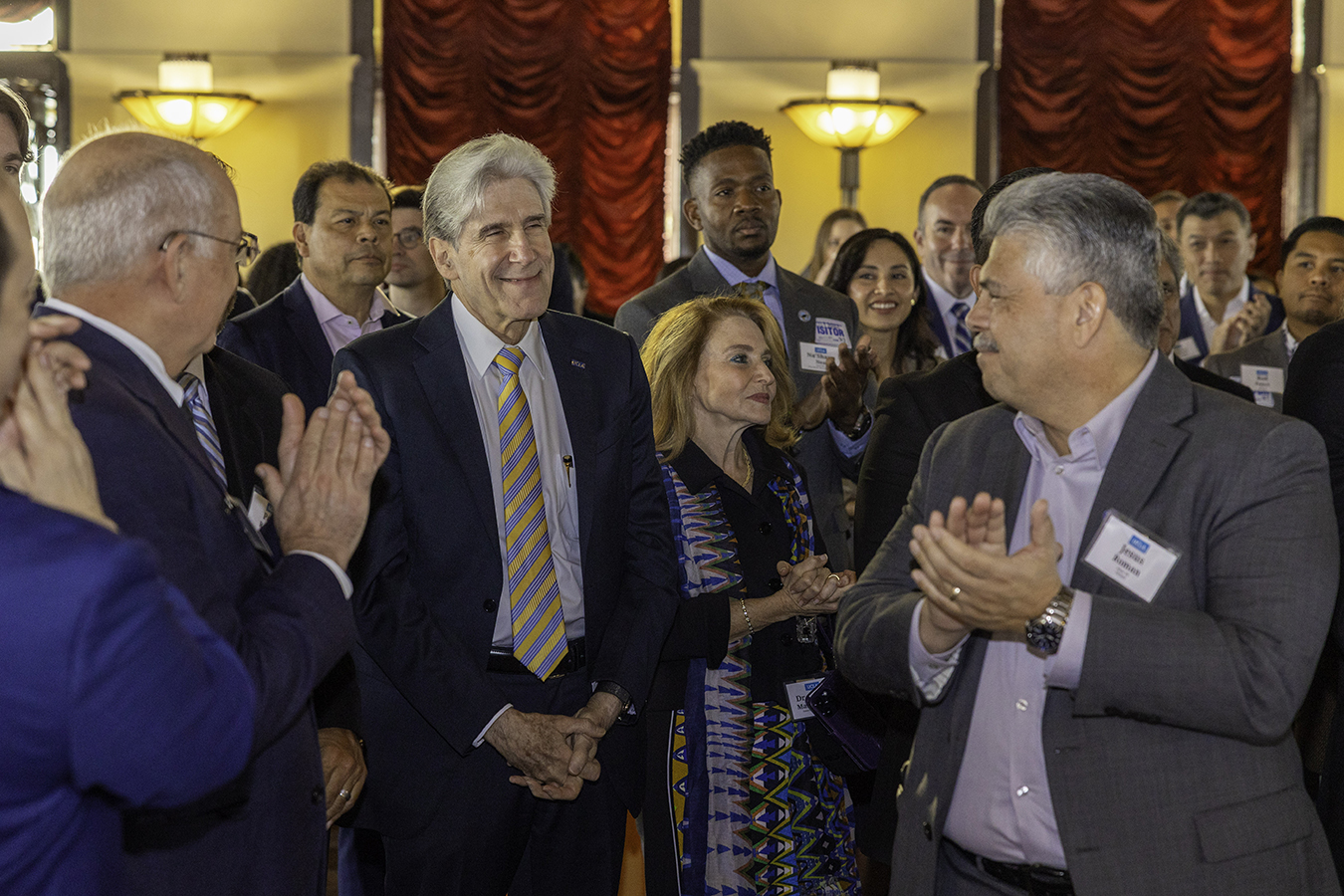
Early Friday morning, March 21, Chancellor Julio Frenk mingled with more than a hundred guests in the Mayor Tom Bradley Room atop Los Angeles City Hall — a space, appropriately enough, named for one of the city’s most illustrious Bruins.
Over a buffet breakfast, UCLA’s newest leader accepted well wishes and chatted with local elected officials and business and community leaders eager to welcome him to the city and to celebrate the long and fruitful partnership between Los Angeles and the university.
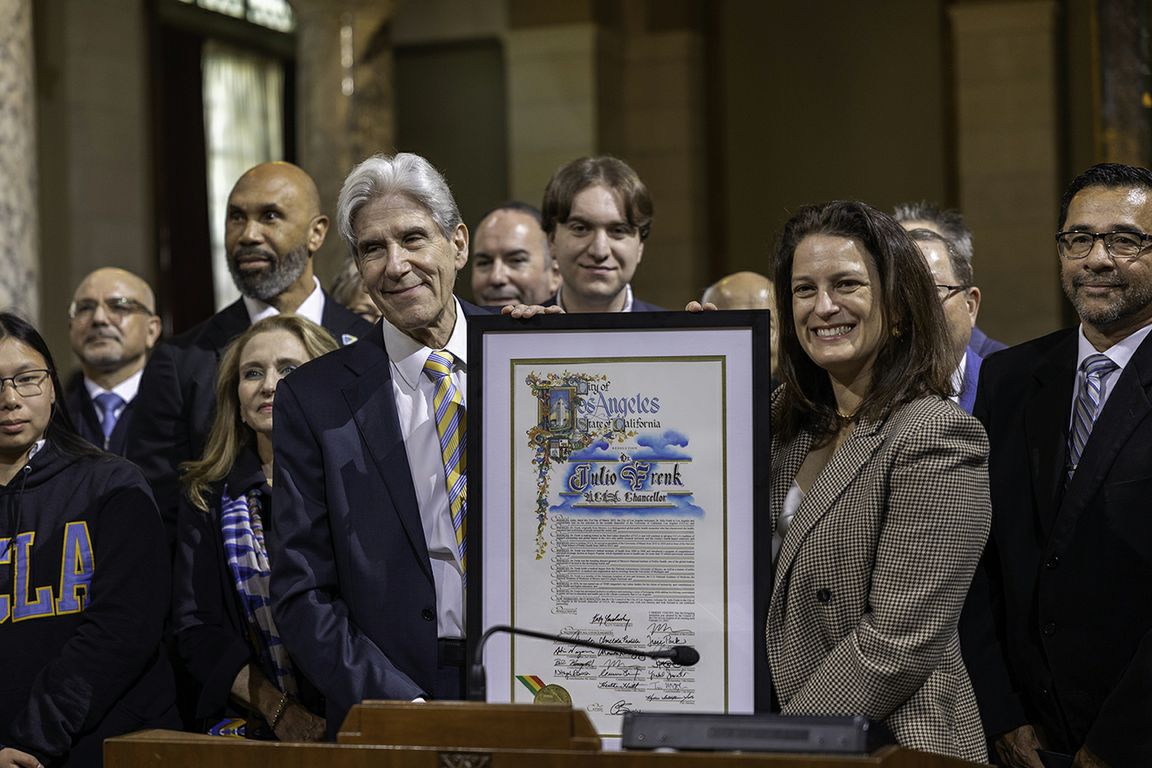
In brief remarks before heading down to City Council chambers to receive an official proclamation of welcome, Frenk spoke to the group about his life’s journey and his embrace of public service as the driving factor in his career — including his decision to come to UCLA.
“For many of you here, public service has driven your own choices in life,” he said. “UCLA stands as your partner in serving the common good. I often say that UCLA is not just a university in Los Angeles but a university of Los Angeles.”
How UCLA and Los Angeles partner to improve the region
The campus and the city have been civically intertwined for more than a century — a partnership of service and education exemplified by the many alumni who have served at City Hall and by the work of faculty, students, researchers, community members and policymakers who collaborate year after year to improve the city and life for its residents.
Today, UCLA has hundreds of community-engaged and volunteer programs operating across the region. Its experts work hand in hand with local leaders on initiatives ranging from clean energy and extreme heat abatement to homelessness, mental health, transportation and wastewater treatment. Its hospitals and clinics play a crucial role in the Los Angeles’ health care system, and together with the Los Angeles Unified School District, it operates several K–12 public schools serving students and families in lower-income neighborhoods. And each year, it graduates thousands of service-oriented students who contribute to the “knowledge economy” of the city.
It didn’t surprise him, Frenk said, to learn that a third of the current 15-member City Council are UCLA alumni. Indeed, four of the last seven mayors have been Bruins — Bradley, Antonio Villaraigosa and Sam Yorty earned their degrees at UCLA, and Eric Garcetti attended the UCLA Lab School.
Julio Frenk: The ways in which UCLA lifts up Los Angeles
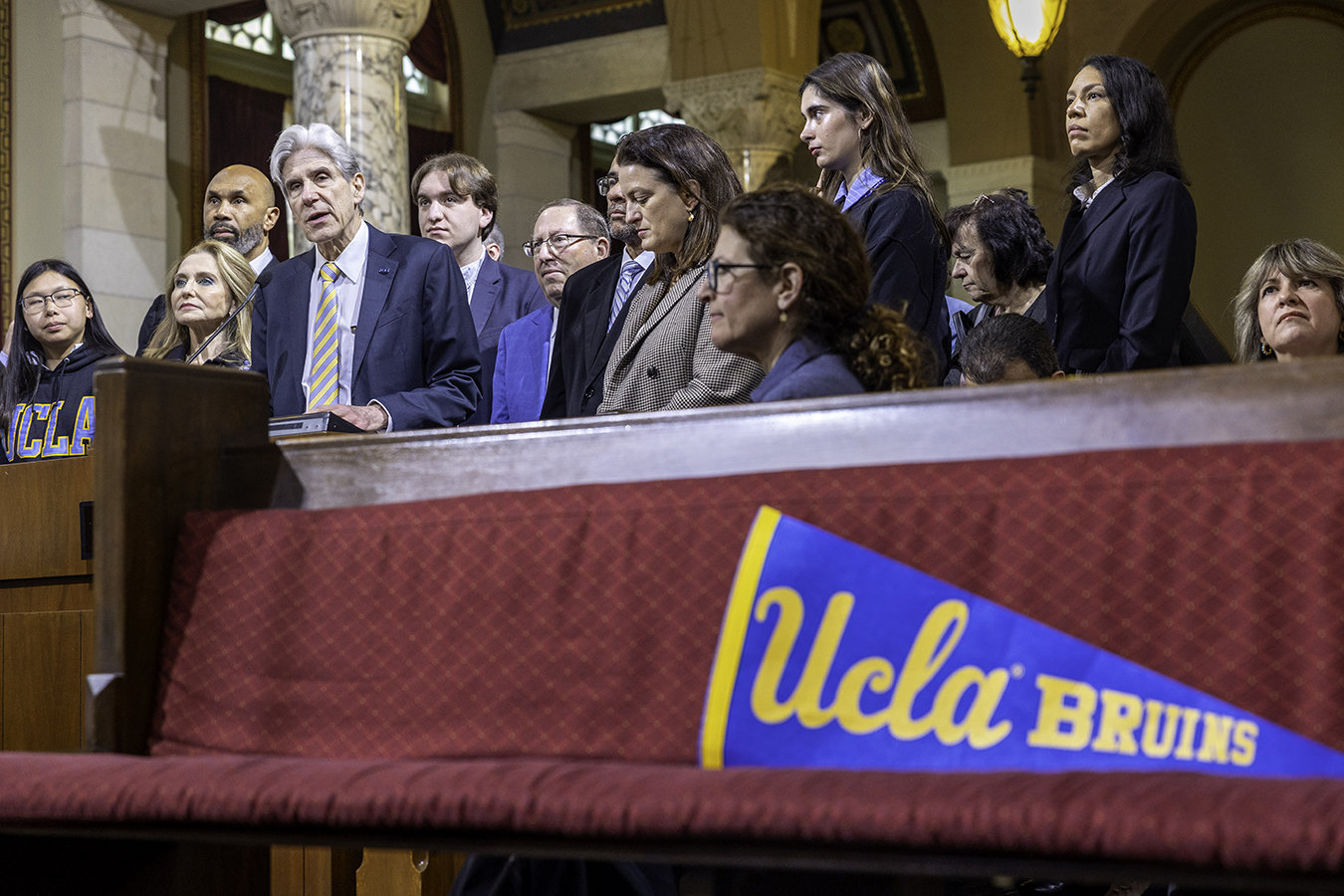
Just after 10 a.m., in City Council chambers, standing next to his partner, Felicia Marie Knaul, and surrounded by UCLA administrative and alumni leaders, Frenk was introduced by council member Katy Yaroslavsky, a UCLA Law School alum whose district includes UCLA, to cheers from the packed room.
“Today, I have privilege of introducing someone who needs no introduction on the world stage but who we’re proud to welcome into the civic life of Los Angeles,” Yaroslavsky said. “I’m honored to present Chancellor Julio Frenk to the City Council.”
You can watch and read Frenk’s full address to the City Council below.
Thank you very, very much, Councilwoman Yaroslavsky. And to all the members of the City Council, thank you for the incredible work you all do to serve the people of Los Angeles.
I was happy to hear that five out of the 15 council members are Bruin alums. But actually, I was not surprised that that was the case — because UCLA is a public university. And that word describes more than our funding model; it describes our orientation to the world, the core of our mission
The UCLA community — and our alumni — are driven by a desire to serve the common good, whether that’s around the world or right here in L.A.
I often say that UCLA is not just a university in Los Angeles but a university of Los Angeles. Our past, present and future are intertwined.
And today I want to talk about three ways in which we try to lift up the city and its people.
First, we connect with L.A. through service. Volunteerism is the link between our UCLA community and the larger world. We saw this firsthand during the devastating wildfires. Bruins worked alongside regional leaders, first responders and volunteers to provide relief. And we were able to donate space at our UCLA Research Park for the disaster recovery center. Over 2,500 members of the Bruin community signed up to volunteer.
Now more than 20 UCLA faculty are helping to reimagine and build back Los Angeles more safely and more sustainably. They are part of an independent blue-ribbon commission we announced with L.A. County Supervisor Lindsey Horvath.
And we have more plans in the works. New spaces like UCLA Downtown — just down the street — as well as UCLA South Bay and the UCLA Research Park, and the Metro D Line extension will make it easier for Angelenos to connect with UCLA.
Second, we are a significant economic driver in L.A. About one-third of our undergraduate students are the first in their families to attend college. This is part of why UCLA has been, for the past eight years, ranked as the No. 1 public university in this country. And we all know that offering those pathways of opportunity has ripple effects across generations.
UCLA is a powerful economic engine. We are the fourth-largest employer in the county. Our research advances lead and help and empower companies and ventures. We actively translate our discoveries into solutions. And we educate the next generation of knowledge workers, health care professionals and community leaders.
Finally, we are a cultural and civic partner. And the partnership works both ways. Our students benefit from living in the creative capital of the world, and we are contributing to that vibrancy every day. We are home to the Hammer and Fowler museums, the UCLA Film & Television Archive, and cultural events bring thousands of people — actually, about half a million people — every year to Royce Hall, the Nimoy Theater and other places.
As a civic partner, we collaborate with LAUSD and community colleges to strengthen educational pathways. And in just a few weeks, a group of UCLA students will be here for Luskin City Hall Day, a way of connecting with city leaders on public policy and governance.
So together, as a city and a university, I am proud of all that has been accomplished in the 105 years of existence as a university. I believe our partnership years, with all that we have to build on, the best years still lie ahead.
And I’m especially excited about the 2028 Olympic Games. This will be a moment for both L.A. and UCLA to shine on the international stage. We will be honored to host the Olympic Village on our campus.
Thank you again for this warm welcome and for your ongoing partnership. I look forward to working with each and every one of you. Thank you.



