Political parties and their impact have been thorny issues in the United States since its founding: George Washington famously warned against them in his farewell address.
Perhaps it’s no surprise then that in today’s highly polarized political environment, a record 45% of U.S. adults identify as political independents rather than as Democrats or Republicans, according to a recent Gallup poll.
So, would democracy function better without political parties?
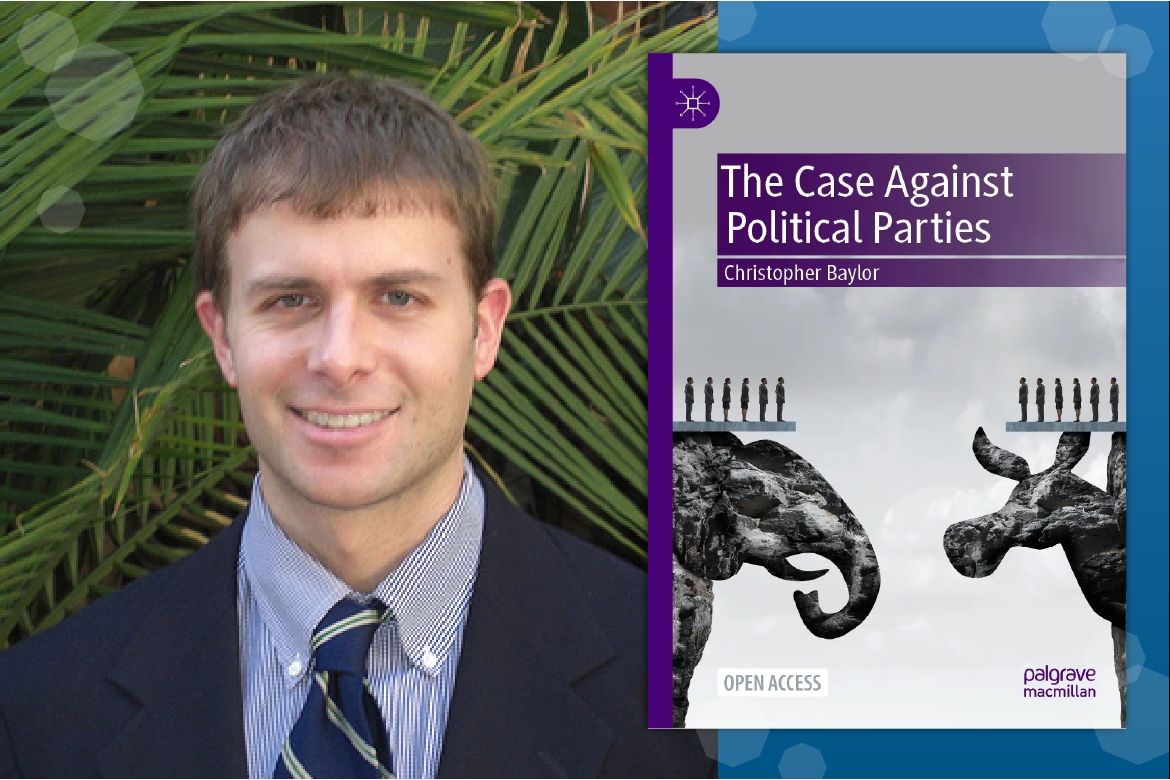
To find out, Newsroom spoke with Christopher Baylor, a lecturer in UCLA’s political science department who received his Ph.D. from UCLA. He explores this question in his new book, “The Case Against Political Parties,” which was written to be accessible to undergraduates and is available free of charge.
What inspired you to write this book?
A few years ago, there was a discussion on Twitter that asked political scientists what they know that they wished everybody else knew. And a common answer from political scientists was that political parties are good, and the public doesn’t think so — dissatisfaction with political parties is at an all-time high, with over 50% disapproval today. I wanted to write a book that explores this controversy, taking public criticisms and dissatisfaction with political parties seriously.
The main point of the book is that parties lead to an “in-group/out-group” mentality and a lack of accountability in democracies that can result in the undermining of checks and balances. You can be for political parties, but you should realize that they come with a strong cost.
What surprised you as you wrote the book?
I was surprised at how strongly a lot of political scientists favored political parties and hoped for more partisanship in the electorate. In the 1950s, the American Political Science Association was calling for more ideological polarization because that offers a clearer choice to the voters, and another book published in the past 10 years said that trying to hide your partisanship and be independent leads to less activity in politics. So we’ve long had political scientists that want you to wear your partisanship proudly rather than become less partisan.
What would you say to the argument that the U.S. needs more political parties?
I do think a multiparty system would be an improvement. For one thing, it gives people who feel left behind by the two parties another place to go. In addition, in a two-party system, the parties tend to burn bridges, but in a multiparty system, a party that you oppose today might be an ally tomorrow — coalitions rearrange more often so I think it would lead to less outright dismissal of the other party. That said, in both two-party and multiparty systems, parties get baked into your identity, which can lead to a kind of rigidity. Ultimately, I think having no formal parties is closer to an ideal democracy.
What would you like the real-world takeaway to be for readers?
I hope that people start frowning upon excessive partisanship, where politics are handled like sports — your personal “home team” can never do any wrong, for example. That kind of thinking in politics can undermine your credibility with people outside of the party and also prevent the people inside the party from making necessary changes or honest assessments. We have to watch out for that.
Attitudes can change about political parties, but the bottom line is you can’t ban them; the First Amendment protects the freedom to associate. However, that doesn’t mean state governments need to list a candidate’s party affiliation on the ballot, for example. I think not listing it on the ballot would lead to some improvement because it would inspire some voters to look up a candidate’s record that they might not otherwise.
This is a fraught topic for many people. Can you clarify any misconceptions you've seen in response to your book?
A common misunderstanding is that my book is an argument for centrism. It isn't, although moderates are one group of people that parties leave behind. Political parties package issues together in a way that doesn’t reflect how a lot of people think — for example, many people have strong views that cut across party lines, and the current system offers no good ways to be represented. Being against parties doesn’t mean being against strong beliefs or collective action. There are other ways of organizing collective action, such as interest groups and mass movements, which are often more transparent than political parties. Political parties often give smaller groups cover and the illusion of a majority.
Also, political parties are not synonymous with democracy. I hope that people challenge the assumption that parties are the only way to organize democracy and disagreement. Even if we don’t eliminate parties, we might be better off with weaker partisanship, like the U.S. had in the 1970s or the 1980s.
Why was it important to you to make your book free and open access for students — or anyone?
My goal in writing this book was not to make money. There is no single other book or article that gives students all the information I think they need on this topic, so I wanted to fill that void in an accessible way.



