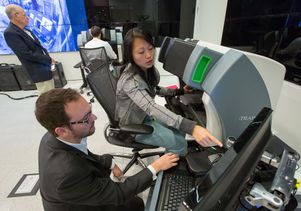
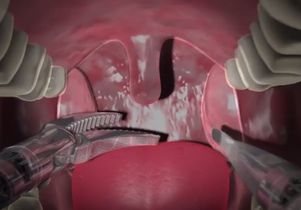
UCLA’s Center for Advanced Surgical and Interventional Technology is holding its first-ever, grand-scale robotic surgical training sessions over two days, concluding today.
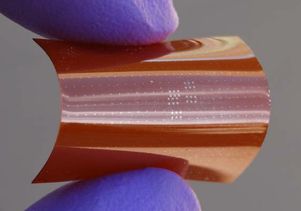
New compact, reliable energy storage devices outperform batteries by holding larger amounts of energy, recharging more quickly and lasting for longer recharge cycles.
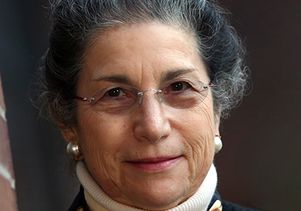
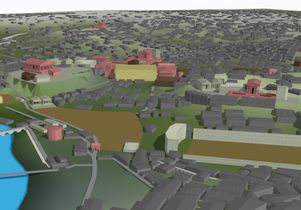
Intrigued by the question of whether Augustus Caesar transformed Rome from a city of bricks into a city of marble, as legend has it, UCLA professor Diane Favro decided to use advanced modeling software to reconstruct Rome at the time of his reign.
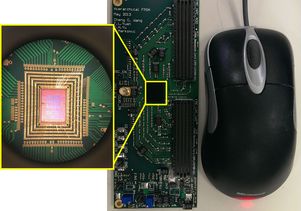
Two engineering graduates are the first employees in a new Mountain View startup that will use their innovation in the design of an important semiconductor chip.
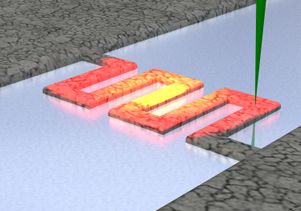
Researchers developed a thermal imaging technique that can “see” how the temperature changes from point to point inside the smallest electronic circuits.
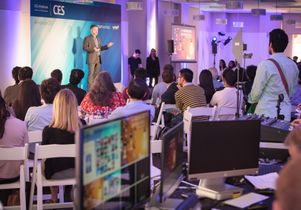
UCLA students as well as tech lovers and industry entrepreneurs came together Thursday to learn about and discuss the latest developments in wearable devices, virtual reality, robotics, connected cars and the Internet of Things at UCLA Anderson’s inaugural Consumer Electronics Show.
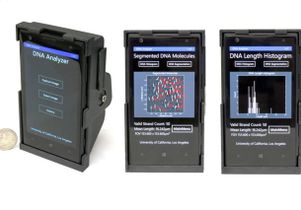
Researchers from UCLA have developed the first lightweight, compact device that converts an ordinary smartphone into an advanced fluorescence microscope.
New findings by UCLA neurophysicists could be significant for people who use virtual reality for gaming, military, commercial, scientific or other purposes.
Company emerges from King Abdulaziz City for Science and Technology and the UCLA Center for Excellence in Green Technology. It aims to revolutionize electronics by using carbon-based nanomaterials to lower power consumption and improve performance of smartphones and wearable devices.
UCLA researchers find that using a perovskite solution could improve the quality and manufacturing efficiency of medical and commercial imaging devices.
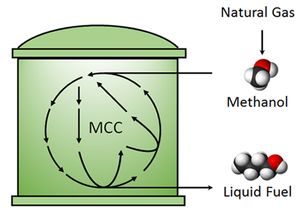
Researchers at UCLA have developed a more efficient way to turn methanol into useful chemicals, like liquid fuels, that would lower production costs in addition to reducing emission of the greenhouse gas.
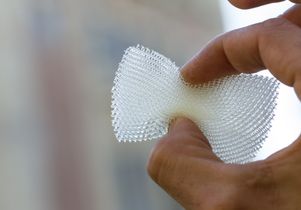
Researchers from UCLA and Architected Materials will use the grant to continue developing breakthrough technology to reduce the frequency and severity of head injuries to football players.
The technique, developed by researchers from UCLA and the Department of Energy’s SLAC National Accelerator Laboratory, shows promise in powering the next generation of particle accelerators.
The technology, which could be used in smartphones and other wireless devices, would reduce demand on the radio spectrum without compromising quality or speed of communications.
With their special electronic and optical properties, nanomaterials such as graphene and molybdenum sulfide have created excitement among scientists for their potential to revolutionize transistors and circuits.
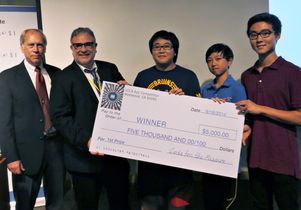
uHearingTest, which lets people self-administer hearing tests, won an award in the Code for the Mission contest, which aimed to translate UCLA researchers’ expertise into public benefit.
SACNAS at UCLA is trying to bring more Latinos and Native Americans into science and engineering, a crucial step to help the U.S. keep pace with the rest of the technological world.
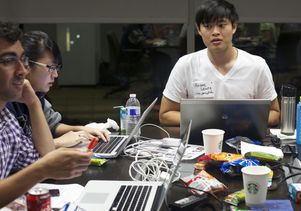
The second-annual Inventathon encourages interdisciplinary teams of young inventors to develop innovative solutions using the latest technology and mobile applications.