Starting next fall non-English majors will for the first time be able to enroll in a creative writing course. It will be taught by professor and acclaimed novelist Mona Simpson, and newly hired head of creative writing, Fred D’Aguiar.
Recovery has at least as much to do with rewarding oneself as it does with depriving oneself, according to a new book by a UCLA expert in addiction treatment.
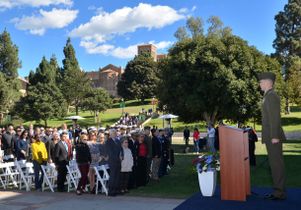
More than 350 UCLA community members gathered in Wilson Plaza today for UCLA’s eighth annual Veterans Day ceremony to honor current military service members and veterans.
The therapy shows great promise for extending the lives of people with an advanced form of the disease, and it does so without causing a secondary skin cancer, a side effect seen in some patients who took only one of the drugs.
Archaeologist Matthew Curtis was part of a team that recently discovered a skeleton that yielded the first complete ancient genome ever found in Africa.
The Ziffren Center for Media, Entertainment, Technology and Sports Law will expand UCLA Law’s highly regarded programs through curricular innovations, research support, new programming and hands-on skills training.
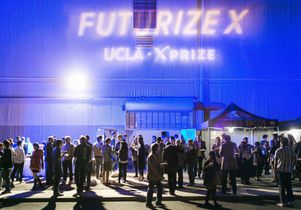
A sold-out crowd at UCLA’s IDEAS campus got a visionary glimpse into the future of space exploration Friday at the first of a series of events hosted by FuturizeX, a campuswide initiative being launched by UCLA and XPRIZE.
All are invited to attend Nov. 10 to hear remarks by two distinguished military servicemen and Chancellor Block that will be part of the UCLA’s Veterans Day ceremony.
Eating local is good. All corporations are bad. Population growth is the problem. Peter Kareiva, director of the UCLA Institute of the Environment and Sustainability, implores people to question assertions like these.
For the last 18 years, UCLA’s Lisa Snyder has been bringing to life the bygone glory of a true architectural, social and cultural wonder — the Chicago World’s Fair.
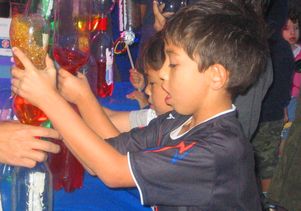
Guests can launch a rocket, take a peek at planets outside our solar system, make a cloud in a bottle and get up close and personal with dinosaur fossils and meteorites.
Dr. Thomas Klitzner, a UCLA professor of pediatric cardiology, said the findings could help identify high-risk patients so doctors can provide a higher level of support.