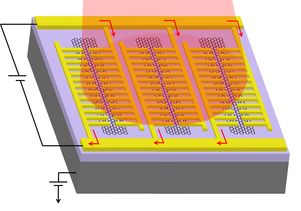
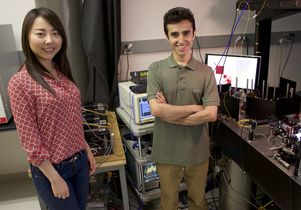
The device, designed by UCLA Engineering researchers, operates across a broad range of light, processes images more quickly and is more sensitive to low levels of light than current models.
“The center will provide CNSI with the cutting-edge technology to help us maintain our leadership in biophotonics research,” said UCLA’s Laurent Bentolila.
Researchers used cryo electron microscopy to obtain the first atomic model of the particle, which is made up of more than 3,000 protein molecules comprising tens of millions of atoms.
The scientists are working on a way to stop heart disease in patients with this severe muscular dystrophy, which affects one in 5,000 male babies in the U.S.
The new technique produces better images than current methods, and it’s easier to implement because it requires fewer measurements and performs computations faster.
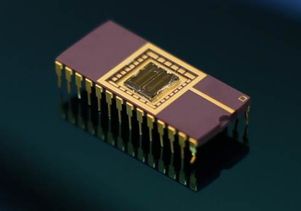
The system is made of inexpensive components, including an image sensor chip that costs just a few dollars apiece and is like the ones used in mobile phone cameras.
“The dream is to have an array of hundreds or thousands of qubits all working together to solve a difficult problem,” said graduate student Joshua Schoenfield. “This work is an important step toward realizing that dream.”
A biologically friendly supercapacitor invented by UCLA and University of Connecticut researchers charges using electrolytes from biological fluids like blood serum and urine.
Rankings by the Milken Institute put UCLA No. 1 in the nation when it comes to the number of startup companies launched as a result of campus research, no. 15 overall.
UCLA-led research shows that adding nanoparticles of aluminum oxide allows for more control over manufacturing processes, which could make them more efficient and reliable.
UCLA researchers note that the next decade shows great promise for things like improving food safety, fighting infections, storing energy and supplying clean energy.
The UCLA professor emeritus, who directed the California NanoSystems Institute at UCLA, was honored with two others for designing and developing molecular machines.
The findings are a major step toward confirming an unusual theory of how some cancer cells metastasize, and the study could lead to new strategies for keeping melanoma from spreading.
The device combines two components invented at UCLA: a photonic time stretch microscope and a deep learning computer program that identifies cancer cells with over 95 percent accuracy.
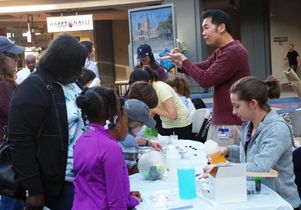
Volunteer scientists, graduate students and staff from the California NanoSystems Institute at UCLA set up a booth to demystify nanoscience in fun ways.