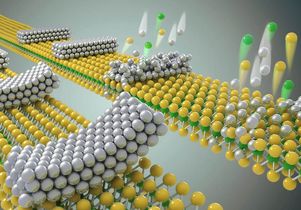
Their method joins a semiconductor layer and a metal electrode layer without the atomic-level defects that typically occur as part of the process commonly used now.
UCLA’s Sarah T. Roberts spoke with the executive about how the world’s largest social media platform balances free expression with creating a safe community for all.
The studies found a link between risk-related terms that Google and Twitter users researched or tweeted about and subsequent syphilis trends that were reported to the CDC.
The advance could help bring high-quality medical diagnostics into resource-poor regions, where people otherwise do not have access to high-end technology.
Working to upend one of the most stalwart of construction materials, a team of UCLA researchers created a near carbon dioxide-neutral version of concrete.
UCLA professor of musicology David MacFadyen is a champion of blockchain and how it could influence the future study and scholarship in arts and literature.
Hong shares what it was like to run a leg in the torch relay for the 2018 Winter Olympics in Pyeongchang, South Korea, and the future of robot athletics.
UCLA’s Jane Margolis and Julie Flapan use research to help policymakers devise equitable and effective strategies to scale up diversity in computer science.
Q&A with UCLA’s Sarah T. Roberts about seeing the subject of her work — the study of people who keep the internet “clean” — on screen in “The Cleaners.”
A UCLA digital artist and neuroscientist collaborated to create a performance art installation in which participants explore unspoken, visual communication.