Only a dozen such quakes have been identified in the past two decades, according to Lingsen Meng, UCLA’s Leon and Joanne V.C. Knopoff Professor of Physics and Geophysics.
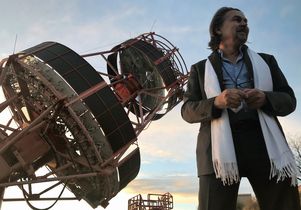
Vladimir Vassiliev, professor of physics and astronomy, has served as principal investigator on project that could help address questions in very-high-energy astrophysics.
At the heart of the dispute is the Hubble constant, a number that relates distances to the redshifts of galaxies — the amount that light is stretched as it travels to Earth.
UCLA professor talks about how the event promotes software literacy within the visual arts, and visual literacy within technology-related fields, while increasing accessibility for all.
25 years after Northridge, civil and environmental engineers are using artificial intelligence, machine learning, sensor networks and advances in mapping in their work.
“The platform is like a motion detector for the microscopic world because of its ability to lock onto any moving objects in a fluid sample,” said Yibo Zhang, a UCLA doctoral student and the study’s first author.
A preview of the paper that was posted on the website ChemRxiv was downloaded 19,000 times in 24 hours, shattering the site’s previous record of 15,000 downloads in six months.
The life scientists have provided the first cell “atlas” of the hippocampus — the part of the brain that helps regulate learning and memory — when it is affected by traumatic brain injury.
Hans Block and Moritz Riesewieck featured Sarah T. Roberts in “The Cleaners” — their movie about the anonymous people who screen objectionable content on social media.
The $3.7 million, three-year grant will go toward research aimed to develop imaging technology that allows the recording of tens of thousands of neurons to better understand how the brain goes awry in disease.