You can be among the 1,000 volunteer citizen scientists who will collect 18,000 samples of soil and aquatic sediment from across the state through a new University of California program called CALeDNA.
UCLA’s Jonathan Aurnou and collaborators in Marseille, France, demonstrated that the planet’s jets likely extend thousands of miles below its visible atmosphere.
UCLA-led research shows that adding nanoparticles of aluminum oxide allows for more control over manufacturing processes, which could make them more efficient and reliable.
The UCLA Sustainable LA Grand Challenge awarded its second round competitive research grants this month, providing $1 million to eight new projects focusing on renewable energy, transportation and urban ecosystems.
The device, developed by UCLA’s Aydogan Ozcan and colleagues in Sweden, could be manufactured for less than $500 each — far less expensive than the equipment that labs use for the same tests.
A UCLA-led research team reports that the moon is at least 4.51 billion years old and probably formed only about 60 million years after the birth of the solar system — 40 million to 140 million years earlier than had been thought.
The key is “sequentially switched delay lines,” an approach similar to the way passenger trains are routed from one track to another, to allow them to enter and exit train stations at the same time and avoid collisions.
UCLA professor Henry Kelly examines historical canonical legal procedures to correct the popular myths around the Italian astronomer’s belief in a sun-centered solar system.
The team found a way to correct the instability by resetting the stem cells from a later stage of development to an earlier stage. These results could have great impact on the creation of healthy tissues to cure disease.
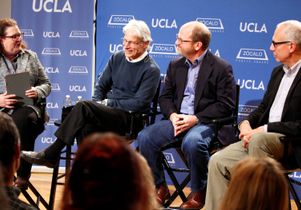
Two UCLA faculty members — molecular biologist Robert Goldberg and international law and policy scholar Edward Parson — defended the use of genetically modified organisms in food production at a Zócalo/UCLA discussion held in downtown Los Angeles.
The findings could help improve upon standard behavioral therapy, in which people are exposed to the objects they’re afraid of — which can be frightening enough that some cannot complete treatment.
Researchers from the schools of dentistry, medicine and engineering developed a digital health platform capable of optimizing efficacy and safety during chemotherapy.
An multidisciplinary team designed an algorithm that could discern structured narratives within the flow of posts on the internet reflecting how humans communicate.
Mitochondrial DNA discoveries by a team of UCLA and Caltech scientists may help to prevent or delay the onset of age-related diseases such as Parkinson's and Alzheimer's.