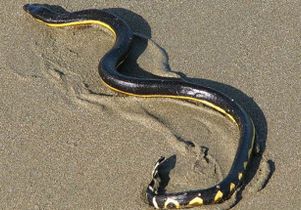
The animals, which are related to spiders and scorpions, “look terrifying, but are actually delicate, timid and afraid of you,” says UCLA doctoral candidate Kenneth Chapin.
The new building material called CO2NCRETE would be made from carbon captured from power plant smokestacks potentially eliminating a huge source of greenhouse gas emissions.
Shapley, widely considered a father of game theory, was professor emeritus of economics and mathematics and shared the 2012 Nobel Memorial Prize in Economic Sciences.
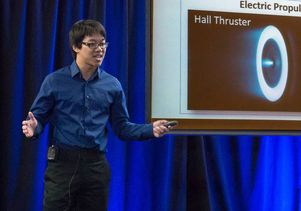
Aerospace engineering graduate student Gary Li won first place last week at UCLA Grad Slam, a campuswide competition where graduate students give three-minute presentations on their research.
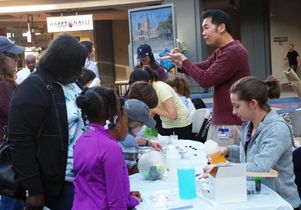
Volunteer scientists, graduate students and staff from the California NanoSystems Institute at UCLA set up a booth to demystify nanoscience in fun ways.
The events are designed to appeal to people who share a fascination with the science hidden in our food or who are simply curious to know more about the food we eat and cook.
Susan Wojcicki, CEO of YouTube, returned to UCLA Anderson, where she got her M.B.A. in 1998, to talk about her career and share her insights on how to succeed in the tech world.
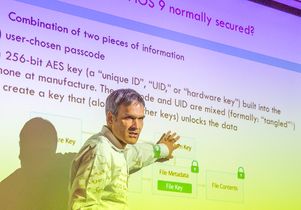
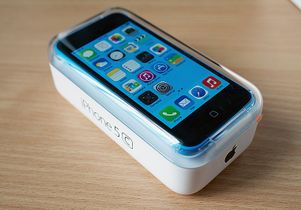
John Villasenor notes that in the battle between Apple and the U.S. government, the ever-accelerating pace of change in technology makes applying older laws a murky proposition.
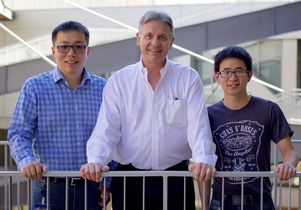
UCLA awardees are Dino Di Carlo, a professor of bioengineering; Jonathan Hopkins, an assistant professor of mechanical and aerospace engineering; and Benjamin Williams, an associate professor of electrical engineering.
Brad Shaffer, director of the UCLA La Kretz Center for California Conservation Science, says the role of citizen scientists is important in helping scientists track changes in the environment due to climate.
In this Q&A, Jon Christensen of UCLA and his colleague Adam Wolf discuss their study of how climate change affects plant species’ shifting in California.
Discovery provides scientists with critical information on the best way to create stem cells for purposes such as cell transplantation or organ regeneration.
The violent impact with a “planetary embryo” called Theia occurred approximately 100 million years after the Earth formed, UCLA geochemists and colleagues report.
The six UCLA undergraduates are vying for top honors in the inaugural FuturizeX Student Challenge, a competition that aims to inspire the next generation of innovators.
The advance could make it much more efficient to build nanoelectronic and nanobioelectronic devices that could measure brain cell and circuit function in real time.