UCLA In the News lists selected mentions of UCLA in the world’s news media. Some articles may require registration or a subscription to view. See more UCLA In the News.
UCLA’s Dennis Hong on achieving the impossible with robotics | Spectrum News 1
As a professor of Mechanical & Aerospace Engineering at the UCLA Samueli School of Engineering and the founding director of RoMeLa (Robotics & Mechanisms Laboratory), Dr. Hong works with a team of students that focuses on robot locomotion and manipulation, autonomous vehicles, and humanoid robots. One of Dr. Hong’s most impressive inventions is a car that can be driven by the blind. Nothing seems out of the question for him.
U.S. ready to rejoin Iran nuclear deal, but challenges remain | KPCC-FM’s “AirTalk”
“The international scene has changed somewhat from the last time that this came up. On one part, you have a more consolidated effort by other Middle East allies of the United States. The Saudis, the Israelis, the U.A.E.,” said UCLA’s Benjamin Radd (approx. 5:50 mark).
Battle over climate change boils over on the home front | Washington Post
“The indoor air quality analysis found that concentrations of nitrogen dioxide (NO2) during cooking events can exceed the levels set by national and California-based ambient air quality standards,” said a study by the University of California at Los Angeles. UCLA Fielding School of Public Health Professor Yifang Zhu, the lead researcher, said that “fossil fuel use in household appliances can adversely impact indoor air quality and public health.”
Why do we pronounce L.A. place names this way? | Los Angeles Times
Happy to say that Reynaldo F. Macias pretty much agrees with me about that arc. He’s a professor of Chicano/Chicana studies, education and socio-linguistics at UCLA. Don’t forget, he reminds me, that Spanish, not English, was the first non-indigenous language in North America. Yet in studies of a few decades ago, “you had a hierarchy of how accents were viewed and valued. French was up there, German was somewhat up there, but Spanish was way down there.”
How to reduce waste at home during the pandemic | Orange County Register
“The pandemic has made things worse in a couple of different ways,” says J.R. DeShazo, professor of public policy and director of Luskin Center for Innovation at UCLA. Last year, De Shazo and his team released the report “Plastic Waste in Los Angeles County,” which looked at the impact of single-use plastic utensils on local waste streams.
New COVID-19 strains: What we know | Rolling Stone
It is common for viruses to mutate over time, in some cases, forming new variants. “That is why we get a flu shot every year — because the flu virus changes and we have a new variant each year,” says Dr. Karin Michels, professor and chair of the Department of Epidemiology at the UCLA Fielding School of Public Health. “We may have to get the annual Covid shot from now on in addition to the annual flu shot.”
U.S. crosses a horrific pandemic milestone | CNN
“When we think back to last year, when we were talking about some 250,000, 275,000 people dying, we were all aghast at this number. And here we are at half a million deaths. This is really something that we should all be very sad about. And the deaths are only one piece of this story,” said UCLA’s Anne Rimoin.
Queer people of color twice as likely to get COVID-19 | Instinct
A new study released by the Williams Institute states that Queer people of color are twice as likely to test positive for COVID-19 when compared to straight white people. The Williams Institute, which is a subsection of the UCLA School of Law, conducted a national survey involving more than 12,000 U.S. citizens. (UCLA’s Brad Sears was quoted.)
Can we get to herd immunity by April? Experts are skeptical | Healthline
Christina Ramirez, PhD, a professor of biostatistics at the UCLA Fielding School of Public Health, said until we know the answer to these questions, we’ll have to keep some public health measures in place.
California’s coronavirus strain looks increasingly dangerous | Los Angeles Times
Dr. Marc Suchard, an expert on infectious disease tracking at UCLA, said that some of the team’s findings would probably be refined as more virus samples were genetically sequenced and more data came to light. “It remains critically important that we actively sequence the virus as cases are diagnosed in our state,” said Suchard, who was not involved in the UCSF work. “I am glad to see such a collaboration between academics and public health departments in California to identify the emergence of a previously unidentified lineage.”
How COVID-19 has tested hospitals’ limits | New York Times
“We’re all exhausted,” said Dr. Nida Qadir, co-director of the medical intensive care unit at Ronald Reagan UCLA Medical Center. “We’ve had to flex up quite a bit.”
Is it dangerous to be vaccinated when you have coronavirus infection? | Los Angeles Times
“If we were extremely concerned about this, we would require everybody to get a COVID test before they got vaccinated,” said Shira Shafir, an epidemiologist at UCLA’s Fielding School of Public Health. “And that’s not a policy.” (Shafir was also quoted in The Guardian (U.K.) and The Wrap.)
Vaccine rollout has contributed to drop in new U.S. new cases | Xinhua
“The vaccine rollout is the major reason for the decreasing of new cases, deaths and hospitalizations,” said Zhang Zuofeng, professor of epidemiology and associate dean for research with the School of Public Health at the University of California, Los Angeles. The effect began to show 28 days after the start of vaccine rollout in the country on Dec. 14 last year, and was quite obvious after nine weeks, Zhang noted.
The latest on the pandemic | KPCC-FM’s “AirTalk”
“To put it in context, in Los Angeles County we’ve had just under 20,000 deaths. We’ve had 19,885 deaths just in Los Angeles County from COVID-19. That’s about what you would expect in a typical influenza season in the entire country,” said UCLA’s Dr. Timothy Brewer (approx. 2:10 mark).
In the California prison where COVID ‘spread like wildfire’ | Valley Public Radio
“There has not been the political will to do what’s necessary to keep people safe, which is to dramatically reduce prison and jail populations,” said Aaron Littman, a teaching fellow at UCLA School of Law and deputy director of the COVID-19 Behind Bars Data Project.
Wearing glasses might protect you from the coronavirus | Men’s Health
Carolyn Duong, OD, an optometrist at the UCLA Stein Eye Institute offers a word of warning if you do switch out of your contacts and into your glasses. “A study showed that the virus could live up to three days on plastic and stainless steel—which are likely the same materials that some glasses are made of. Therefore, if you are opting to wear glasses, please clean them,” she said.
From sourdough to sacrifice, how COVID is changing Americans’ values | HealthDay News
As the COVID-19 pandemic transformed everyday lives in 2020, Americans began dwelling on a few key topics, sourdough bread among them. But we were also tweeting about and researching sacrifice, survival and death, according to new research on online trends… “‘Sacrifice’ was a complete nonstarter in U.S. culture before COVID,” said study author Patricia Greenfield, a distinguished professor of psychology at the University of California, Los Angeles. The study determined that the pandemic inspired a resurgence of community-oriented values, with people thinking more about supporting one another, Greenfield said in a UCLA news release.
Lab-grown brain organoids found to mature at same rate as an infant’s | New Atlas
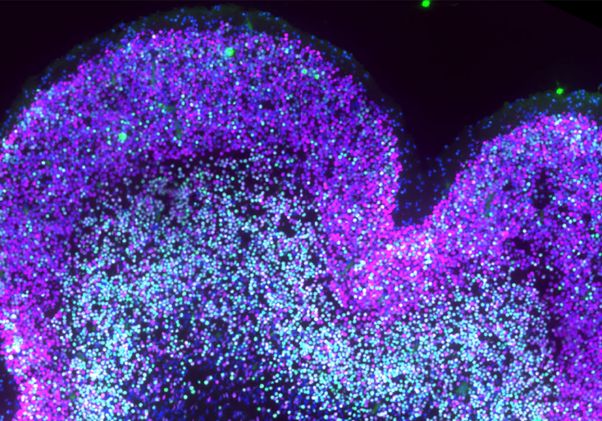
In this novel study, scientists at Stanford University and the University of California, Los Angeles grew these organoids in lab dishes over the course of 20 months. The researchers then used genetic analysis to investigate the rate of development, finding that these lab-grown mini-brains had reached postnatal maturity in 250 to 300 days, a “timeline paralleling in vivo development.” (UCLA’s Daniel Geschwind and Aaron Gordon were quoted.) Also: Science and Science Times.