UCLA In the News lists selected mentions of UCLA in the world’s news media. Some articles may require registration or a subscription to view. See more UCLA In the News.
California’s ballot measure on stem cell research funding | USA Today
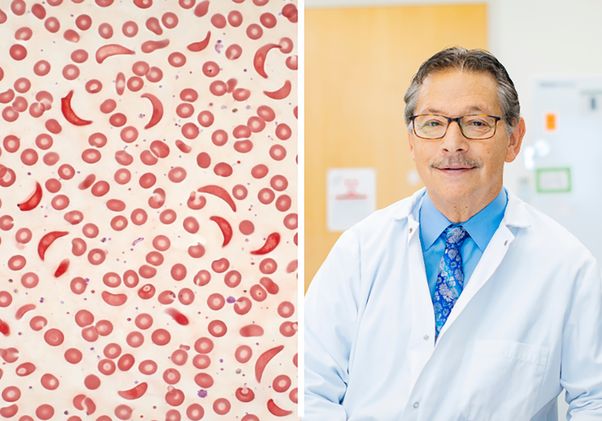
Donald Kohn, the Langenhops’ doctor at the University of California-Los Angeles, has been involved in stem cell research since 1985. “I’ve seen it go from a dream, a vision, to now just various degrees of how it’s working,” said Kohn, also a member of the UCLA Broad Stem Cell Research Center. About a dozen blood diseases such as LAD-1 have shown “very good clinical responses” to the type of treatment the Langenhop children received.
A UCLA librarian has the story on books bound in human skin | Los Angeles magazine
Unlike the Necronomicon Ex-Mortis (the Book of the Dead) in The Evil Dead movies, the human skin books in author Megan Rosenbloom’s new Dark Archives: A Librarian’s Investigation Into the Science and History of Books Bound in Human Skin (Macmillan, $26) never summoned evil spirits in the woods that turned a cabin full of teens into flesh-eating zombies. In fact, they look like ordinary vintage books with covers made from regular old leather. But Rosenbloom has spent the last five years researching the grim details behind some of the “most macabre books in history” to find out how they came to be and where. (Also: Rosenbloom was quoted. Also: Medium.)
Affirmative action divides Asian Americans | Los Angeles Times
UCLA Vice Provost for Enrollment Management Youlonda Copeland-Morgan told The Times last week that she didn’t know if Asian American enrollment would decline at UCLA but that the campus would continue to focus on outreach to those from less represented communities, such as Hmong, Laotian, Vietnamese and Philippine students.
Even amid pandemic, climate change remains biggest concern | Los Angeles Times
“We’ve been assaulting biodiversity for over a hundred years,” says Professor Stephanie Pincetl, founding director of the Center for Sustainable Communities at UCLA. Pincetl’s resume would not fit on this page. Her areas of expertise include environmental science, urban planning, natural resource depletion and land use governance.
Candidates’ health plans would affect the U.S. economy differently | Reuters
There’s evidence that the uninsured who do get sick get care in expensive settings like the emergency room, says UCLA public health policy professor Gerald Kominski. That takes a toll on their financial health and, when they can’t pay, strains the finances of hospitals that provide their care, with taxpayers footing part of that bill as well.
Some voters say preexisting conditions are top concern | NPR’s “Morning Edition”
“There doesn’t seem to be any real political advantage at all,” said UCLA’s Mark Peterson (approx. 3:20 mark).
Republicans prepare to challenge individual ballots | Washington Post
“The other side has given every indication that they will challenge every ballot they can, at every step of the process,” said Chad Dunn, general counsel for the Texas Democratic Party and co-founder of the UCLA Voting Rights Project. “The mask is off. This isn’t about rooting out any mythical voter fraud. It never was,” Dunn said. “This is about raw power and obtaining power by any means necessary.”
San Diego health pros use relationships to turn out voters | San Diego Union-Tribune
The University of California, Los Angeles’ Latino Policy and Politics Initiative authored a study that showed a nearly 13 percent increase in turnout among voters in the targeted communities who had not voted in the last three elections.
When parents lose their jobs, their children also suffer | New York Times
“These levels of unemployment are huge,” said Jennie E. Brand, a sociologist at the University of California, Los Angeles. “There’s a lot going on in these families that’s going to be hard to recover from.”
Senators mispronounce the names of Kamala Harris and Sundar Pichai | CNN
Non-English names, naturally, employ stress patterns or sounds that aren’t used in English, and remembering those sequences can be challenging, says Megha Sundara, a linguistics professor at the University of California, Los Angeles. The issue, though, isn’t unintentional mistakes, but rather how people recover from them. “You can double down out of embarrassment, or apologize and fix it,” Sundara wrote in an email to CNN. “Because ‘say my name’ is perhaps the most basic way in which we ask others to acknowledge our existence.”
Suburban women are among groups who’ve turned against Trump | New York Times
(Column written by UCLA’s Lynn Vavreck) The more meaningful story in this race is the 2016-to-2020 election gap. Polls suggests that almost all groups are moving away from President Trump relative to how they voted in 2016.… The Democracy Fund + U.C.L.A. Nationscape Project has interviewed just over 100,000 people between June and Oct. 22. On average, the data reveal the gender gap in two-party support to be nearly 13 points among those who are registered to vote.
Rapid virus test falters in people without symptoms | New York Times
Failing to grow the coronavirus out of a person’s sample also does not guarantee that individual is not contagious to others, said Omai Garner, the associate director of clinical microbiology in the UCLA Health System, who was not involved in the study.
Political satire isn’t dead; it’s been turned into horror stories | New York Times
Tananarive Due, a writer and UCLA professor who teaches a class on Black horror aesthetics, told Vanity Fair that she thinks horror was “therapeutic” for her mother, the civil rights leader Patricia Stephens Due. The thrill of watching horror, she said, “helped her slough off some of that fear and anger.” When a toxic political idea is turned into a literal demon, the audience can imagine slaying it and escaping from its gory reign of terror.
COVID-19 deaths could swing the election to Democrats | Los Angeles Times
“Increasing fatalities from the disease leads to losses for Republicans,” a team from George Washington University and UCLA reported Friday in the journal Science Advances. The researchers used data collected by the New York Times to tally COVID-19 deaths in every state up through May 31. They also looked at responses gathered by the Democracy Fund + UCLA Nationscape Project, a public opinion survey that reaches about 6,400 people each week.
Europe aims to emerge smarter from latest lockdowns | Wall Street Journal
“Anything we can do to reduce contact between people is going to make a difference,” said Anne Rimoin, an infectious-disease epidemiologist at the University of California, Los Angeles, Fielding School of Public Health. “Right now, all we have are the blunt public-health measures that we’ve been using all along.” (Rimoin was also quoted by HuffPost.)
Halloween a big moment in latest wave of COVID-19 | Los Angeles Times
“Treat yourself and your family to a safe Halloween. Don’t trick the community to even higher levels of spread,” said Dr. Robert Kim-Farley, medical epidemiologist and infectious disease expert at the UCLA Fielding School of Public Health.
Former Fowler Museum director dies | Los Angeles Times
[Doran] Ross joined the Fowler Museum as associate director and curator of Africa, Southeast Asia and Oceania in 1981, when the institution was called the UCLA Museum of Cultural History. He contributed to the development of the museum’s new facility, a three-story $22-million building completed in 1992. After serving as deputy director and curator of African collections, Ross became the first non-faculty, full-time director in 1996, a position he held until his retirement in 2001.
2020, the year that never ends | National Post column
Dean Buonomano, a professor of neurobiology and psychology at UCLA, and the author of Your Brain Is a Time Machine: The Neuroscience and Physics of Time, says the Holiday Paradox can be explained by the fact that our brains measure time in two distinct ways: retrospectively and prospectively.
Ancient dog DNA reveals 11,000 years of canine evolution | Nature
Evolutionary biologist Robert Wayne at the University of California, Los Angeles, sees the large-scale analysis of ancient dog genomes as a major advance. Efforts to unequivocally determine the origins of domestic dogs will need to take the same approach, he adds. “It is just going to require an exhaustive sampling of wolves and dogs throughout the history of dog domestication.”
A reason to feel confident about a COVID-19 vaccine | CalMatters
(Commentary co-written by UCLA’s Kristen Choi and Jessica Saleska) Worry over the speed of vaccine development and approval may not be unfounded. The U.S. Food and Drug Administration will consider potential COVID-19 vaccine candidates for emergency use authorization, a temporary approval which takes less time and requires less evidence on safety and effectiveness than a full approval. This authorization, while often used to green-light life-saving medical treatments in times of crises, is virtually unheard-of for the approval of vaccines.
Can California help women get back to work? | Fresno Bee
Women in ages 21 to 50 who lost stable jobs from mid-sized or large companies can miss out on more than $100,000 in lifetime earnings, according to a paper from Till von Wachter, a professor of economics at UCLA and faculty director of the California Policy Lab.
Diabetic amputations a ‘shameful metric’ of inadequate care | Kaiser Health News
Californians with diabetes who have a regular place to go for health care other than the emergency room are less likely to get amputations, according to an analysis conducted for Kaiser Health News by the UCLA Center for Health Policy Research. If they have a plan to control their diabetes, they also have less chance of amputation. The analysis shows that many amputations could be avoided with better access to care and better disease management, said Ninez Ponce, director of the center. “It’s the most shameful metric we have on quality of care,” Ponce said. “It is a health equity issue. We are a very rich state. We shouldn’t be seeing these diabetic amputations.”
Whether Californians vote may hinge on race, ethnicity | Rafu Shimpo
According to data from the latest California Health Interview Survey, or CHIS, an estimated 2.8 million eligible Californians never vote in national, state or local elections, and 7.7 million only vote sometimes — which could potentially leave more than 10 million ballots uncast. The findings on voter participation and other demographic and health-related topics are part of the UCLA Center for Health Policy Research’s annual CHIS data release, which took place online on Oct. 29. (UCLA’s Ninez Ponce, Susan Babey and Todd Hughes were quoted.)