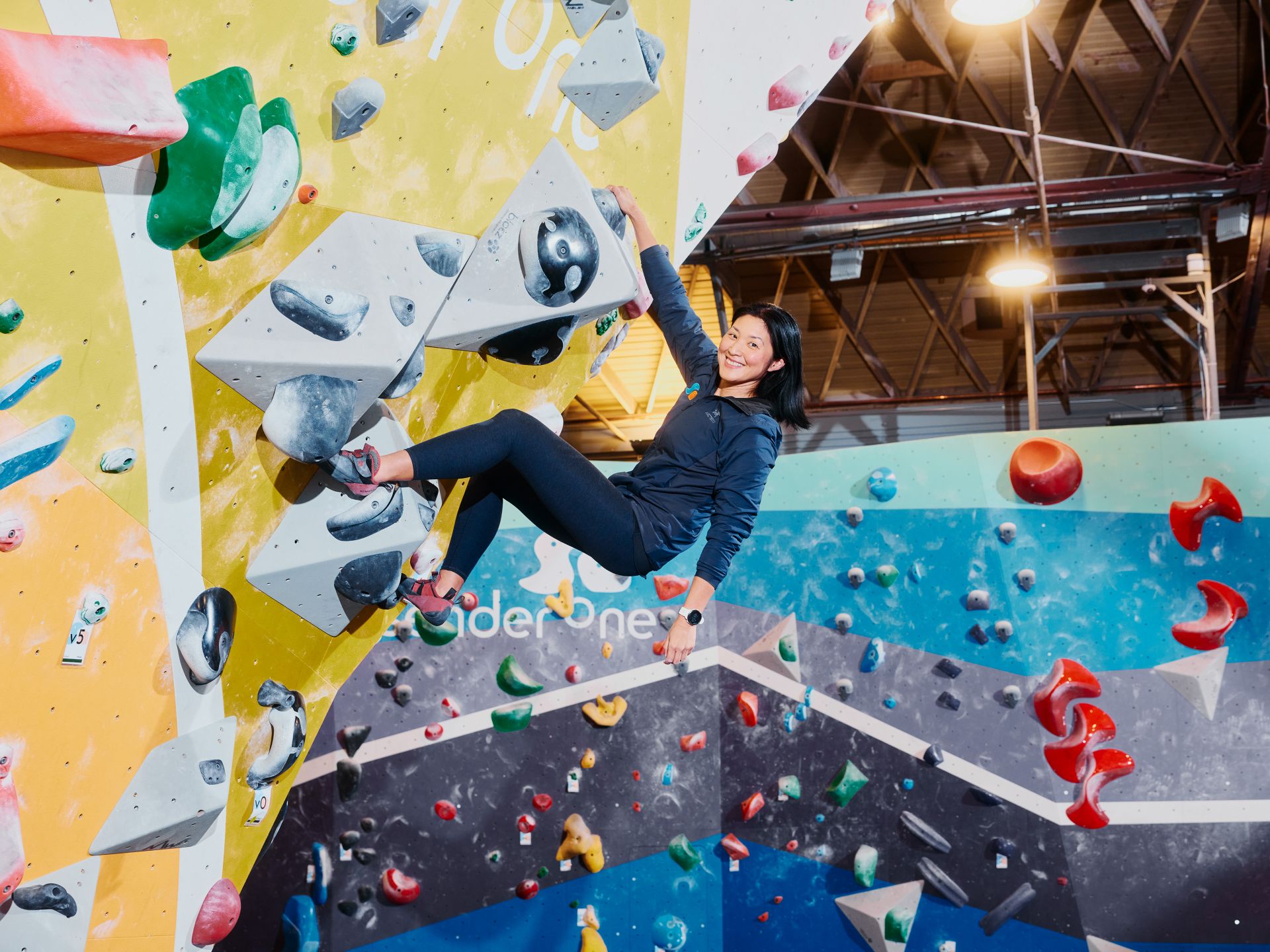
Halfway up the wall, I feel my arms go numb. It’s been two decades since I’ve been in a harness with my hands and toes gripping those colorful, odd-shaped rocks for dear life. At the other end of the rope, down on the slate-colored cushioned ground, Alice Kao ’01 roots me on. Kind of. Her tone is coach rather than cheerleader. Not, “You can do this!” More like, “You can do this.”
But I can’t. So, after a few check-ins from Kao to see if I am really quitting, I lean back off the wall and she slowly lowers me to the ground.
Kao, 45, slips her flip-flops back on and we walk from the towering, 50-foot indoor climbing walls, past the ropeless bouldering area and Sender City — a kids’ climbing section with scalable skyscrapers, giraffes and slides — to an office near the workout machines. She’s the boss here at Sender One LAX: founder and CEO. Kao, her husband, Wes Shih, and the company’s co-founder, Wes Chu, opened their first grand-scale climbing gym in Santa Ana in 2013. Today, Sender One has five locations: this one, near LAX; the original, in Santa Ana; and new entries in Playa Vista, Lakewood and Westwood (right by the UCLA campus).
I’ve driven across town to try to understand two things: What does climbing mean to Kao, and how does a degree in international economics lead someone to build a SoCal climbing empire? To that first question, Kao explains that the power of climbing isn’t the climbing itself — it’s the community. “This is your church; this is where you feel like you belong,” she says. “Climbing matters because my people are here. When I come here, I feel like I belong.”
The answer to the second question isn’t so straightforward. Like many career paths, Kao’s wound around and around. Wearing a Sender One staff fleece and black leggings, with a string backpack given out as swag to those who completed last year’s Escape from Alcatraz triathlon in San Francisco, Kao sips a kombucha and begins to explain.
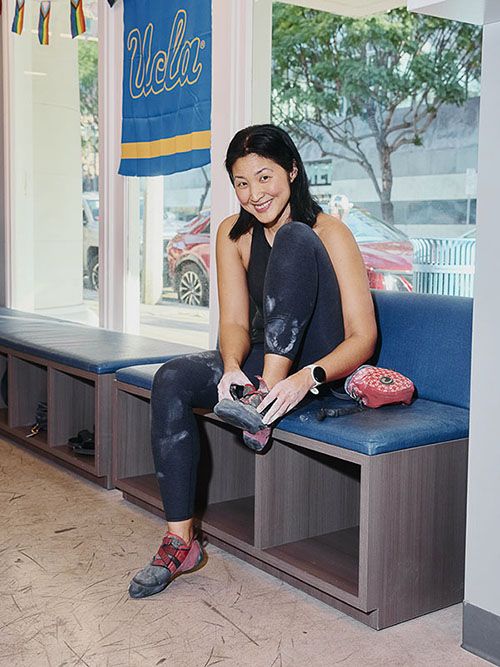
“I had a really serious boyfriend in college,” she says. “We met when I was at UCLA doing an internship in investment banking. We were together for five years.” She’d gotten into banking, she says, “to make my Asian parents proud,” but two years in she switched to the toy industry, working for Mattel and then MGA Entertainment. Kao’s boyfriend took a job in Hong Kong; she was 26, ready to get married, and put in for a transfer there to run MGA’s international sales. “But right before we moved to Hong Kong, he said, ‘You know what — I don’t want you to go for me.’”
They broke up. Kao was heartbroken. But she’d already gotten the new role, so she moved anyway, 5,000 miles from L.A., now single and unsure how to be alone. Six months later, she got a call from her ex — he was getting married. “I was so depressed. I didn’t get out of bed for a month,” Kao says. “All that time, it was like, Wow, something is wrong with me. I’m not marriage material. I’m not good enough. I’m too fat. You know, fill in the blank.”
Feeling she had to get out of Hong Kong, she transferred to London, which she found unbearably cold and rainy; it got dark at 3:30 p.m. She couldn’t snap out of her funk. “But at some point, I was like, You know what, I gotta get better,” Kao says. A friend told her to try climbing. She walked into a gym in London, signed up for a class, and scrambled to the top for the first time. “And I just thought, Oh, my God. This is amazing. This could be my thing.” She started going five days a week, sometimes climbing until midnight.
For her first time trying the sport outdoors, she hired a guide to take her climbing in Wales. Up on the rock face, surrounded by green mountains and the sheer vastness of it all, things came into perspective for her: Maybe the breakup had been a scrape, not a terminal wound. “One day I just got better,” she says. “And climbing was the thing that kicked me and got me out of bed and made me better.”
“I have to be able to stay in America”
Born in Taiwan, Kao spent most of her childhood with her grandparents. Her father died when she was young; her mother remarried. As her teenage years approached, her grandmother was becoming too old to care for her, and her mother and stepfather moved to the Solomon Islands. They wanted Kao to have a first-class education, so her mother sent her — alone — to Palos Verdes, where she lived under the care of a guardian. “She gave me some keys and some money, and she just left,” Kao says. “I was 13 years old, and I was living here by myself. I walked to school, made my own meals.”
What ensued was loneliness, for sure. But Kao also felt pressure to succeed. She had learned English and aced her studies, and she was determined to make something of herself. “My single focus was: I need to go to college and figure out how to make money and survive,” she says, “because I have to be able to stay in America.”
She chose UCLA because it was in Los Angeles. “I just didn’t want to move,” she says. “I finally had come somewhere I could settle.”
In Westwood, she found a community. She became a citizen. And she met that ex-boyfriend who became the center of her life.
When Kao returned to Los Angeles for a job in 2009, she went right to a climbing gym. But it was small and badly lit — nothing like the massive gyms she’d come to love in Europe. “It was kind of dirty and there was bad service,” she remembers.
Check out the other stories in our “Climb Every Mountain” package: Read about how Sara Safari ’07, M.S. ’09 scaled the Seven Summits; and watch our video story on current Bruins finding joy — and community — climbing together.
Kao had already started dating Wes Shih, who would become her husband. A Harvard-educated lawyer, he kept getting fired because he loved to climb too much. “I would drive to work at some big law firm and park my 4Runner, which was muddy, next to these European sedans,” Shih says. “I like to tell people that my car was telling me I had the wrong job before I understood I had the wrong job.”
Right around the time Shih got his second pink slip, he and Kao met Wes Chu, who had the idea to start a premium climbing gym in L.A. The three co-founders wrote a business plan and began fundraising. They went to banks and friends and family, with a target goal of $2.5 million.
During this round of raising capital in 2011, Kao got a call — from her ex-boyfriend. He asked how she was doing. She told him she was doing great, getting married, opening her own climbing gym. He was still in banking, and he had made a small fortune betting against subprime mortgages. He offered to invest.
“My first response? I threw the phone, and I was like, ‘No! If you want to buy your guilt out of this, like, ‘No, thank you,’” Kao says, grinning. But then she talked to Shih and realized this man had been a big part of her life, and it hadn’t been all bad. The relationship had helped make her who she was. It led her to climbing. She took the check.
In 2013, the first Sender One gym opened in Santa Ana and was an instant success. “Fast-forward now: I’m seeing him in a couple of weeks. He’s coming to the U.S. with his wife,” Kao says. “They’re now the largest investor in this business.”
“An epicenter to build community”
Kao and Shih have two kids now; the older child is approaching her teenage years, just as Kao was when she was sent to live alone halfway across the world. She knows that the scared teenager and the depressed 20-something who followed are both still a part of her. But they’re not the main part. They’re not what people see every day amid the ropes and rocks.
Todd Presner, chair of UCLA’s Department of European Languages and Transcultural Studies, first met Kao and Shih when they opened the Santa Ana gym. He’d discovered climbing in his mid-20s, while writing his dissertation; it was the perfect counterbalance to his solitary work in the library stacks. “Instead of parsing a text, I’m parsing holds on a wall,” he says. “I’m trying to figure out, like, What’s the sequence that’s gonna make sense here? How do I interpret this? How does my body interpret this?”
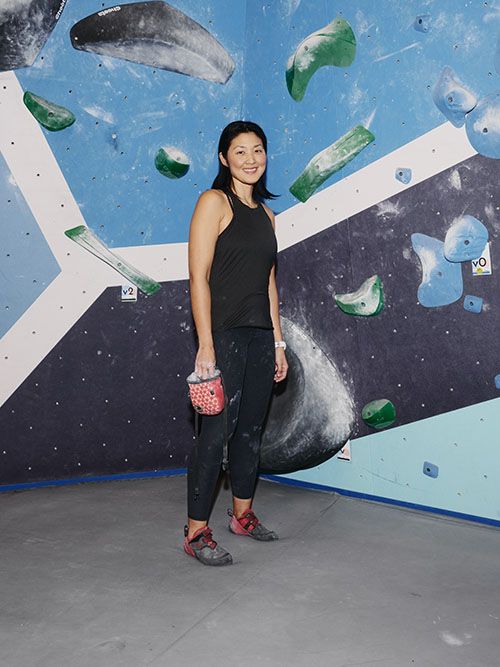
To Presner, Kao is a gregarious host. “Her gym is really an epicenter to build community,” he says. “There’s a door everywhere, and she wants people to figure out which door makes sense for them to walk through to experience this sport.”
That’s not accidental. Kao says that as an Asian woman, she felt “othered” in the climbing community, even as it became a refuge during her most difficult times. The sport was crunchy, sure, but it was still very male and very white. During her first climbs in America, she remembers being both the only Asian and the only woman in the room, while bros with six packs climbed shirtless. She was discouraged on the home front, too — her grandmother warned her that climbing would give her sun damage, roughen her hands — and make it hard to find a husband.
Kao is legally blind (“I know that because last year my optometrist said that my contacts are now free”) and has always struggled at ball sports. The woman who now runs triathlons and rock climbs never saw herself as an athlete. “Climbing is the first sport that helped me feel like, Oh, I can be an athlete,” she says. “By the way, there’s a lot of kids like me, and I see them here.”
This last half decade, as Sender One has grown its business exponentially, Kao has watched as climbing has gone mainstream, which has been heartening for her. It’s also been helpful for her growing business empire. Sender One’s sixth location — a new, 24,000-square-foot climbing gym, yoga studio and fitness center — will open in Aliso Viejo, in Orange County, early next year. The flood of documentaries and the addition of speed climbing to the Olympics have brought out a whole new type of climber.
Kao tells me she was working a birthday party just two days before our talk, and she watched as a Chinese grandmother helped the birthday girl get ready to climb. “I saw this 85-year-old grandma kind of hunched over, clipping her grandkids in,” Kao says. “I got in the car, and I started crying. I thought it was the most beautiful thing ever, because I thought that would have been my grandma.”
Kao finishes her drink, looks at her watch, and tells me we’re not done quite yet. We need to get back on the wall.
I say, “Sure, I’ll try it, but I’m not gonna make it.”
She shakes her head. “Not with that attitude.”
As we walk over, Kao explains what I was doing wrong. Climbing starts with the legs. Plan out your footing before you reach with your hands. Push up instead of pulling yourself with your arms. And find the places to rest if you need it.
I’m dubious, but I step back up to the wall. On belay. Belay on. Climbing. Climb on. I feel a strong desire not to disappoint her. So, I grab for the first hold. Then another. Then another.
And then I reach the top.
Read more from UCLA Magazine’s Spring 2025 issue.