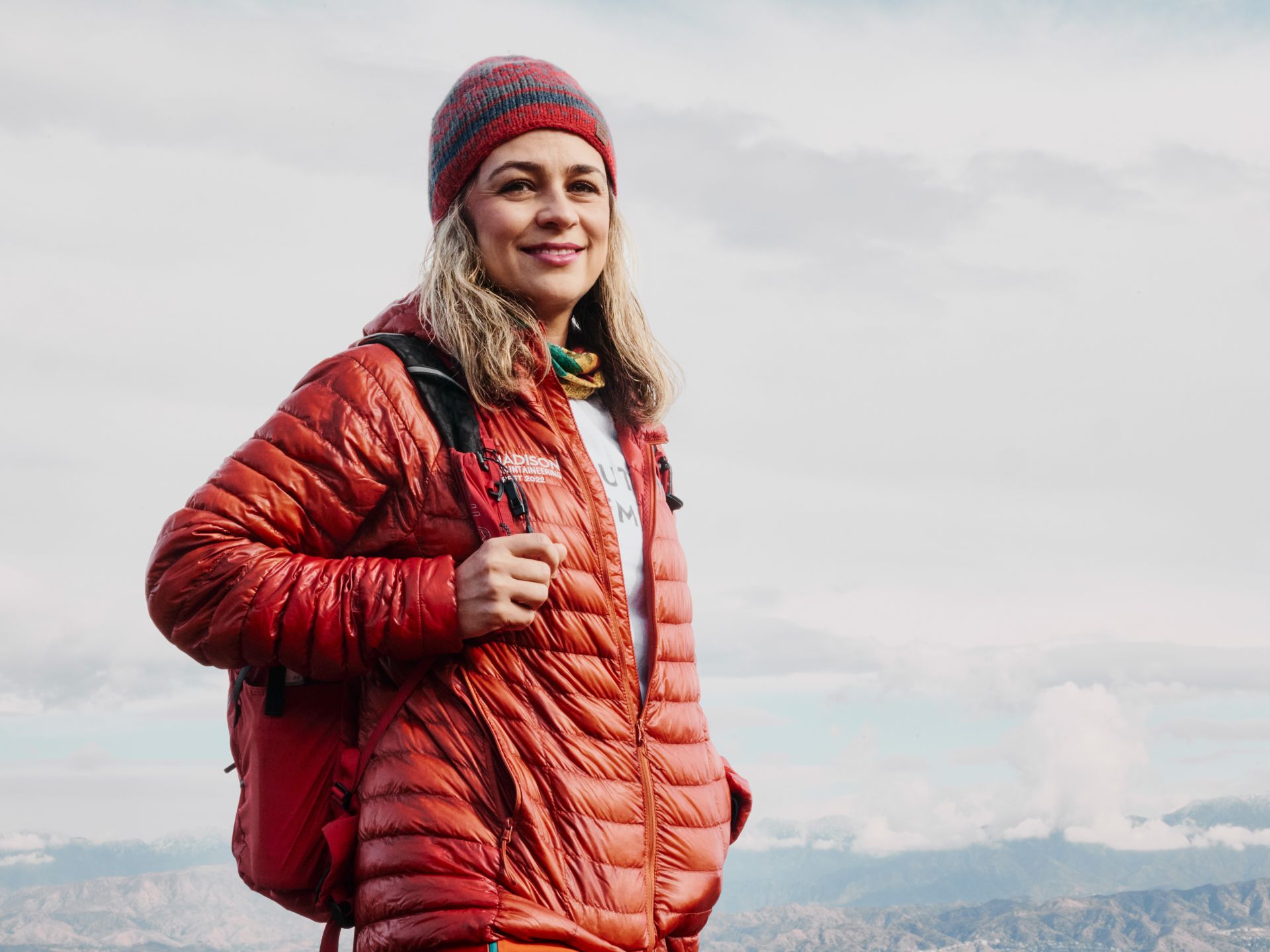
A recent Monday finds Sara Safari ’07, M.S. ’09 at the base of Fryman Canyon in Studio City, not quite sure why she has to hike to the top. “We could’ve just met for coffee,” she says genially.
But given that she’s one of only a handful of women, and the first Iranian national, to ever climb the “Seven Summits” — the tallest mountains on each of the Earth’s seven continents — it seems appropriate to see her in action. Even if a walk up through the 2.6-mile Southern California canyon is not exactly analogous to her past efforts.
“Compared to ice climbing in high elevation,” she says, “hiking in California is like playing with a 2-year-old.”
Probably easier. Growing up in her native Iran, Safari craved the great outdoors. “I wanted to climb trees and play soccer,” she says, striding uphill while chatting at the clip of a cable news regular. “But as I got older” — coming of age in the increasingly restrictive Islamic state — “there were more and more rules. ‘You’re not supposed to do this, that.’” Her father pushed her to study engineering, his chosen field. “It was easy for me,” she says, “but then, when you’re being told to focus on a topic and become really good at it, what else can you do?”
It turns out there was a lot Safari could — and would — do beyond the scope of engineering, much to her own shock and awe. Today, the double Bruin is one of the world’s most in-demand motivational speakers, traveling the globe to share with others what she’s learned while summiting the world’s highest peaks, sometimes in deadly conditions. Safari is the author of two books, and her TEDX Talk about her first attempt to summit Mount Everest has logged more than 25,000 views. Her impact — particularly as a motivator for women — seems only to keep growing.
Ryan Thomas Neace, founder and CEO of Change, Inc., a counseling company based in St. Louis, Mo., first met Safari in 2018. “Real leaders don’t just offer platitudes or advice or ideology,” he says. “They offer themselves. Sara was, and is, a real leader.”
Safari’s path to that role started in 2012, when she enrolled in a three-day personal and professional betterment seminar. The leader instructed the participants to each come up with an “impossible project,” a pie-in-the-sky goal. “Just before the seminar started, the person behind me was telling her friends about how she made it to the base camp of Everest,” Safari recalls. “I heard that, and something clicked. I had no idea what the difference between base camp and a summit was. I just thought it was a mountain.”
When it was Safari’s turn to share her impossible project, she gamely announced it: She would be climbing Mount Everest.
“These Windows Are Weird, Like Me”
As a teenager, Safari stumbled on a photograph of Royce Hall, and it struck a deep chord. She says, “There was something about the windows and how weird they were,” with their leaded glass and atypical shapes. “I was like, This is my school. The windows are weird, like me.” She had an uncle who lived in Los Angeles; when Safari visited him, the first thing she asked on arriving was how far UCLA was from the airport.
“Twenty minutes,” he said.
“Perfect,” she replied.
Accepted into UCLA with a full scholarship, she quickly seized the opportunity to catch up on the fun she’d missed growing up, making friends, joining a sorority. “It was like the United Nations,” she says. “There was always another non-American person who also didn’t speak English as their first language, with whom I could make all my mistakes.” Graduating magna cum laude, she immediately entered UCLA’s electrical engineering master’s program, and from there, went on to a job at a software company. After realizing that the corporate track wasn’t for her — “I didn’t like the concept of a 9-to-5 job,” she says — she began teaching electrical engineering and computer science at the Southern California Institute of Technology and at Cal State Fullerton. Still, something was missing.
“I was shy, quiet, terrified of speaking in front of others,” she says. “I had basically been taught to be invisible growing up. But as an adult, I felt like I didn’t know myself. If someone had asked, ‘Who are you?’ I would have said, ‘I’m an engineer,’ as if that’s all there was to me. I was really frustrated with myself.”
Then came a 2012 conference room epiphany that birthed a bold, audacious dream.
As Safari recounted in her 2017 TEDX Talk, at the time she committed to the goal of climbing Everest, she’d never even slept in a sleeping bag, let alone scaled a mountain. Given that her home was now California, she thought she’d start with Mount Whitney (not exactly a molehill itself). She assembled her supplies and set up camp at Bighorn National Recreation Area; the night before she was to start climbing, her water bottle leaked through her sleeping bag. She got so cold that she thought she was going to die. (She recorded a tearful video saying as much, also featured in her TEDX Talk.) Mission aborted. Her next attempt, climbing a volcano in Ecuador, was also a bust.
“I didn’t know how to train, or what to eat,” she says now. “I decided mountain climbing was not for me.” Fortuitously, the same day she made that decision, a friend introduced her to Jeffrey Kottler, a professor at Cal State Fullerton and the founder of Empower Nepali Girls, a nonprofit organization. “He told me about how so many girls there become victims of human trafficking or get forced to marry young,” Safari says. “Something hit me.”
Safari told Kottler that she wanted to do something drastic to raise funds for his organization. “It was one thing when I was just one person wanting to climb a mountain,” she says. “But now, I would have a whole group of people counting on me. I would have a greater purpose.”
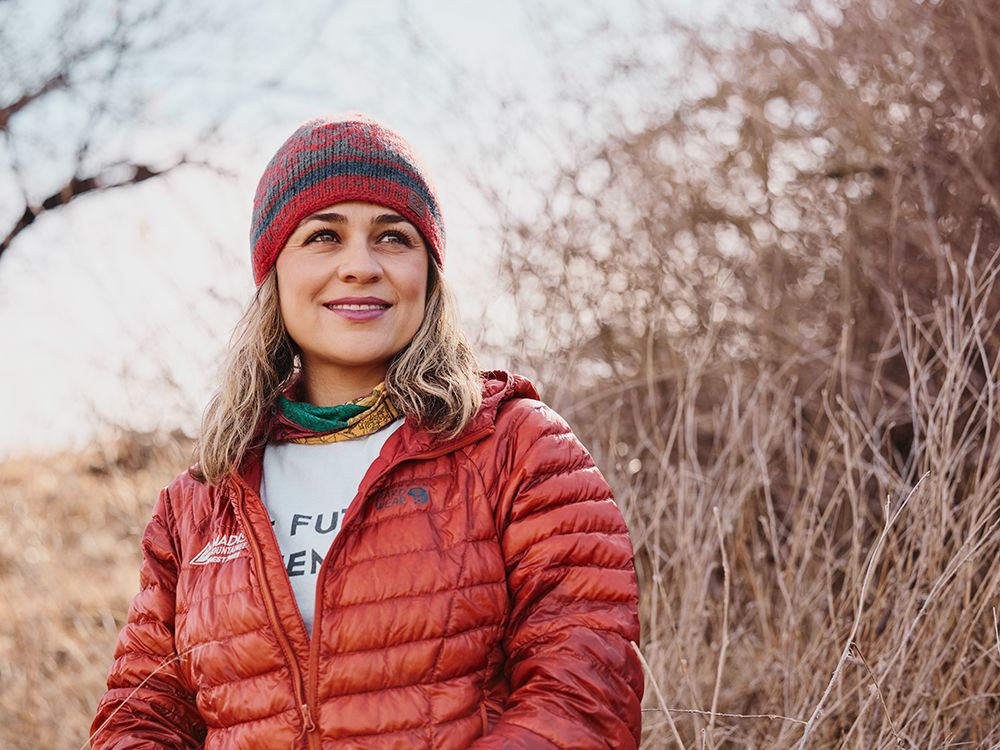
Fueled by a new dream, she began training twice a day. She successfully scaled Argentina’s Mount Aconcagua, the tallest mountain in the Americas. She attempted Mount Whitney again — this time successfully. By spring 2015, she was ready to take on Everest. “It’s 60 days of camping and ice,” she says. “By that point, I was getting stronger and more confident in my abilities.”
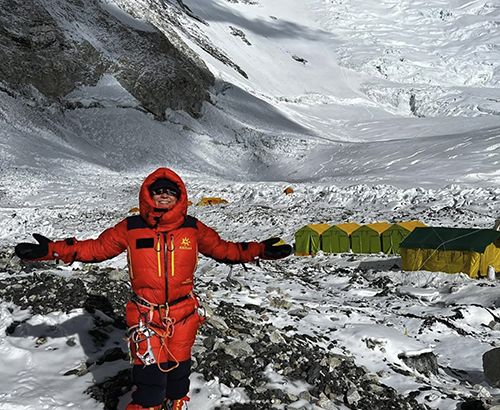
On the morning of April 25, 2015, Safari was on a ladder at 20,000 feet, climbing an ice wall on Mount Everest, when the rock beneath her fingers began shaking. A chunk of ice “the size of a car” flew by her. “There was so much snow in the air, I couldn’t see anything,” she says. “I couldn’t breathe.”
She climbed past the edge, clipped herself to the anchor, and made peace with the fact that this was the end. Then, the shaking stopped. A 7.8 magnitude earthquake had rocked the mountain and the entire nation of Nepal; somehow, she had survived. “I tried to take a deep breath and started sobbing,” she says. Helicopters soon arrived to airlift her and other survivors; within days, she was back in California, shellshocked.
“A Woman Needs to Do It First”
Thousands of people died in the aftermath of the earthquake, including 20 at Safari’s base camp. “I was in the worst place you could be on the mountain, in a situation like that,” she says. And yet she had lived to tell the tale. She wasn’t happy with it. “I just thought, That can’t be the end of the story,” she says. “It would be so sad.” Someone told her that no one from Iran had ever completed the Seven Summits. “That was it,” says Safari. “Coming from a country like Iran, I thought, A woman needs to do it first.”
She now had a new mountain to climb — six of them, to be precise, given that she had already summited Aconcagua. She partnered with seven nonprofits dedicated to female empowerment, pledging to raise money with each step she took. To hear her tell it, most were molehills. (“I started easy, with Kilimanjaro,” she says. “I don’t have kids, but if I do, I’ll take them to Kilimanjaro.”)
Still, Everest loomed in the distance. She didn’t want to revisit the site of so much devastation, but she considered what was at stake. “I didn’t want to teach the girls to quit,” she says. “I felt responsible to them and these charities. I could not just go home.”
And so, in 2022, 10 years after conceiving her “impossible” project, she summited Everest. No small feat, but Safari was already hard at work on yet another one — Climb Your Everest, a nonprofit she founded in 2019 to help women overcome obstacles and become the best version of themselves.
“It’s not that I fell in love with sleeping on ice,” says Safari. “It’s that I really liked the person it made me, the results of it.”
In Safari’s view, much of mountain climbing applies to life. “When I was climbing, I became very comfortable with uncertainty,” she says. “That’s one thing I talk about a lot, dealing with failure and uncertainty, the fact that you have to be resilient.”
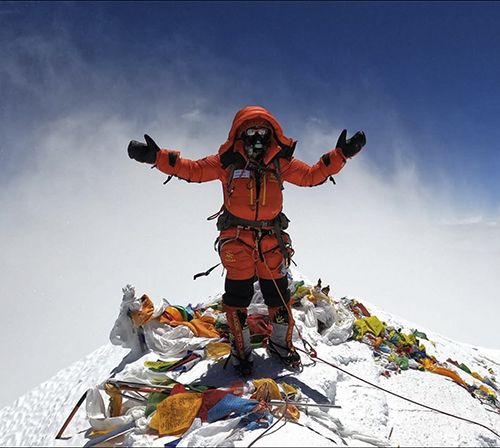
Today, Safari travels the world hosting leadership workshops for women, with a focus on practical disciplines like communication and how to build confidence. The process has also built up her own sense of purpose. “She’s really come into her own as a leader,” says Alyssa Theis, a Climb Your Everest board member who’s known Safari since 2015. “She is a very natural person that people want to follow, but I’ve seen so much growth in her ability to articulate what she’s doing, and why she’s doing it. She is a very enigmatic and exciting person. If ever there was a person to make such a significant impact on the world, it’s Sara.”
Today, corporations and organizations often hire her to speak on topics like conquering adversity and how women can empower themselves. “Beyond the other explicitly powerful and inspiring messages she provides about her treks to Everest and her advocacy efforts across the globe, she gave us herself,” says Neace, the Change Inc. CEO, who befriended Safari during a hike to Mount Everest’s base camp. Neace subsequently hired her to speak at two of his company’s events. “She spoke plainly and authentically, without subtext or hiding. She didn’t pretend to be anyone she’s not.”
After our hike together, we are back at the Fryman Canyon parking lot, and business beckons. “I have another speech to give this week,” Safari says. I ask her if she misses actual mountain climbing.
“I love nature, so yes, I miss that part, but for 10 years, I was so focused on mountains and just getting to the top,” she says. “Now it’s time to focus on something else.”
Read more from UCLA Magazine’s Spring 2025 issue.