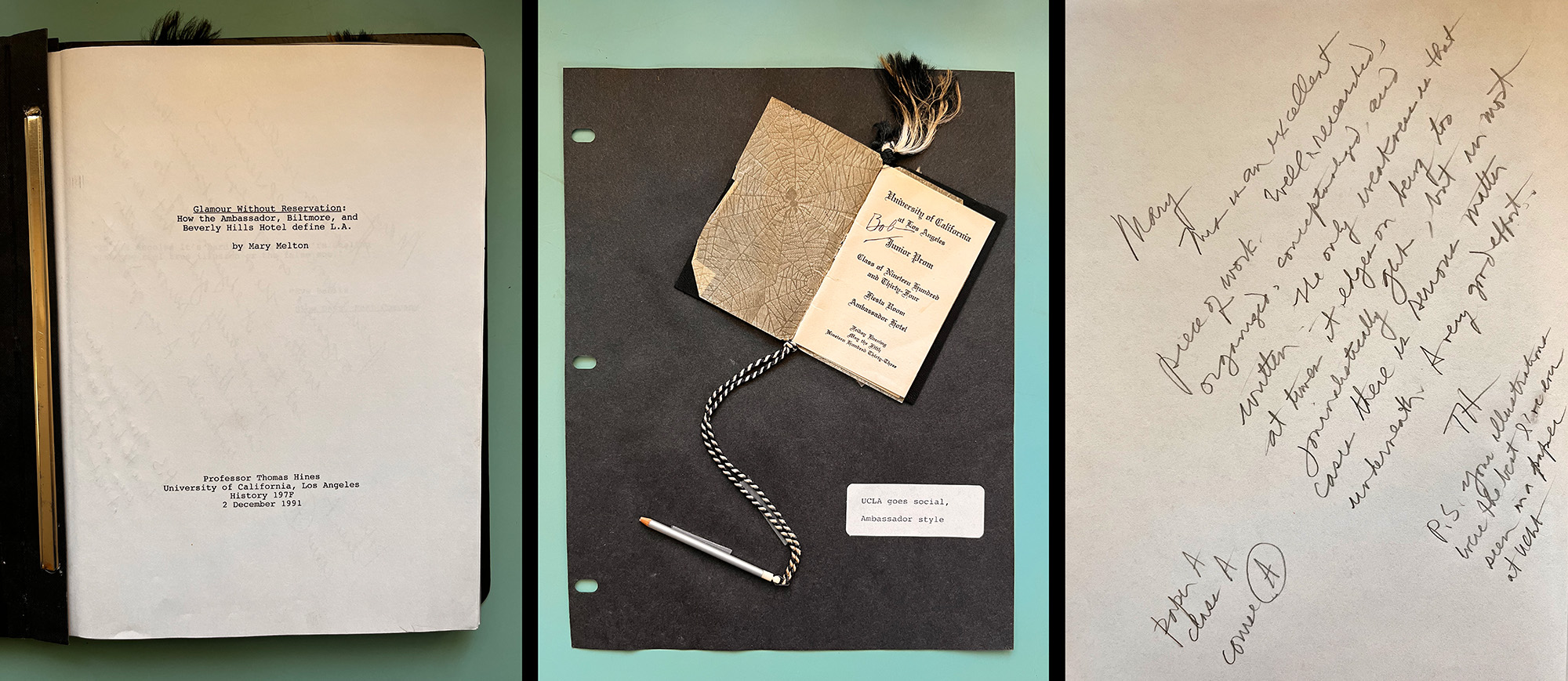
Among the many volumes on the subject of Los Angeles that line my bookshelves — I reached 273 before I lost count — only one is handmade. Its title is Glamour Without Reservation: How the Ambassador, Biltmore, and Beverly Hills Hotel Define L.A. It’s only 21 pages of text (not including endnotes or the bibliographical essay), with an additional 17 pages of photographs and collected ephemera, all held together in a folder with a metal fastener. Inside the title page is this inscription:
Mary
This is an excellent piece of work. Well researched, organized, conceptualized, and written. The only weakness is that at times it edges on being too journalistically glib, but in most cases there is serious matter underneath. A very good effort.
TH
P.S. Your illustrations were the best I’ve seen in a paper at UCLA
I wrote the paper in 1991 for a fall seminar at UCLA called “History of Los Angeles.” The seminar was led by Professor Thomas Hines, who taught in both the history department and the department of architecture and urban design. He had begun offering the class two years earlier. Enrollment was limited to a dozen juniors or seniors, who met once a week for three hours of intensive study.
I was set to graduate with a B.A. in history that fall. History 197F would be among the last courses I took at UCLA; it would also be the most consequential.
Over the course of 10 weeks, Hines led us on a deep dive into the mythologies of a place I thought I knew well, but didn’t. I’m the fifth generation of my family to call Los Angeles home. I grew up in the San Fernando Valley and attended Hollywood High School (my mother’s parents met there in the late 1920s); I had strong opinions about guacamole, the Dodgers and the Oscars. What I didn’t have was a strong grasp of what made Los Angeles, well, Los Angeles, beyond those kinds of pop cultural touchstones.
Hines asked us to read Nathanael West’s apocalyptic novel about Hollywood’s dark underbelly, The Day of the Locust, and Otto Friedrich’s oral history of film’s golden age, City of Nets. We parsed and picked apart (and sighed at the singular elegance of) essays by Joan Didion. We learned that to understand how power works in Los Angeles, you must dip your toes in the chapter about water in Carey McWilliams’ Southern California: An Island on the Land, written in 1946 and still, for my money, the definitive history of the region.
At the head of the table each week sat Hines, nattily dressed, with a flat smile and a well-articulated beard. He was warm and compact as a human, but also suffered no fools — in that way, he reminded me of my father, who led the drama department at my alma mater, Hollywood High. But while my father was all booming Texas bravado, Hines began each class with an introduction to the work delivered in an understated, melodic Southern lilt. If he looked and sounded like a character out of Faulkner, there was geographic justification: Hines grew up in the writer’s hometown of Oxford, Mississippi.
This son of the South had fallen hard for Southern California, and through his eyes and instruction I was falling hard for it, too. In our class, he placed an emphasis on his own area of interest: modern architecture, a subject to which I’d never given much thought. Hines had written his own definitive history of modernist icon Richard Neutra, and he assigned us architectural historian Reyner Banham’s critique of the city, Los Angeles: The Architecture of Four Ecologies, which devoted chapters of equal weight to downtown and Disneyland. Was I really studying … Disneyland? I was! And I saw it, and every intersection I drove my pickup truck through — commuting from my childhood home in North Hollywood to the UCLA campus to my internship at the LA Weekly newspaper in Silver Lake — through a wider lens.
A city that was black and white was now in color: I was noticing and able to differentiate between Streamline Moderne, Spanish Colonial and Mission Revival design. I was also feeling so much more. My primary education in the Los Angeles Unified School District had skipped the ugly parts of our history. I was now realizing just how fraught that history was. No wonder it was such a complex and confounding city.
For my final paper in the course, I chose to write about how three landmark hotels reflected “the idealized definition of Los Angeles” rather than the real L.A. that was sprouting up around them. Before our last class met, Hines piled us into a van and took us on a tour of places that defined the city for him. We visited the Bradbury Building and ate lunch at Central Market; in Santa Monica, we stopped at Horatio West Court, Irving Gill’s influential 1919 attached-house complex, and at Frank Gehry’s cockamamie residence.
These weren’t just works of architecture — they were living, breathing works of art. In some cases, we were able to go inside the buildings. The rediscovery of and new appreciation for midcentury modernism hadn’t yet swept home design when I was at UCLA. But when it did, I had a bank of knowledge to draw from.
I talked recently with my friend Allison Arieff ’88, who had taken Hines’ course a couple of years before me (we learned of the connection later). When Alison was serving as the editor-in-chief of Dwell magazine, years after graduating from UCLA, she recalls sitting at her desk one day and looking through pictures of iconic L.A. spots like the Eames House. “For some reason, it hit me,” she says. “Oh my God, I went to all these places.”
“I’ve always had a soft spot for [Professor Hines] and that class,” she told me later. “So much of my experience at Dwell was meeting people who maybe didn’t have an appreciation for architecture at all until they stepped physically into it. I completely understood that, because it was such a memorable experience for me to be in those houses.” Hines’ course, she says, was “a little spark I didn’t even realize until later, because I’ve spent a good deal of my life looking at modern architecture.”
A few weeks after graduating from UCLA, I started a full-time job as an editor at the LA Weekly. I’d go on to be an editor at the Los Angeles Times Magazine, and eventually became editor-in-chief of Los Angeles magazine. Now, I’m the editor-at-large for Alta Journal, a quarterly that demystifies California and the West. So you could say that I’ve spent the entirety of my professional life looking at Los Angeles from every angle. That spark was lit, like Allison’s, in History 197F. (And for the record, I still lean toward being too journalistically glib.) It’s a lot to say that one class can inspire an entire career path, but for me, it’s true. My desire to learn everything I could about this place, and to share what I discovered with as many people as possible, started that fall in Bunche Hall.
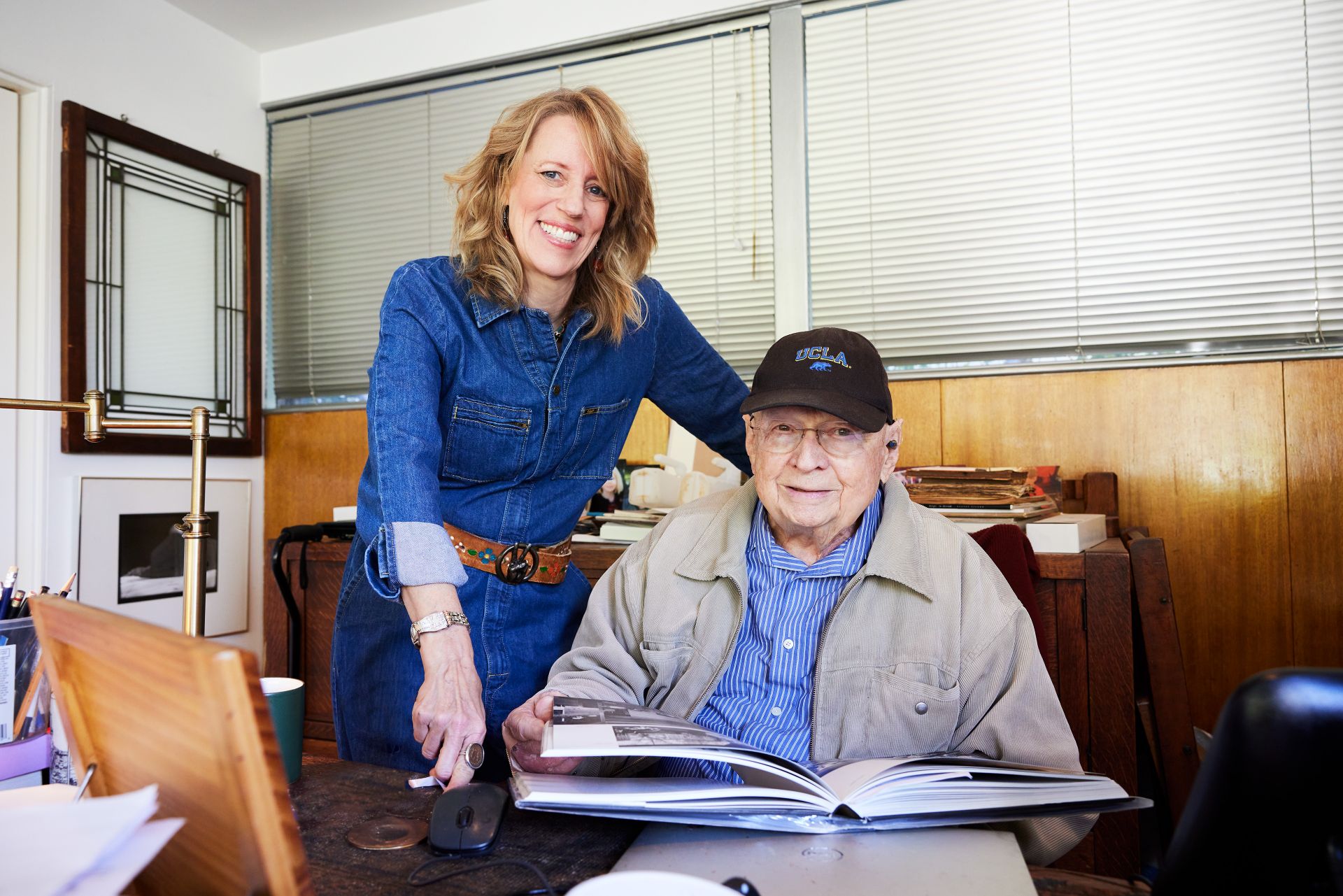
At the culmination of the course in December, Professor Hines invited the entire class to dinner at his own home. He lived then, as he does now, in a Richard Neutra–designed apartment in Westwood. He treated his college students like full-grown adults, and it’s something I’ve been able to thank him for in person more than once. We met for lunch again last summer at the Getty Center, where Hines maintains a research desk in the library. At 88 years old, he’s still studying and still figuring out this vexing adopted home of his. He asked about book projects I have swirling in my head, and was insightful, thoughtful and constructive. The spark hasn’t left him yet.
And thanks to the path he set me on, I know it will never leave me, either.
Read more from UCLA Magazine’s Spring 2025 issue.