When Guillermo Miranda’s grandmother flew in from Mexico to visit his family several years back, she packed light on clothes and heavy on cheese. Wrapped in salmon-pink butcher paper, over 100 pounds of homemade queso de cincho filled his Abuelita’s checked bag, resulting in a hefty overweight baggage fee.
Those cheese wheels and their roughly $300 ride to California became a running joke in Miranda’s family, but the experience stuck with the UCLA history major. Miranda loved cheese and revered the generations of artisans and ranchers in his family who had upheld traditional dairy practices in their respective states of Guerrero and Michoacán, Mexico.
But why was cheese so important to his grandmother that she would dedicate an entire suitcase to it — and pay extra for it? What did those wheels of cheese represent beyond flavorful food? And what did it say about the dairy practices in Mexico that have survived over centuries?
The curiosity sparked by that visit became the foundation of Miranda’s scholarly exploration into traditional Mexican cheesemaking and the role that food and informal economies play in preserving identity. These ideas would be tenets to his research focus as an undergraduate student at UCLA and in the Mellon Mays Undergraduate Fellowship program, for which he was selected in his first year on campus.
‘I didn’t think it was attainable’
Miranda, who is graduating this June, transferred to UCLA from Long Beach City College in fall of 2023. Being a first-generation college student, he hadn't initially considered UCLA within reach. “I applied kind of on a whim,” he said. “I honestly thought they had made a mistake when I got in.”
Miranda began to think differently once he took part in UCLA’s Academic Advancement Program’s Transfer Summer Program. It was there that he was introduced to research as a structured academic path. “I realized I needed to hit the ground running,” he said. “And I did.”
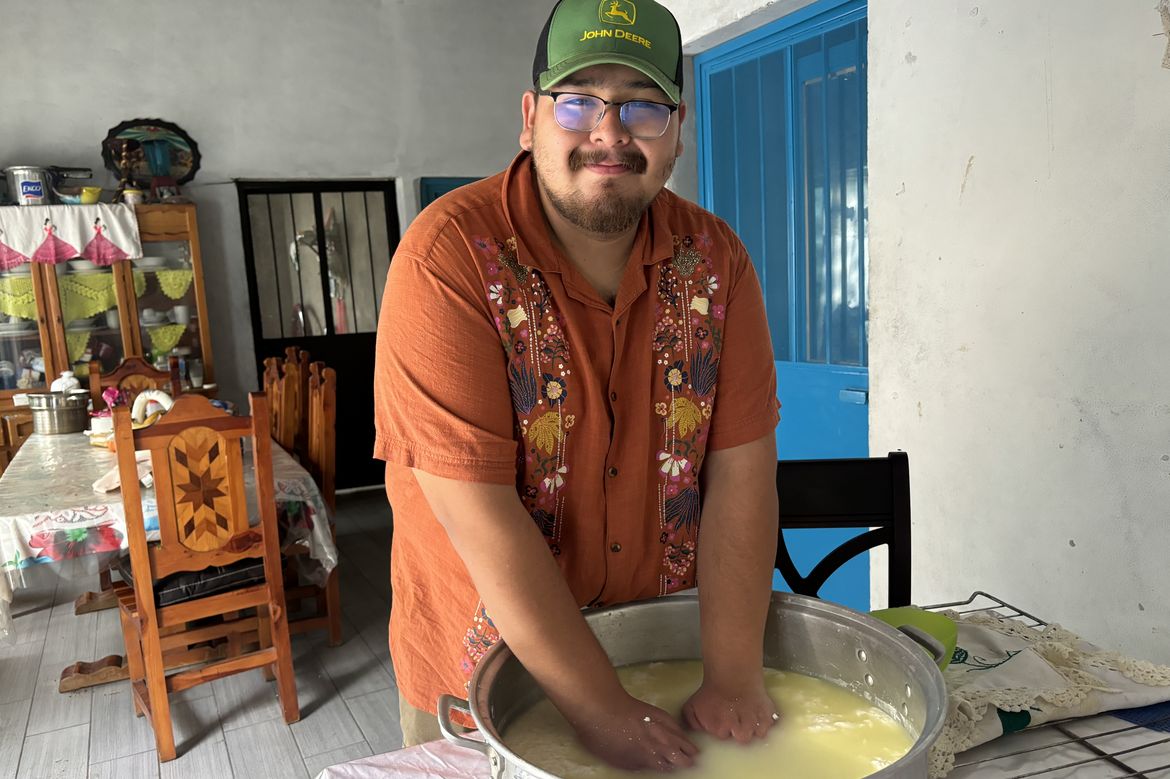
Working with history professor Robin Derby as his faculty mentor, Miranda began transforming family conversations into academic inquiry. The notion for his senior thesis started with cheese and memories of growing up close to his Abuelita, Mariana, an artisanal cheesemaker who once taught him how to separate curds from whey by hand.
“She told me, ‘You have to go slow or you ruin it,’” said Miranda, noting that moving too fast would turn the cheese to sludge. “It was very sensory. I vividly remember the feeling of it sticking to my hands.”
As Miranda dove deeper into the economic and cultural history of cheesemaking, he uncovered larger patterns: economic survival through community-based credit systems called “fiao”; resistance to U.S. and Mexican government campaigns to industrialize food production; and the ways rural families exercised their autonomy through everyday practices.
Field notes from Guerrero
In the summer before his senior year, Miranda spent time in Guerrero, immersing himself in ranching and cheesemaking. There, he was struck by a rancher’s attention to his cows, like in the case of “Tortuga,” who had lost a calf a few days prior and was tenderly milked to relieve the pressure on her teats; the milk then poured over her back and tenderly rubbed into her skin so that she could re-absorb the nutrients.
Miranda also observed artisanal cheesemakers so in tune with their product that barely a caress over the surface of their aging wheels could allow them to gauge the ripeness of the cheese inside. Some, like Mariana, stored heaps of cheese wheels in spare bedrooms, awaiting pickup by buyers both local and from the U.S.
His own memories of watching his father slice cheese from the wheel to share with the family gave him a way to frame these practices not as curiosities, but as culturally significant and economically strategic.
On one visit, Miranda remembered going to the store to buy a bag of chips but realizing he didn’t have enough cash on hand. The vendor waved him off and told him to pay next time — a firsthand lesson in “fiao.” That moment underscored the quiet economies of trust and the community closeness embedded in everyday life for those in the region.
For Miranda, those field experiences blurred the lines between scholarship and lived experience. “I can talk so much about cheese and cows,” Miranda said. “But what surprised me most was how much others wanted to talk about it, too. I realized this project could resonate beyond just me.”
Miranda’s work has already received notable recognition. Earlier this year, he earned second place in the UCLA Library Prize for Undergraduate Research in International Studies. He also presented his findings at the Mellon Mays Undergraduate Fellowship Western Regional Conference.
“At first, I was surprised,” Miranda said of the library prize. “You don’t think of cheese research as something that’s going to win awards. But I think people connected with it because it was personal.”
Miranda believes it’s essential that undergraduates are supported in doing original research. Pursuing a personal topic, he said, can open new ways of thinking and learning — and that passion resonates.
Miranda plans to pursue a master’s degree at Cal State Long Beach before returning to UCLA for a doctoral program. Along the way, he hopes to deepen his research by exploring other regions’ dairy practices and possibly expanding his focus to look at cheesemaking traditions beyond Mexico.
“I always thought I wanted to teach high school,” he said. “But now I think maybe I could be a professor one day. I want to keep going.”
That doesn’t mean forgetting where he came from. Miranda works his construction job with his brother on weekends, and he credits his background for shaping his intellectual perspective.
“This research has helped me reconnect with my family and culture,” he said. “It’s also helped other people do the same. I’ve had people come up to me and say, ‘Hey, my parents make cheese too.’ That’s what makes this all worth it.”