UCLA is ranked among the most Instagrammable universities in the nation, and it’s easy to see why. Across 419 acres, Bruins can frame a perfect shot almost anywhere — beside the Inverted Fountain, from Janss Steps at dusk or in Royce Hall portico as morning light pours through.
Yet the site holding some of UCLA’s earliest history may be one of its least photographed: Founders’ Rock.
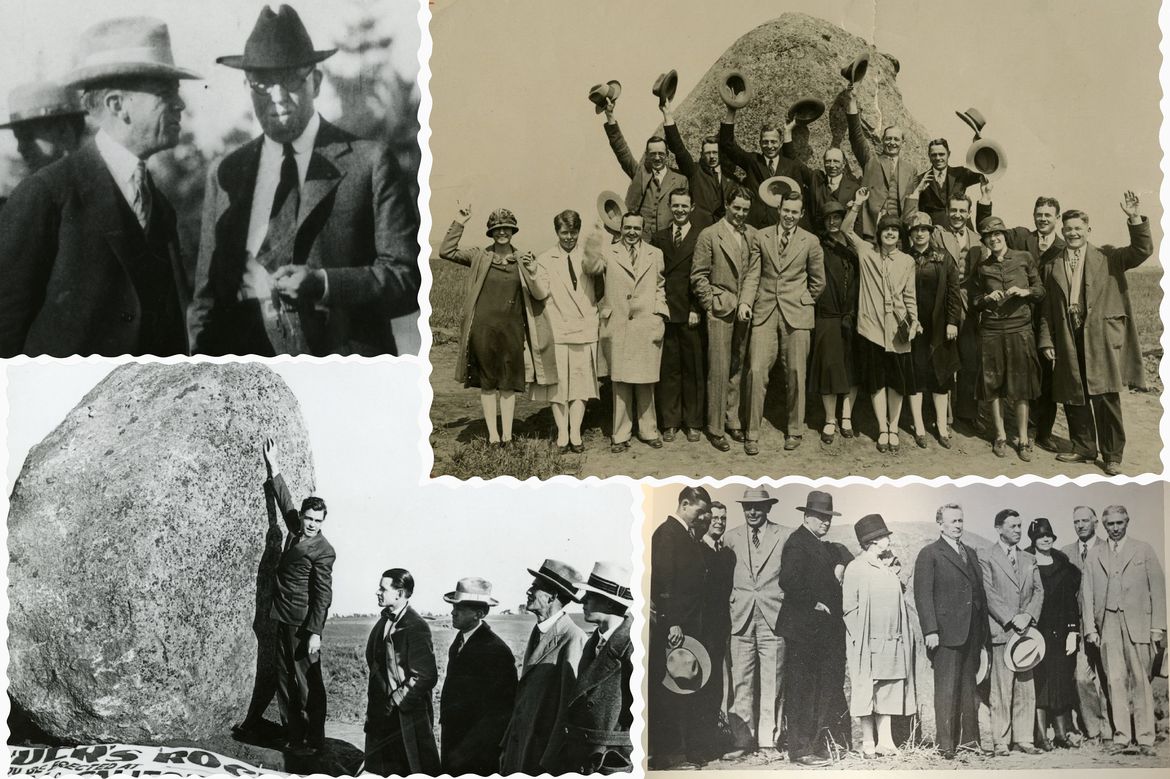
On Feb. 19, 1926, a 75-ton granite boulder hauled from Perris Valley in Riverside County was placed on the site that would become UCLA’s new home in Westwood. At the time, the university — then known as the Southern Branch of the University of California — was still at its 25‑acre campus on North Vermont Avenue.
Today, Founders’ Rock sits across from Murphy Hall at the northeast corner of Dickson Court and Charles E. Young Drive — a quiet but enduring witness to the university’s beginnings in Westwood.
We asked Robert Gurval, associate professor emeritus in the UCLA Department of Classics, who is widely regarded for his deep knowledge of the university’s history and architecture, about those early years.
How did a 75‑ton boulder end up representing UCLA’s future in Westwood?
Its original intention was to serve as a marker, similar to “Founders’ Rock” in Berkeley, where the University of California was dedicated in 1860. The rock arrived on Feb. 19, 1926, and was installed on the spot where UC Regent Edward Dickson and his friend Irwin W. Muma, former president of the Los Angeles Rotary Club, first surveyed the future site of the Westwood campus in 1923.
A long-standing campus legend claimed that students impulsively ordered the massive granite boulder and then failed to pay the trucking bill. In reality, it was Dickson’s friend James R. Martin who covered the cost of transporting the rock — a journey said to have taken 10 days.
Early photographs show the rock standing upright, with people stretching to touch its top. It has been moved three times since then to its current location in the northeast corner beside Murphy Hall, where it now rests on its side.
On Oct. 25, 1926, California’s 25th governor, Friend Richardson, members of the UC Board of Regents, university officials and students officially dedicated the rock in a campus ceremony — in front of the newly installed flagpole and nothing else.
A freshman who attended the ceremony, Sherman Grancell, recalled in his journal that “there was dirt and weeds and Founders’ Rock.”
What was the terrain like in Westwood before UCLA’s founding?
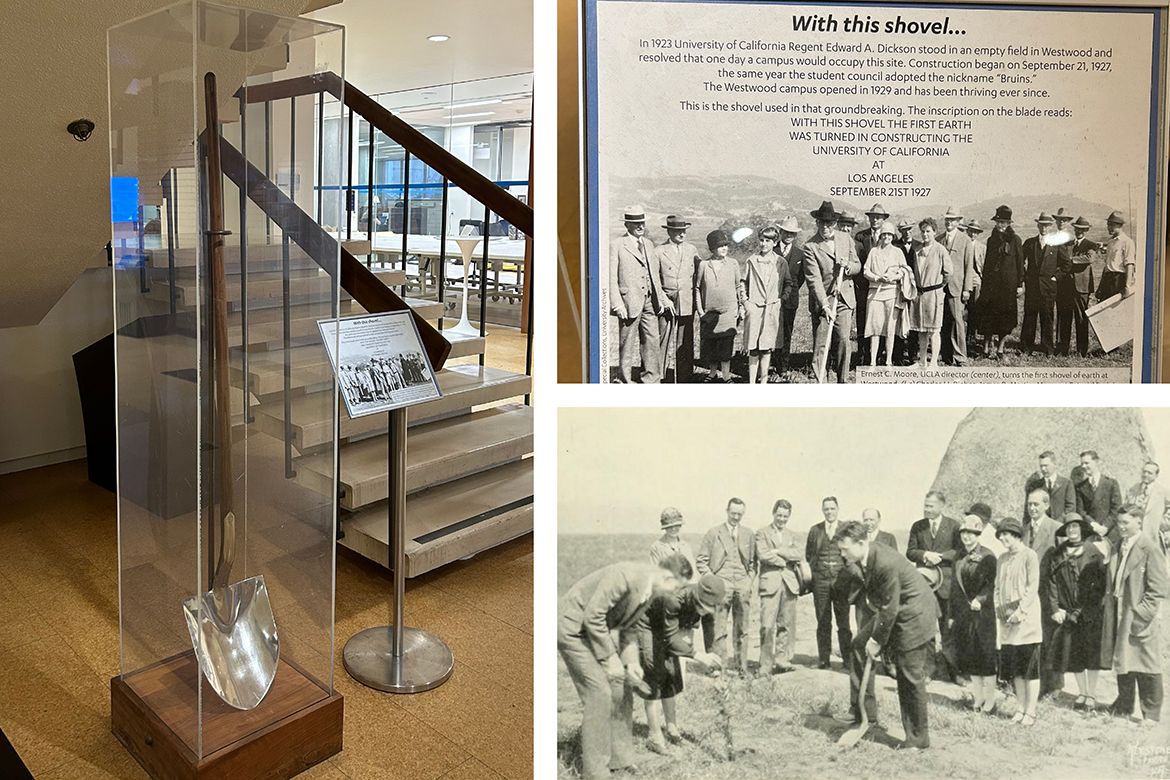
It was originally just acres upon acres of shrubs. There were some chaparral plants and very few trees. When ground was first broken on May 3, 1927, the first structure built was the Arroyo Bridge. It was needed to transport building materials across the deep ravine, or arroyo, which originally cut through the campus. On Sept. 21 of that year, Dr. Ernest Carroll Moore, the first director of the University of California at Los Angeles, or the Southern Campus, as it was called by the student yearbooks, turned the first shovel of earth for the construction of what would go on to be UCLA’s famed quadrangle. There’s a picture of this day — and the actual shovel that Moore used — at the bottom of the stairs opposite Special Collections of the Young Research Library.
In this video, you describe a surprising incident involving UCLA’s original flagpole, which was dedicated at the same time as Founder’s Rock.
Jake Gimbel was the donor who gifted both the original wooden flagpole and the steel pole that is still standing. When the wooden pole eventually cracked and oil began to seep out at its base, people got very excited. They thought, “Oh, there’s oil under our campus,” — which wasn’t an unreasonable guess, given that Los Angeles had active oil wells at the time.
But what actually happened was quickly clarified by the man overseeing the campus grounds. He explained that when the wooden flagpole was installed, its base was set into a casing or basket filled with oil to prevent the wood from rotting in the soil. At some point, that casing cracked, and the oil that surfaced was simply the protective oil they had used, not evidence of any underground reserve.
So, the brief excitement about striking oil beneath our new campus faded almost as quickly as it began.
What is the story behind the stone bench on the east side of Royce Hall inscribed with the words “Trees of 1931”?
This lonely stone bench was once known as the “Senior Bench,” according to the photos I found in old yearbooks. We also know the seniors of the Vermont Avenue class of 1926 gave the gift of trees when the Westwood site was newly acquired, but they were planted along the campus arroyo five years later, in 1931.
Are these then the trees of 1931? I’m still not sure, but I can tell you that the two majestic Himalayan cedars — which were planted to symbolize the university’s growth and strength — now stand as wooden pillars framing the bench and are, perhaps, the oldest trees on campus.
But the first major gift to the new Westwood campus was Kerckhoff Hall. Before his death, lumber and energy magnate William G. Kerckhoff, who helped bring electricity to California, told his wife, Louise, that he wished to fund a building for student purposes. She ultimately gave more than $715,000 toward its construction and more than $100,000 for its furnishings. (Adjusted for inflation, that commitment exceeds $15 million.)
The campus was especially fortunate in its timing. In October 1929, the stock market crashed, marking the start of the Great Depression. Had the funds for Kerckhoff Hall not already been secured, it’s hard to imagine what would have become of the project.
Why does Kerckhoff Hall’s architecture differ from that of Royce Hall and the other three buildings that make up UCLA’s iconic quad?
The architectural language of UCLA’s earliest buildings is rooted in the Lombard Romanesque style of northern Italy. That choice wasn’t accidental. The architects wanted a style that aligned with Southern California’s Mediterranean climate and cultural sensibilities. Romanesque architecture, with its ties to Italy and Spain, felt more at home here than the Gothic traditions associated with Oxford and Cambridge.
Kerckhoff Hall is the exception — and intentionally so. Because it was conceived as a student building, the director, architects and possibly Mrs. Kerckhoff wanted it to have a different character. They chose a Gothic style. While the rest of the original quad speaks in a unified Romanesque voice, Kerckhoff stands apart, signaling that student life had its own distinct place and spirit on the emerging campus. As Dr. Moore wrote in his autobiography: “It has a purpose of its own and should be set apart in a style of its own. It should be in its own note and should accent the style in which the other buildings are.”
As for Royce Hall and its neighboring trio of buildings, a lot of symbolism is at play. The university’s founders wanted to gesture toward the lineage of Europe’s earliest centers of learning. Bologna — often cited as the oldest university in the Western world — sits in northern Italy, so adopting a Lombard vocabulary was a way of placing UCLA in conversation with institutions nearly a millennium older.
If you walk into the front lobby of Royce Hall today and look up at the eight painted “wooden” (disguised concrete) beams, you’ll see the seals of 16 European universities, two on each beam, starting with the oldest: Bologna and Paris, Oxford and Cambridge, Padua and Salamanca, Prague and Montpelier, Heidelberg and Uppsala, St. Andrews and Leyden. It’s a visual declaration of aspiration that this brand‑new university, founded in the 20th century, could — one day — stand among them.