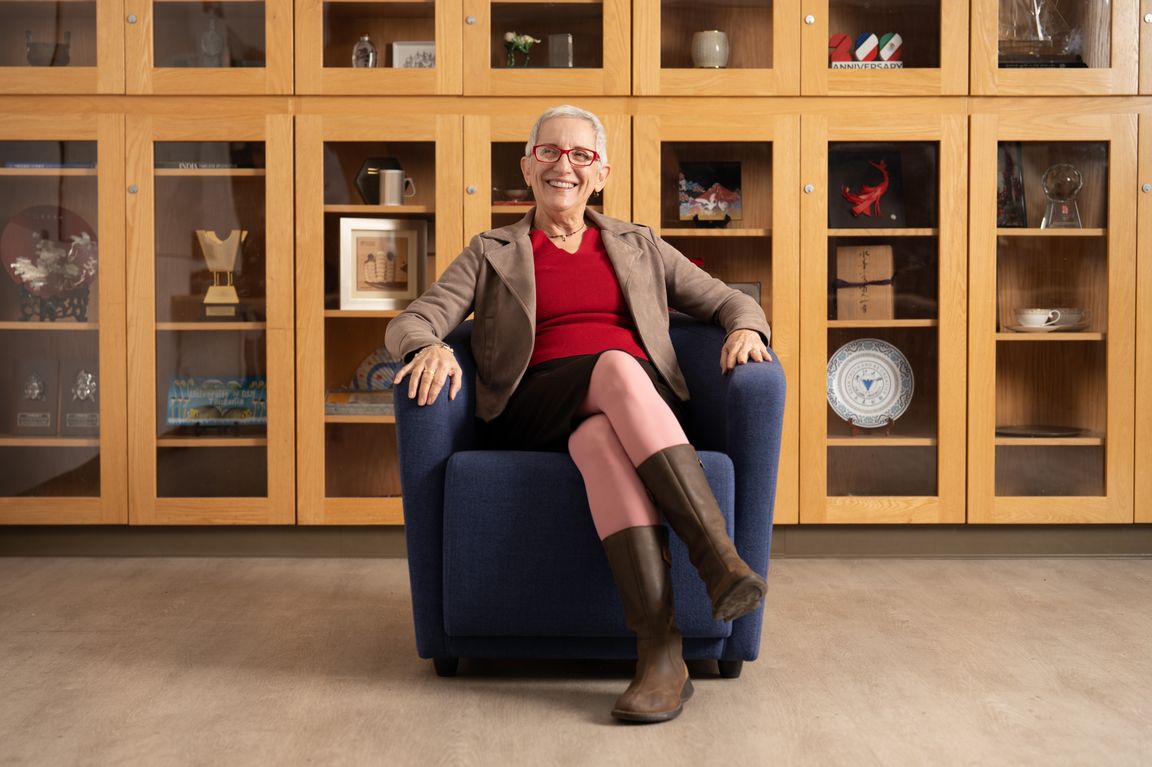
Kathryn Paul joined UCLA several years ago as a part-time employee at the Center for World Languages, and has since become an integral part of the UCLA International Institute and Creating the Future: UCLA Strategic Plan 2023-28.
For the past several years, Paul’s work at the center focused on research and teaching programs that helped heritage language speakers — or those who grow up in homes where English is not the primary language — improve literacy and vocabulary skills.
Five years ago, she was elevated to assistant vice provost for international studies and global engagement at the UCLA International Institute, and is now part of the senior leadership team that examines potential international projects for the university. Along with Vice Provost for International Studies and Global Engagement Cindy Fan, Paul and the team bring in a wide range of projects, including undergraduate academic programs, cross-disciplinary majors like global studies, and international development and faculty-driven research projects in places such as South Korea, Greece and elsewhere.
Newsroom sat down with Paul to talk about her vision for the university’s outreach, both locally and abroad.
This interview has been edited for length and clarity.
What specifically do you do in your job?
Prior to working on the university's goal to expand our reach as a global university, I was already managing most international agreements for our campus. I’m not an attorney, but I work closely with our legal office as the point person. Most international agreements are faculty-driven, so when a faculty member finds a partner they want to work with, they come to me directly, and I work across departments and campus units like human resources, insurance and risk management and even administration to see if things have come up like policy changes.
The agreements I work on can run the gamut, which is exciting. Projects range from student or faculty exchanges on collaborative research projects to training. For example, in a typical week, I could work on an agreement for a joint project in urban planning, another for returning art objects to indigenous peoples by the Fowler Museum, or clinical training at the David Geffen School of Medicine! There is such a variety.
A recent project I helped collaborate involved master clinical training affiliation agreements between the David Geffen School of Medicine (DGSOM) and about 30 medical schools across the globe. These agreements allow our medical students and other trainees to spend at least four months at a host university to complete a project in global health related to research, policy, advocacy or public health programming.
Another project, a student exchange agreement between the UCLA Luskin School of Public Affairs and the University of Geneva, has established a graduate student exchange program where each institution is allowed to send up to three students to the host institution for up to one year.
I’m working now on an agreement between the Waystation Initiative of the UCLA Cotsen Institute of Archeology and Peru’s Ministry of Culture to promote research and academic training on the protection of and enhancement of properties of cultural heritage as well as the return of some properties.
While international agreements play a large part in our strategic plan, we also have a strong commitment to cultural competence. We were already working with Dean and Vice Provost of Undergraduate Education Adriana Galván to look at travel study opportunities, overseas programs and ways we could create more study abroad opportunities for students. That workstream was also broadened to align with the strategic plan.
What is a project you’re working on — and why is it important?
When I started working with Cindy Fan, we realized that at UCLA, “international” doesn’t just mean “another country outside of the United States.” We saw faculty working on local issues with an international impact and vice versa — work on international problems had a local impact. Los Angeles itself is an international, or “glocal,” city, and this framing helped us expand our strategic goals to connect faculty internationally and locally.
During our initial work on the strategic plan, we met with alumni, donors, students and faculty, and we asked them, what does “expand our reach as a global university” mean to you? One view that emerged quickly is that UCLA already is a global university, but we do so much that people don’t know about.
A major part of our work then became collecting the data and telling the stories, and we formed the Global Advisors Council to help do that. Every department on campus, including UCLA Extension and the Library, has a representative on the council, which meets monthly. At the start, we asked representatives about their international endeavors and talked about what is happening internationally on campus — so we could share that knowledge. We hope this will inspire more cross-campus activity and dialogue about international activity.
We also formed a subcommittee to look at ways of collecting data on the international activity of our faculty. We now have funding for two award grants, a global research award and a global education award, with the goal of expanding international education and curricula within departments and overseas.
For me, the Global Advisors Council is one of the most important projects I’m working on. It has four subcommittees and I work directly with each one to help them brainstorm and move projects forward. It’s been wonderful seeing the enthusiasm and dedication that faculty and staff across campus bring to the committee. There was not a huge international voice on campus before, but we are now bringing this important perspective to UCLA. There is a lot of excitement around the “glocal” aspects of the strategic plan and people love to share their stories.
What do you love about working at UCLA?
I just love my colleagues! I think it all comes down to who you work with, and I just couldn’t be happier. UCLA is a great place to be, and the International Institute is the perfect place to be for me. Cindy Fan is an amazing leader and my colleagues in the senior leadership group are wonderful and supportive.
My role working across campus has been so rewarding, and I get to meet so many people from so many different places. Every day, I get an email from a faculty member at an international university seeking a connection. And I have the joy of helping them connect with the right person! I get to say ‘Yes, we have someone who does X, Y or Z, and I’ll put you in touch with them.’ And you just feel good about that.
Of course, I do not do this on my own. The staff I work with want to be here and are so committed to this work. I have fantastic colleagues who help me connect people internationally so we can secure agreements.
And of course, I love our beautiful campus!