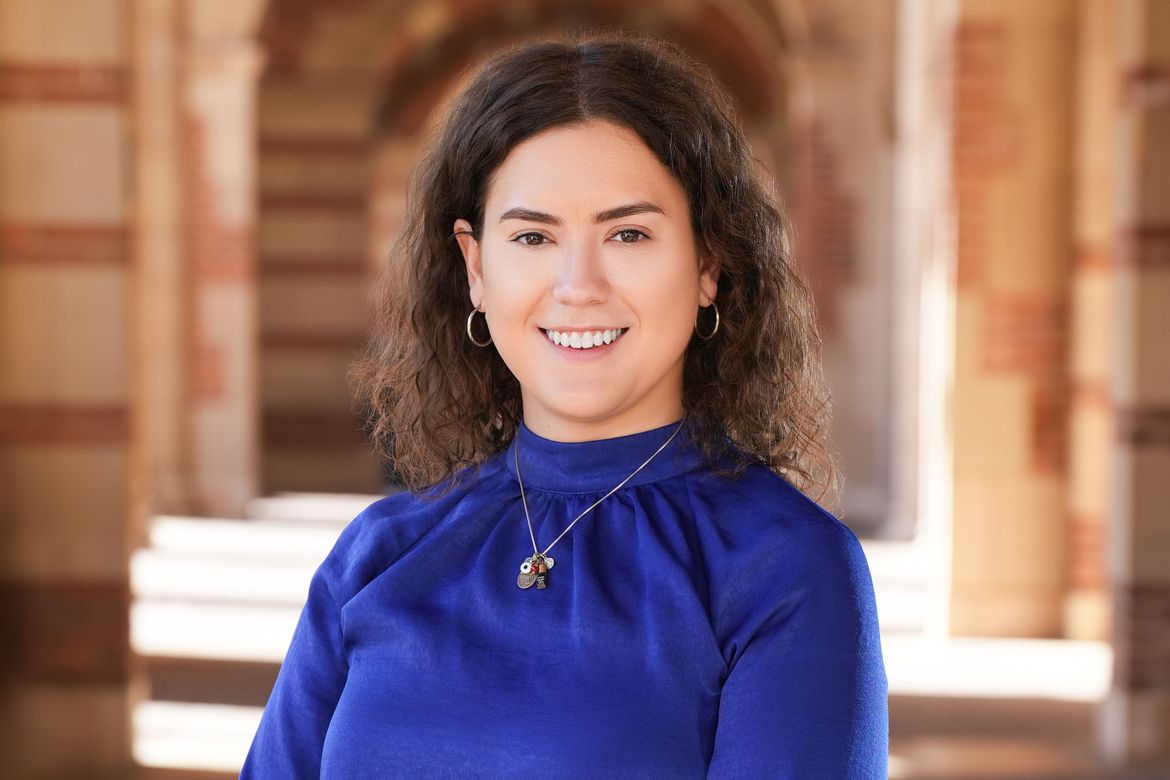
As a youngster, Vanessa Aviva González-Siegel didn’t always like the music of Celia Cruz, the Cuban artist who reigned the latter half of the 20th century as the “Queen of Salsa.” González-Siegel associated the singer’s music with the soundtrack to weekend chores, which in her childhood home started promptly at 7 a.m. when her grandmother handed González-Siegel a broom and expected her and her cousins to clean the one-bedroom apartment their immigrant family of 10 shared in New York City’s Washington Heights neighborhood.
González-Siegel has since come to cherish these memories as reminders of the place where her sense of identity and purpose first took shape. Cruz’s music can often be heard blasting from González-Siegel’s car or office — a testament, she says, of the enduring influence of her background and its ability to be her “superpower” as she’s navigated a life committed to inclusion work in higher education and LGBTQ+ advocacy.
Last fall, González-Siegel, whose pronouns are she, ella and ela, assumed the role of director at the UCLA LGBTQ Campus Resource Center. Previously, she served as associate director of multicultural affairs at Columbia University, where she also oversaw the campus’ LGBTQ center as a staff of one.
González-Siegel has achieved several firsts in higher education as a transgender woman. She’s also earned awards from entities such as the National Conference on Race and Ethnicity and has been recognized by former President Joe Biden for her leadership in supporting LGBTQ+ college students during the COVID-19 pandemic.
Staff from UCLA Student Affairs caught up with González-Siegel earlier this year to hear about the unique experiences that have shaped her commitment to creating a safe and vibrant community at UCLA and what she wished more people understood about pronouns.
*This interview has been edited for length and style.
Can you share a little bit about your background — where you grew up and how you landed at UCLA?
My family immigrated to the United States from Cuba in the 1980s, and I was the first one to be born in the states. My family shared an apartment in Washington Heights, which is a neighborhood just above Harlem. Moving to Los Angeles has marked the first time I’ve ever lived anywhere other than there!
I’d worked for private institutions all my career, but I went to a large public university for undergrad, and that’s the institution type and the student population I wanted to work with. I knew the previous director of the UCLA LGBTQ Resource Center through personal connections, so when I heard he was leaving, I thought, “Why not?” and threw my hat in the ring. In the interview process, I realized that this is my dream job in so many ways.
Not everyone understands what LGBTQ work is in higher education. But folx at UCLA are willing to hold space for what that work needs to look like, and that was something for me that signaled that I’m in an environment that actually supports this work.
What are some of the challenges in inclusion work in higher education?
Inclusion work, or DEI work, is often thought of simply as programs. For example, you might hear, “We’re doing programming,” or “We’re doing community development, identity development, affirmation spaces.” But that’s only a part of it.
A lot of the work is advocacy, campus education and case management. When students are in crisis, they go to the UCLA LGBTQ Center, or the UCLA College Programs Office or the Veteran Resource Center and say, “Hi, I’m walking in because I need help.” And we have to learn how to navigate an institution that was not built with marginalized students in mind —literally, figuratively and administratively. The work that folx don’t always see is the political navigation that has to go on behind the scenes around coalition-building.
I can’t just say to these students, “Here’s the email for the dean of students office.” Instead, it must be, “Here is the dean of students that I know, and I can connect you.” There’s a coalition there. We’re in support of each other’s work.
We also have to be in-the-know of what’s happening in our local and national context. That’s always a challenge because our students are also being impacted by these things.
What does it mean to you to be serving in the director position you are in now?
I’m very personally dedicated to the work that I do. I do it outside of my nine-to-five, both within the movement nationally but also informally with other trans colleagues who don’t get to become directors. It’s actually quite rare for a transgender person to be out and a director. I’m one of, I think, two or three in the country. I’m the only trans woman right now that I’m aware of who is a director, has a team, a center and the resources I have access to. But with that comes the responsibility. I should not be the exception to the rule. I should not be unique. It should be normative.
As someone who has spent a career doing inclusion work, what do you wish more people understood about pronouns, gender identity and trans identity?
Oftentimes, we only think or talk about gender and sexuality when we’re talking about LGBTQ folx. But everyone has a gender and sexual orientation, and therefore, everyone is engaged by the world. We’ve always used pronouns. English is not inherently a gendered language, but there are elements of the language that are. Gender-neutral pronouns are always a big thing for people. But the notion is not new. Shakespeare wrote about them. They are in the Magna Carta, and that’s over 800 years old.
If a person has a resistance to somebody using a different name or using a different pronoun than what that person assumed them to use, I’d invite them to reflect on why that bothers them so much. When you’re talking one-on-one, you don’t even use pronouns. But regardless of whether they’re talking to that person directly or referring to them in the third person, it really is just base line respect to honor those pronouns. Everyone deserves dignity regardless of whether others agree, disagree, support or don’t support. And that’s what pronouns are.
At every institution I’ve worked at, I’m oftentimes the only staff member who introduces themselves with their pronouns. As a transgender person, when the room doesn’t introduce their pronouns, I make note of that environment. It’s inherently an unsafe environment for me and will impact how I show up in the space.
What is something you’ve cared about since childhood that has carried on from then to now?
One thing is fairness. If it’s good for the goose, it’s good for the gander. If we’re going to implement something, we have to implement it equitably and not target folx or tailor policy to implicate just one area or office. That creates a dangerous and unsettling precedent within organizations and campuses.
When there’s a crisis on campuses and new policies are being developed, I usually ask a lot of process questions, like, “What are we hoping this policy does or doesn’t do?” “Are we thinking about it impacting a community that is not at the center of our conversation today?” Those pieces are important so that we are thinking about the full picture.
Then the second thing I’ll name here is the practice of waking up every day and choosing to do good in the world. Doing good and being a good person is a choice. That’s what I believe. I wake up and say: “I’m going to be kind. I’m going to come from abundance. I’m going to not come from a deficit model.” There’s enough for everyone, and we’re not in competition.
Read more about González-Siegel from UCLA Student Affairs.



