He was, arguably, the most sought-after college basketball recruit since Wilt Chamberlain. But when young Lew Alcindor — later, Kareem Abdul-Jabbar ’69 — had to decide where he was going to college, he only had eyes for one destination: UCLA.
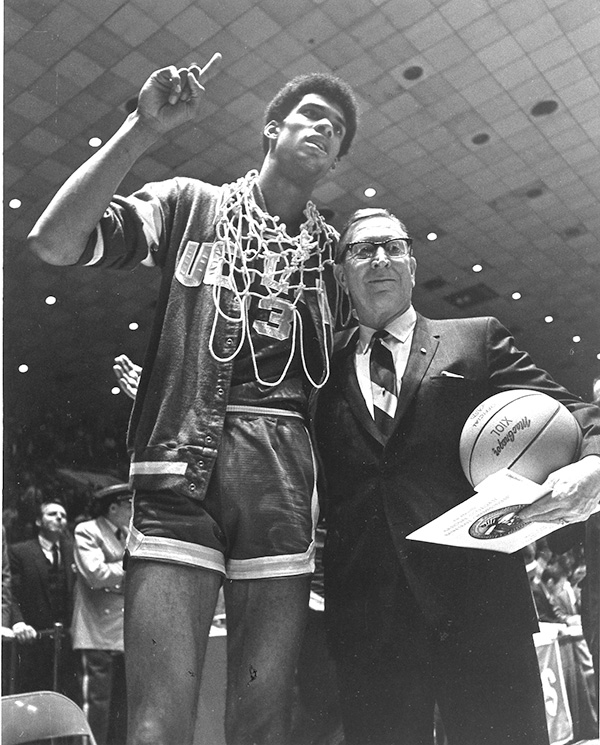
In his first game on the varsity squad, he scored 56 points — still an NCAA record — and led the Bruins to a national championship, the first of seven consecutive titles. But his academic bona fides were just as significant to his life: The B.A. he earned in history, something that would come in handy when he co-wrote an acclaimed history of a forgotten Black World War II battalion, and again later when he became one of the nation’s foremost authorities on the Sherlock Holmes canon. He also co-wrote three critically acclaimed novels featuring the famed detective.
Abdul-Jabbar remains one of the most beloved Bruins in UCLA history, and for good reason: Throughout his life and storied career, he has always credited the university and his renowned coach, John Wooden, for not only the knowledge he obtained in Westwood, but also the critical life lessons he learned here.
Below, we’ve gathered some reflections from a legend about why he chose UCLA and the most important thing he learned as a Bruin. Reading these, it’s easy to see how he has come to define “UCLA for Life.”
On his longtime Bruin dream
“In truth, attending UCLA had always been in the back of my mind. Many, many years later I found my grade school album. There was a page in the back about my future. In response to the question ‘Your Favorite College,’ I had written ‘UCLA.’”
On that first day touring campus
“I saw various exotic flowers I’d never seen before, all in full spring bloom. ‘Those are she-oaks,’ my enthusiastic campus guide said, as she pointed at some plants. ‘And that’s weeping wattle. Over there are bristly oxtongue. Those are sausage trees — indigenous to Africa.’ She smiled as if the connection to Africa would tip me into choosing UCLA. … Still, this was more green than I’d ever seen outside of Central Park.”
On how Rafer Johnson ’59, the university’s second Black student body president, inspired him
“To me, that meant that at UCLA I could aspire to be more than a jock, that the people there respected Johnson for all his abilities and gave him the opportunity to succeed. That was important to me. I didn’t want to be categorized as only an athlete.”
On first meeting his famed coach
“I first met John Wooden on a recruiting trip to UCLA in March of 1965. When I saw that his office was in a squat World War II Quonset hut, the bright Los Angeles sun glinting off the shiny corrugated steel, I worried that the campus couldn’t afford proper offices for its coaches and was forced to shove them in army huts. At the same time, I thought it looked kind of cool, like a science fiction film.”
On what surprised him
“Over the years, people have asked me if I was nervous that day, meeting the great John Wooden. I probably should have been, but I wasn’t. Instead, I was anxious and impatient, ready to get my college life going. … ‘I’m impressed with your grades, Lewis,’ he said as we sat across from each other, his crowded desk between us. Grades? I thought. You’re the coach of one of the best basketball teams in the country, and you’re talking about my grades? What about my impressive stats? He looked me straight in the eyes to make sure I knew he was serious. ‘For most students, basketball is temporary. But knowledge is forever.’”
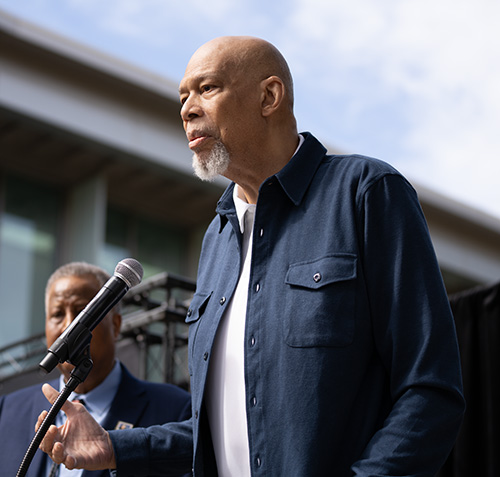
On the value of his UCLA degree
“My choice [of college] wasn’t based on basketball alone — I was also interested in strong academics. I knew that the career of an athlete, whether in college or in the pros, depended on avoiding serious injuries, so I needed to study and make sure I had a degree I could use in case basketball didn’t last. Even more important, I loved to learn. My passion for history and writing had been reignited, and I was eager to take my education to the next step at a university level.”
On the real lessons Wooden taught him …
“Because of Coach Wooden, I left UCLA a basketball player able to play on a professional level. At the time, I thought that basketball was the most important thing he had taught me. Like most kids leaving the cocoon of college, I had no idea what I’d actually learned. That would come with time. During my six years in Milwaukee, I had plenty of opportunities to look back on my years with Coach Wooden and have numerous ‘aha’ moments when I would stop and think, Oh, so that’s what he meant. It reminded me of the old saying that Coach quoted when he thought we weren’t listening to him: ‘When I was a boy of 14, my father was so ignorant I could hardly stand to have the old man around. But when I got to be 21, I was astonished at how much the old man had learned in seven years.’”
… and the most important thing Wooden taught him
“There are two ways that a great teacher influences students: first, by the practical value of their words, in teaching the student how to do things they couldn’t do or can now do better; second, through the purity of their actions. Preaching moral platitudes is easy, but walking the line and living them takes strength. Yes, Coach Wooden taught me a lot about basketball through his words. But most important, his example as a man of unbending moral strength taught me how to be the man I wanted to be — and needed to be.”
Sources consulted: Coach Wooden and Me: Our 50-Year Friendship On and Off the Court, by Kareem Abdul Jabbar; From Lew Alcindor to Kareem Abdul-Jabbar, by James Haskins; Basketball Hall of Famers: Kareem Abdul-Jabbar, by Martha Kneib; Becoming Kareem: Growing Up On and Off the Court, by Kareem Abdul-Jabbar and Raymond Obstfeld; Kareem Abdul-Jabbar, by R. Thomas Cobourn; Giant Steps: The Autobiography of Kareem Abdul-Jabbar, by Kareem Abdul-Jabbar and Peter Knobler.
More UCLA for Life profiles:
Meyer Luskin ’49
Janet Reilly ’86
Scott Galloway ’87
Read more from UCLA Magazine’s Spring 2026 issue.