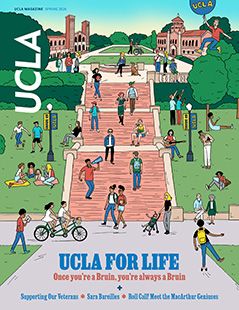
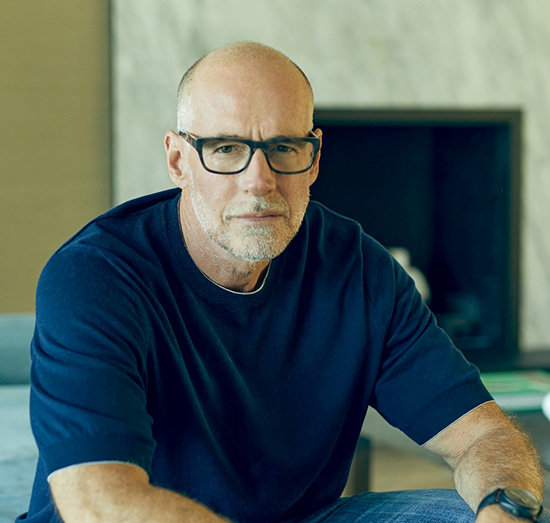
We like to say, “Bruins are everywhere,” but in the case of Scott Galloway ’87, it’s literally true. The academic and bestselling author, who graduated from UCLA with a B.A. in economics, is increasingly ubiquitous in the culture. He teaches at New York University, hosts three popular podcasts, and last fall completed a live tour of sold-out shows across seven cities. In February, he was named one of The Washington Post’s Post Next: 50 People Shaping Our Society in 2026.
Galloway is what might be called an unapologetic radical moderate. His most recent book, Notes on Being a Man, tackles the plight of young, seemingly directionless American men. He’s also launched the website Resist and Unsubscribe, arguing that the only effective weapon for combating the current presidential administration’s “assault on our nation’s values” has to be economic — namely, withdrawing support from companies that are going along to get along with the White House. “My goal isn’t to be right,” he told The Post. “My goal is to provoke or inspire a dialogue that helps craft better solutions.”
Much of his perspective on life was shaped, he says, in Westwood. Here, he tells us how that happened — and why, despite our current tough times, he’s still bullish on democracy.
So tell me what you think of when you hear the term “UCLA for Life.”
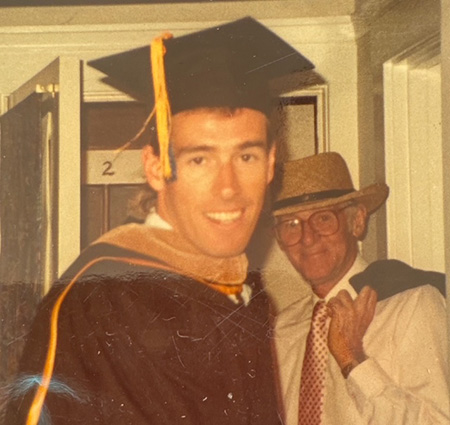
The term “UCLA for Life” makes me think of the endless amount of upward mobility UCLA has given me. I graduated high school with a 3.1 GPA and an 1130 on the SAT, and I was rejected from UCLA before being granted admission through an appeals process. UCLA took a chance on me, and everything else in my life has been downstream from that chance. I built a community and a career at UCLA; I became a man. UCLA will be a part of my life and identity forever.
How did coming here shape your worldview?
UCLA was the first time in my life where I was almost exclusively surrounded by people who were much more talented, smarter, and hungrier than I was. Being exposed to people who wanted to work hard and become the best version of themselves was transformative. Looking back, UCLA didn’t just teach me about business or strategy — it taught me how to push myself and how to recognize potential in others.
You’ve been weighing in recently on hot-button issues in American life. Looking at the 2026 midterms and beyond, are you optimistic or pessimistic about American democracy?
I am, and always will be, bullish on America and American democracy.
Why?
Dissatisfaction and the willingness to risk it all for a better future is in our DNA — at some point, all of our ancestors had to leave everything behind, get on a boat and set sail to the U.S. On the other hand, it may get worse before it gets better. Social media companies have a vested interest in keeping us polarized and angry; corporate interests have more political influence than ever. Unprecedented wealth inequality will exacerbate all of this. These things need to be fixed. But in the end, the good guys will win.
I applaud your optimism. But in terms of wealth inequality, you’ve written extensively about how college has become a “luxury good,” with prices rising 1,600% in five decades while acceptance rates have plummeted below 10% at elite schools. Yet you also call public universities “America's greatest innovation.” How do we reconcile making higher education both more accessible and more valuable?
There’s an easy fix: Expand the number of freshman seats available to the public. A college education is valuable, no matter how low an institution’s acceptance rate is. If you go to college, you’re less likely to be single, poor, obese, depressed. We should be trying to grant this experience to as many people as possible.
You’ve argued that tenure protects mediocrity and drives up costs. If you were designing a university from scratch, what would replace the tenure system while still protecting academic freedom and attracting top talent?
Tenure is a relic that protects mediocrity more than it protects ideas, and it drives costs through the roof. It protects the people that need it least. The way to replace tenure is simple: Expose academics to the free market. The best professors will end up at the best institutions with the largest compensation packages. The rest will be incentivized to become the best. Competition will force costs down and competition up.
Related to that, you’ve argued that family income, not race, is the ultimate determinant of success, and that we should shift from race-based to class-based affirmative action.
In the system that is capitalism, money is the ultimate determinant of pretty much everything. The most meaningful indicator of future success is not race, it’s how much your parents make. It follows that colleges and universities should seek to bring together students from different socioeconomic backgrounds, not just different identities.
So what does true economic diversity look like to you, then?
In practice, economic diversity means admitting poor kids and fully supporting them — full rides, real access, and the removal of legacy and donor preferences that overwhelmingly benefit the wealthy. It means redefining merit to account for context, recognizing that a student who succeeds with fewer resources often has greater upside than one with every advantage. Ultimately, it’s about restoring higher education as a genuine engine of upward mobility.
You run podcasts that reach millions (Pivot, Prof G Show), you've got a massively popular newsletter, you’re active on social media. You’re participating in the very attention economy you critique. How do you personally navigate the tension between building audience and maintaining integrity?
It’s easy: I am unapologetically myself on the platforms I post on, to a fault. Inappropriate jokes and uncomfortable truths are nonnegotiables. I have no issue criticizing Big Tech as I post on their platforms.
So in terms of engagement, that’s the way forward?
The real way to combat the benevolent social media overlords is to engage in real conversations online. Don’t respond to trolls or hate comments. Don’t get trapped in an echo chamber. Listen to people you disagree with. Challenge your own belief systems. If you can break out of your bubble, you’ll be better for it.
In Post Corona, you argued the pandemic would fundamentally reshape business and society. Six years later, what did you get right, and what did you get wrong?
I got the big ideas right. Many of the trends that the pandemic exacerbated were already underway: remote work, e-commerce, digital health and the dominance of Big Tech. Everyone being locked in their houses just turbocharged them. What I underestimated was how quickly people would snap back into their old habits once the crisis was dealt with. It was amazing to see. Human beings are an extremely adaptable species.
What didn’t you see?
I didn’t fully recognize how the pandemic further widened the gap between the asset-rich and everyone else. The S&P 500 rose about 70% in the year following the lockdown, but the bank accounts of those without assets did not. This is something that is still apparent in our economy today — even when almost every trace of the pandemic has been erased from everyday life.
More UCLA for Life profiles:
Meyer Luskin ’49
Kareem Abdul-Jabbar ’69
Janet Reilly ’86
Read more from UCLA Magazine’s Spring 2026 issue.